 Add to Chrome
 Add to Firefox
 Add to Edge
Task-Space Constrained Stochastic Trajectory Optimization for Time-Optimal Forestry Crane Motion Planning
Jul 20, 2026
Efficient, collision-free, and time-optimal motion planning is a fundamental requirement for autonomous forestry cranes operating under hydraulic pump-flow constraints. The Via-Point-based Stochastic Trajectory Optimization (VP-STO) algorithm has demonstrated near-time-optimal hybrid motion planning in this domain, but requires a fixed terminal joint configuration specified prior to optimization. For kinematically redundant manipulators such as forestry cranes, this pre-commitment to a single inverse kinematics solution restricts the planner's ability to exploit redundancy, particularly under the nonlinear, globally coupled pump-flow constraint where admissible joint velocities depend on their combined hydraulic demand. This paper presents TSC-VP-STO, a task-space-constrained extension of VP-STO that replaces the strict terminal joint-space constraint with a task-space constraint, jointly optimizing the trajectory and the redundant degrees of freedom of the terminal configuration. This enables the planner to adapt end configurations to the environment-dependent motion and hydraulic flow allocation, yielding more balanced pump utilization and shorter trajectory durations. We formalize the approach through a configuration space decomposition and derive a concrete reachability constraint for the forestry crane kinematics. Experimental evaluations across multiple planning targets and via-point configurations demonstrates a reduction on trajectory durations by 12-15% on average and improved pump-flow utilization compared to the baseline VP-STO. The practical applicability of TSC-VP-STO is validated through real-world deployment on a forestry crane, including a full log-loading cycle.

Spatially-Aware Adaptive Trajectory Optimization with Controller-Guided Feedback for Autonomous Racing
Feb 17, 2026We present a closed-loop framework for autonomous raceline optimization that combines NURBS-based trajectory representation, CMA-ES global trajectory optimization, and controller-guided spatial feedback. Instead of treating tracking errors as transient disturbances, our method exploits them as informative signals of local track characteristics via a Kalman-inspired spatial update. This enables the construction of an adaptive, acceleration-based constraint map that iteratively refines trajectories toward near-optimal performance under spatially varying track and vehicle behavior. In simulation, our approach achieves a 17.38% lap time reduction compared to a controller parametrized with maximum static acceleration. On real hardware, tested with different tire compounds ranging from high to low friction, we obtain a 7.60% lap time improvement without explicitly parametrizing friction. This demonstrates robustness to changing grip conditions in real-world scenarios.
A Collision-Free Sway Damping Model Predictive Controller for Safe and Reactive Forestry Crane Navigation
Feb 10, 2026Forestry cranes operate in dynamic, unstructured outdoor environments where simultaneous collision avoidance and payload sway control are critical for safe navigation. Existing approaches address these challenges separately, either focusing on sway damping with predefined collision-free paths or performing collision avoidance only at the global planning level. We present the first collision-free, sway-damping model predictive controller (MPC) for a forestry crane that unifies both objectives in a single control framework. Our approach integrates LiDAR-based environment mapping directly into the MPC using online Euclidean distance fields (EDF), enabling real-time environmental adaptation. The controller simultaneously enforces collision constraints while damping payload sway, allowing it to (i) replan upon quasi-static environmental changes, (ii) maintain collision-free operation under disturbances, and (iii) provide safe stopping when no bypass exists. Experimental validation on a real forestry crane demonstrates effective sway damping and successful obstacle avoidance. A video can be found at https://youtu.be/tEXDoeLLTxA.
Efficient Collision Detection for Long and Slender Robotic Links in Euclidean Distance Fields: Application to a Forestry Crane
Jul 02, 2025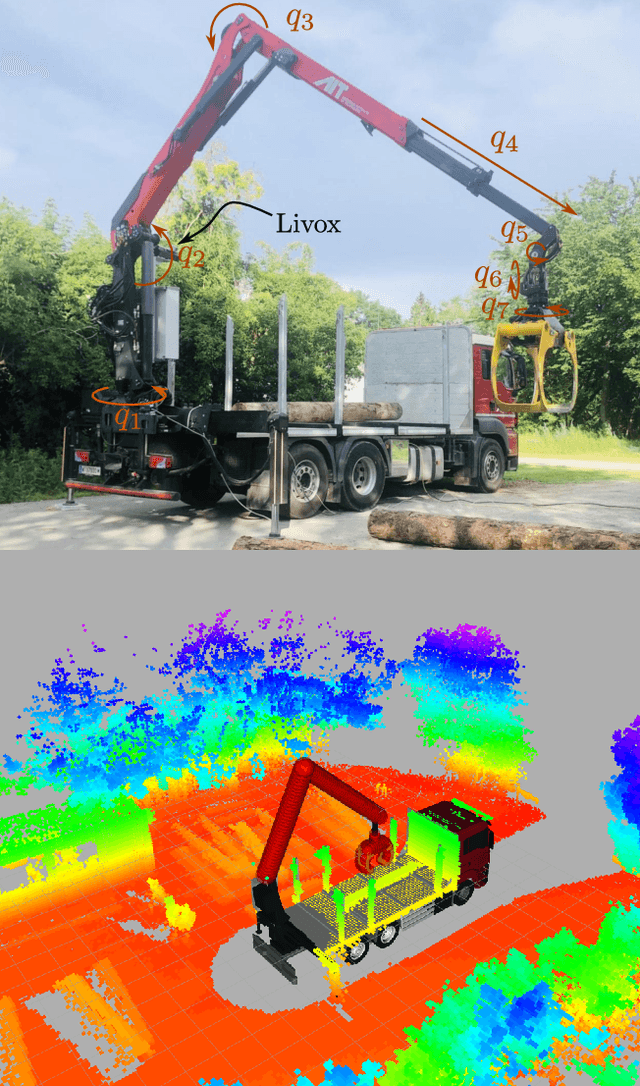
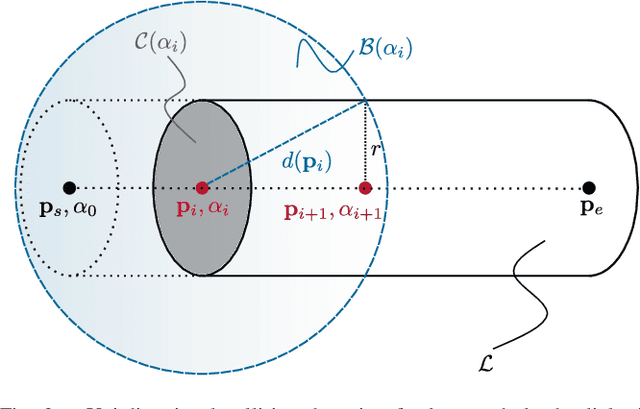
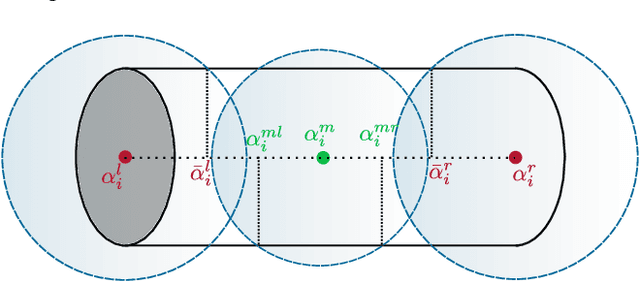
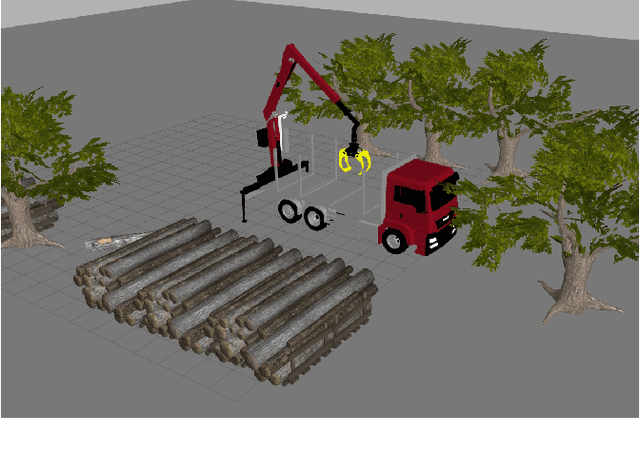
Collision-free motion planning in complex outdoor environments relies heavily on perceiving the surroundings through exteroceptive sensors. A widely used approach represents the environment as a voxelized Euclidean distance field, where robots are typically approximated by spheres. However, for large-scale manipulators such as forestry cranes, which feature long and slender links, this conventional spherical approximation becomes inefficient and inaccurate. This work presents a novel collision detection algorithm specifically designed to exploit the elongated structure of such manipulators, significantly enhancing the computational efficiency of motion planning algorithms. Unlike traditional sphere decomposition methods, our approach not only improves computational efficiency but also naturally eliminates the need to fine-tune the approximation accuracy as an additional parameter. We validate the algorithm's effectiveness using real-world LiDAR data from a forestry crane application, as well as simulated environment data.
GPU-Accelerated Motion Planning of an Underactuated Forestry Crane in Cluttered Environments
Mar 18, 2025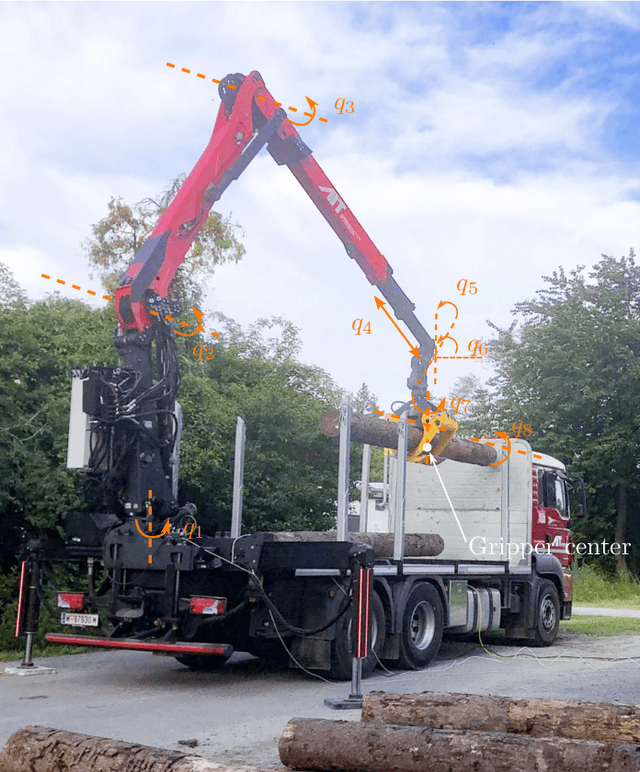

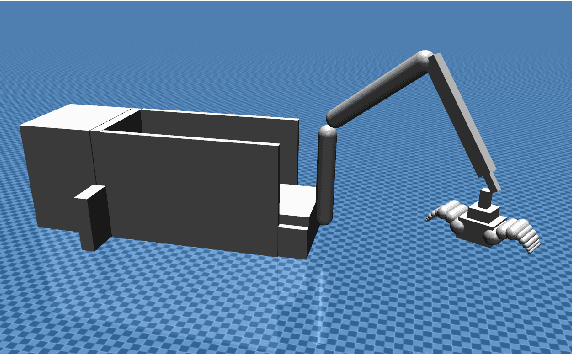
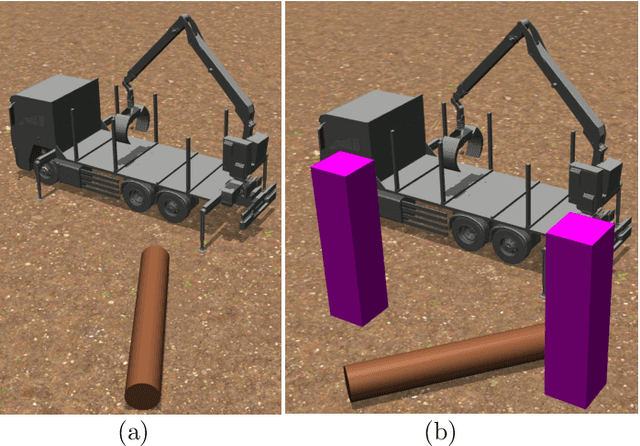
Autonomous large-scale machine operations require fast, efficient, and collision-free motion planning while addressing unique challenges such as hydraulic actuation limits and underactuated joint dynamics. This paper presents a novel two-step motion planning framework designed for an underactuated forestry crane. The first step employs GPU-accelerated stochastic optimization to rapidly compute a globally shortest collision-free path. The second step refines this path into a dynamically feasible trajectory using a trajectory optimizer that ensures compliance with system dynamics and actuation constraints. The proposed approach is benchmarked against conventional techniques, including RRT-based methods and purely optimization-based approaches. Simulation results demonstrate substantial improvements in computation speed and motion feasibility, making this method highly suitable for complex crane systems.
Towards Autonomous Wood-Log Grasping with a Forestry Crane: Simulator and Benchmarking
Feb 03, 2025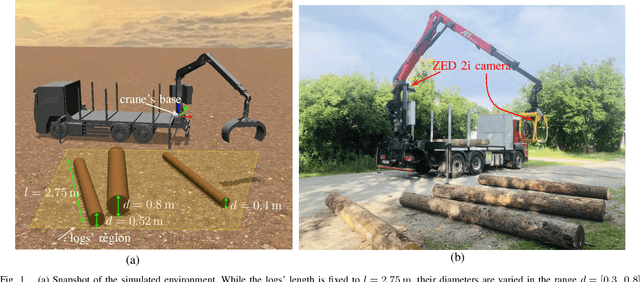
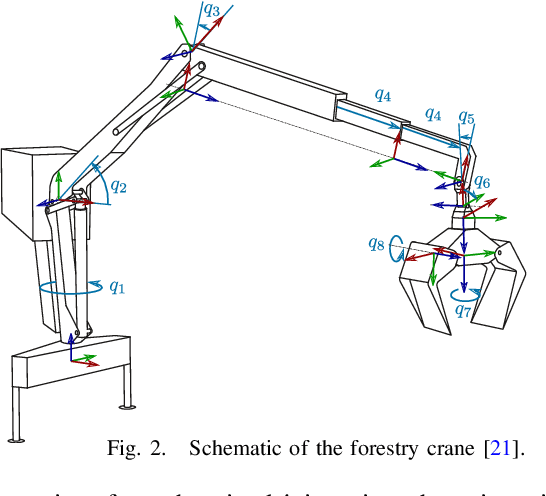

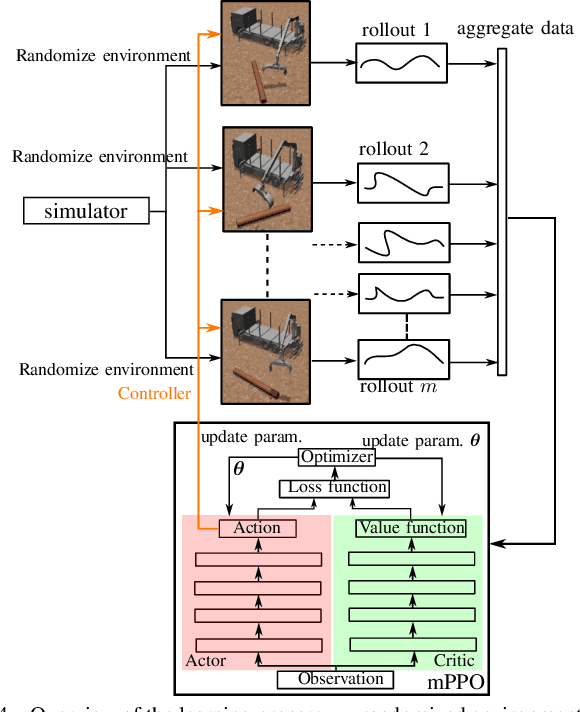
Forestry machines operated in forest production environments face challenges when performing manipulation tasks, especially regarding the complicated dynamics of underactuated crane systems and the heavy weight of logs to be grasped. This study investigates the feasibility of using reinforcement learning for forestry crane manipulators in grasping and lifting heavy wood logs autonomously. We first build a simulator using Mujoco physics engine to create realistic scenarios, including modeling a forestry crane with 8 degrees of freedom from CAD data and wood logs of different sizes. We further implement a velocity controller for autonomous log grasping with deep reinforcement learning using a curriculum strategy. Utilizing our new simulator, the proposed control strategy exhibits a success rate of 96% when grasping logs of different diameters and under random initial configurations of the forestry crane. In addition, reward functions and reinforcement learning baselines are implemented to provide an open-source benchmark for the community in large-scale manipulation tasks. A video with several demonstrations can be seen at https://www.acin.tuwien.ac.at/en/d18a/