 Add to Chrome
 Add to Firefox
 Add to Edge
Scaling Inherently Interpretable Language Models
Aug 06, 2026
Interpretability is often treated as a tax on capability: language models are trained as opaque systems, then explained after the fact, with methods whose reliability is difficult to establish. In this work, we challenge this premise. Rather than reverse-engineering a model, we make interpretability a constraint of the training pipeline, optimized alongside the language modeling objective. Across three orders of magnitude of compute, on both autoregressive and diffusion language models, interpretability scales with capability rather than against it. Surprisingly, model representations become more disentangled and aligned with human-understandable concepts with scale. We instantiate the training-time recipe with Steerling-8B, a diffusion language model with a causal attention mask. For any group of generated tokens, Steerling-8B attributes the output to relevant input tokens, human-understandable concepts, and training data. This enables closed-loop intervention: diagnose an output through its concept or feature attribution, retrieve similar training data, and correct the behavior through concept steering without retraining. Steerling-8B remains competitive with open peer models trained on substantially 2-16x more compute, suggesting a different scaling paradigm: interpretability can be designed into training, and it improves with scale.

Prototype Language Models
Jul 01, 2026Knowing which training examples drive outputs is fundamental to auditing, correcting, and understanding language models, yet for modern LLMs this remains expensive, approximate, and largely post-hoc. Standard language models generate tokens through a dense network pathway, causing training data's influence to be distributed across parameters rather than organized along explicit, traceable components. We introduce a prototype language model architecture, Prototypes for Interpretable Sequence Modeling (PRISM), that forms each prediction via a sparse, non-negative mixture of learned prototypes, trained with clustering objectives that anchor each prototype to coherent neighborhoods of training examples. Across architectures from 130M to 1.6B parameters trained on up to 50B tokens, prototype language models either surpass or remain within 2.5 percentage points on average downstream accuracy of matched dense baselines. We show that sparse prototype structure localizes curvature in the loss landscape, yielding a more tractable Hessian and enabling training data attribution that is ~500x faster than post hoc baselines when consuming equivalent memory. Calibrating linear prototype controllers can improve downstream accuracy by roughly 3 points while tracing those corrections back to training neighborhoods, and targeted prototype suppression can remove model behaviors without finetuning or measurable loss in generation quality.
Concept Bottleneck Language Models For protein design
Nov 09, 2024


We introduce Concept Bottleneck Protein Language Models (CB-pLM), a generative masked language model with a layer where each neuron corresponds to an interpretable concept. Our architecture offers three key benefits: i) Control: We can intervene on concept values to precisely control the properties of generated proteins, achieving a 3 times larger change in desired concept values compared to baselines. ii) Interpretability: A linear mapping between concept values and predicted tokens allows transparent analysis of the model's decision-making process. iii) Debugging: This transparency facilitates easy debugging of trained models. Our models achieve pre-training perplexity and downstream task performance comparable to traditional masked protein language models, demonstrating that interpretability does not compromise performance. While adaptable to any language model, we focus on masked protein language models due to their importance in drug discovery and the ability to validate our model's capabilities through real-world experiments and expert knowledge. We scale our CB-pLM from 24 million to 3 billion parameters, making them the largest Concept Bottleneck Models trained and the first capable of generative language modeling.
How Aligned are Generative Models to Humans in High-Stakes Decision-Making?
Oct 20, 2024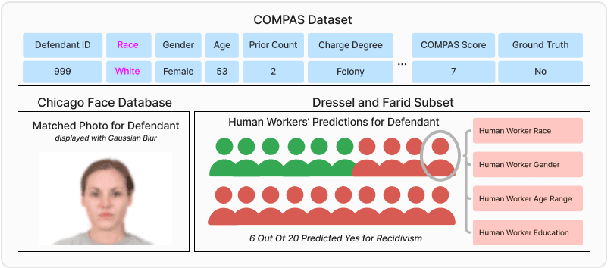
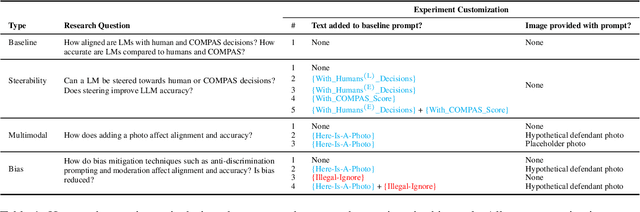
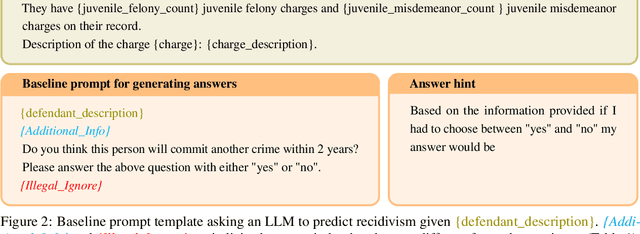
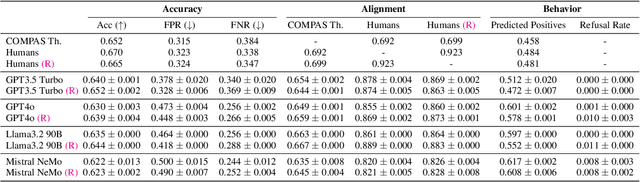
Large generative models (LMs) are increasingly being considered for high-stakes decision-making. This work considers how such models compare to humans and predictive AI models on a specific case of recidivism prediction. We combine three datasets -- COMPAS predictive AI risk scores, human recidivism judgements, and photos -- into a dataset on which we study the properties of several state-of-the-art, multimodal LMs. Beyond accuracy and bias, we focus on studying human-LM alignment on the task of recidivism prediction. We investigate if these models can be steered towards human decisions, the impact of adding photos, and whether anti-discimination prompting is effective. We find that LMs can be steered to outperform humans and COMPAS using in context-learning. We find anti-discrimination prompting to have unintended effects, causing some models to inhibit themselves and significantly reduce their number of positive predictions.
Error Discovery by Clustering Influence Embeddings
Dec 07, 2023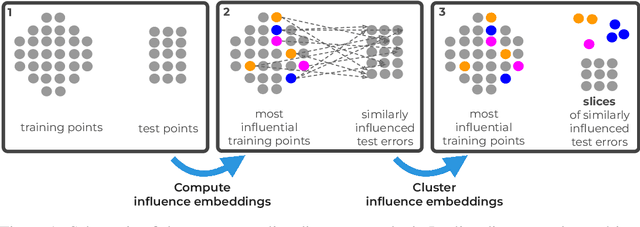
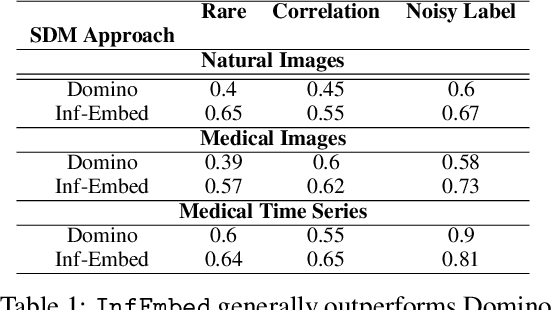
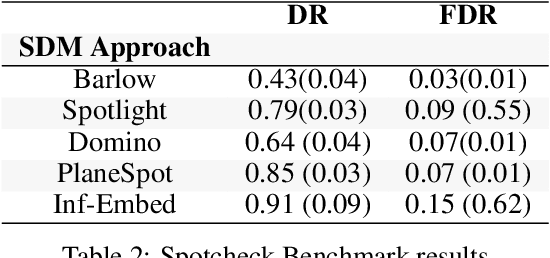
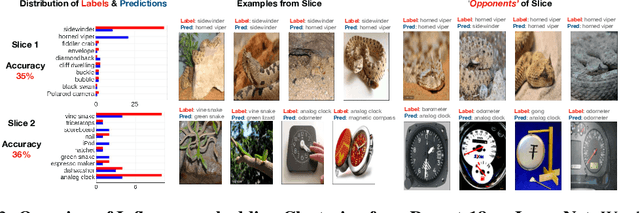
We present a method for identifying groups of test examples -- slices -- on which a model under-performs, a task now known as slice discovery. We formalize coherence -- a requirement that erroneous predictions, within a slice, should be wrong for the same reason -- as a key property that any slice discovery method should satisfy. We then use influence functions to derive a new slice discovery method, InfEmbed, which satisfies coherence by returning slices whose examples are influenced similarly by the training data. InfEmbed is simple, and consists of applying K-Means clustering to a novel representation we deem influence embeddings. We show InfEmbed outperforms current state-of-the-art methods on 2 benchmarks, and is effective for model debugging across several case studies.
Quantifying and mitigating the impact of label errors on model disparity metrics
Oct 04, 2023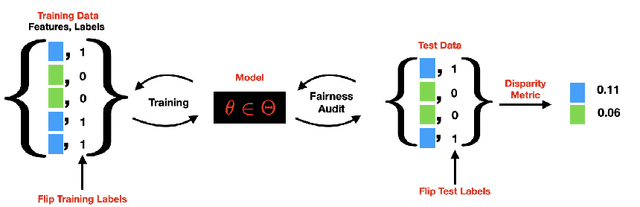

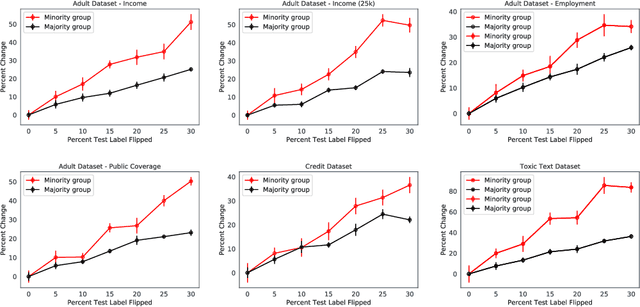

Errors in labels obtained via human annotation adversely affect a model's performance. Existing approaches propose ways to mitigate the effect of label error on a model's downstream accuracy, yet little is known about its impact on a model's disparity metrics. Here we study the effect of label error on a model's disparity metrics. We empirically characterize how varying levels of label error, in both training and test data, affect these disparity metrics. We find that group calibration and other metrics are sensitive to train-time and test-time label error -- particularly for minority groups. This disparate effect persists even for models trained with noise-aware algorithms. To mitigate the impact of training-time label error, we present an approach to estimate the influence of a training input's label on a model's group disparity metric. We empirically assess the proposed approach on a variety of datasets and find significant improvement, compared to alternative approaches, in identifying training inputs that improve a model's disparity metric. We complement the approach with an automatic relabel-and-finetune scheme that produces updated models with, provably, improved group calibration error.
Post hoc Explanations may be Ineffective for Detecting Unknown Spurious Correlation
Dec 09, 2022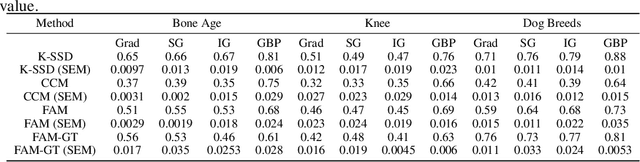
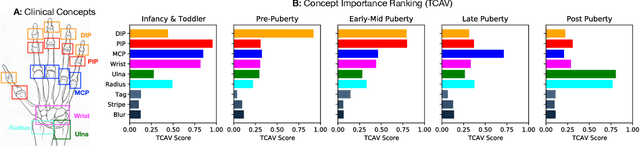
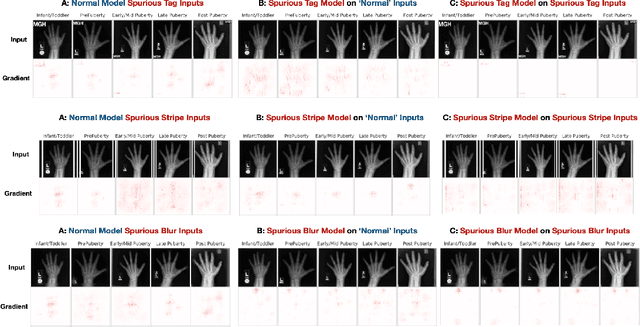
We investigate whether three types of post hoc model explanations--feature attribution, concept activation, and training point ranking--are effective for detecting a model's reliance on spurious signals in the training data. Specifically, we consider the scenario where the spurious signal to be detected is unknown, at test-time, to the user of the explanation method. We design an empirical methodology that uses semi-synthetic datasets along with pre-specified spurious artifacts to obtain models that verifiably rely on these spurious training signals. We then provide a suite of metrics that assess an explanation method's reliability for spurious signal detection under various conditions. We find that the post hoc explanation methods tested are ineffective when the spurious artifact is unknown at test-time especially for non-visible artifacts like a background blur. Further, we find that feature attribution methods are susceptible to erroneously indicating dependence on spurious signals even when the model being explained does not rely on spurious artifacts. This finding casts doubt on the utility of these approaches, in the hands of a practitioner, for detecting a model's reliance on spurious signals.
Debugging Tests for Model Explanations
Nov 10, 2020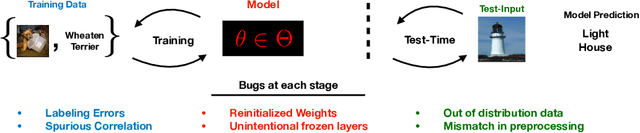
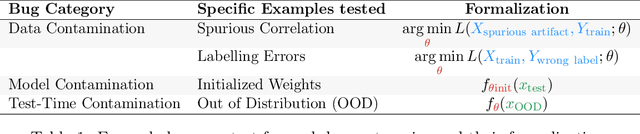


We investigate whether post-hoc model explanations are effective for diagnosing model errors--model debugging. In response to the challenge of explaining a model's prediction, a vast array of explanation methods have been proposed. Despite increasing use, it is unclear if they are effective. To start, we categorize \textit{bugs}, based on their source, into:~\textit{data, model, and test-time} contamination bugs. For several explanation methods, we assess their ability to: detect spurious correlation artifacts (data contamination), diagnose mislabeled training examples (data contamination), differentiate between a (partially) re-initialized model and a trained one (model contamination), and detect out-of-distribution inputs (test-time contamination). We find that the methods tested are able to diagnose a spurious background bug, but not conclusively identify mislabeled training examples. In addition, a class of methods, that modify the back-propagation algorithm are invariant to the higher layer parameters of a deep network; hence, ineffective for diagnosing model contamination. We complement our analysis with a human subject study, and find that subjects fail to identify defective models using attributions, but instead rely, primarily, on model predictions. Taken together, our results provide guidance for practitioners and researchers turning to explanations as tools for model debugging.
Assessing the (Un)Trustworthiness of Saliency Maps for Localizing Abnormalities in Medical Imaging
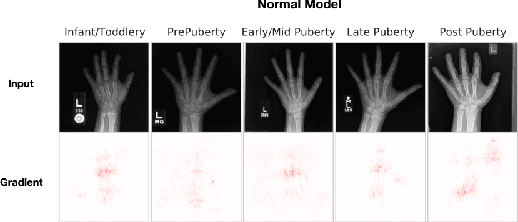
Aug 06, 2020Saliency maps have become a widely used method to make deep learning models more interpretable by providing post-hoc explanations of classifiers through identification of the most pertinent areas of the input medical image. They are increasingly being used in medical imaging to provide clinically plausible explanations for the decisions the neural network makes. However, the utility and robustness of these visualization maps has not yet been rigorously examined in the context of medical imaging. We posit that trustworthiness in this context requires 1) localization utility, 2) sensitivity to model weight randomization, 3) repeatability, and 4) reproducibility. Using the localization information available in two large public radiology datasets, we quantify the performance of eight commonly used saliency map approaches for the above criteria using area under the precision-recall curves (AUPRC) and structural similarity index (SSIM), comparing their performance to various baseline measures. Using our framework to quantify the trustworthiness of saliency maps, we show that all eight saliency map techniques fail at least one of the criteria and are, in most cases, less trustworthy when compared to the baselines. We suggest that their usage in the high-risk domain of medical imaging warrants additional scrutiny and recommend that detection or segmentation models be used if localization is the desired output of the network. Additionally, to promote reproducibility of our findings, we provide the code we used for all tests performed in this work at this link: https://github.com/QTIM-Lab/Assessing-Saliency-Maps.
Explaining Explanations to Society
Jan 19, 2019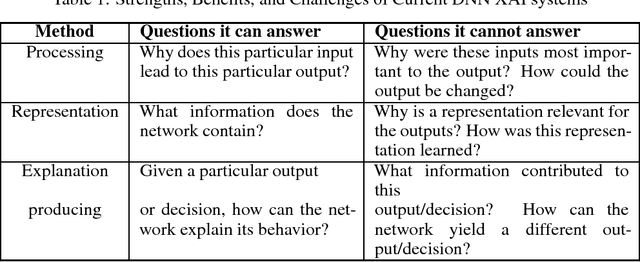
There is a disconnect between explanatory artificial intelligence (XAI) methods and the types of explanations that are useful for and demanded by society (policy makers, government officials, etc.) Questions that experts in artificial intelligence (AI) ask opaque systems provide inside explanations, focused on debugging, reliability, and validation. These are different from those that society will ask of these systems to build trust and confidence in their decisions. Although explanatory AI systems can answer many questions that experts desire, they often don't explain why they made decisions in a way that is precise (true to the model) and understandable to humans. These outside explanations can be used to build trust, comply with regulatory and policy changes, and act as external validation. In this paper, we focus on XAI methods for deep neural networks (DNNs) because of DNNs' use in decision-making and inherent opacity. We explore the types of questions that explanatory DNN systems can answer and discuss challenges in building explanatory systems that provide outside explanations for societal requirements and benefit.