 Add to Chrome
 Add to Firefox
 Add to Edge
AI4EOSC: a Federated Cloud Platform for Artificial Intelligence in Scientific Research
Dec 18, 2025
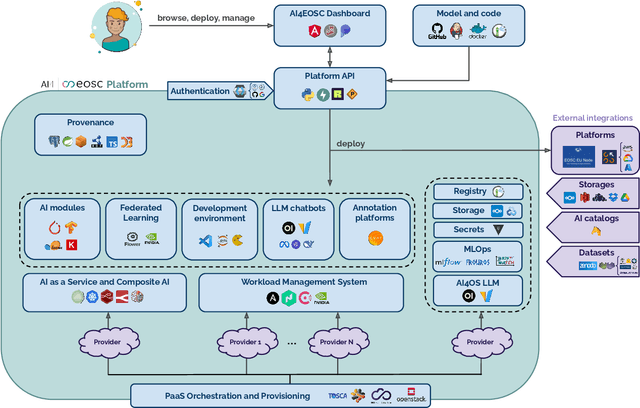
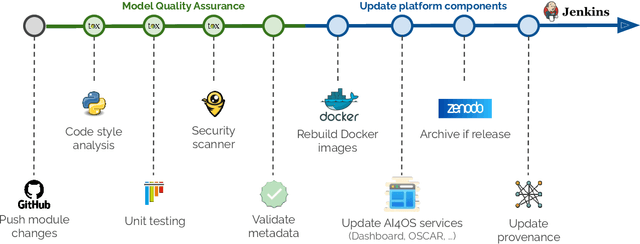
In this paper, we describe a federated compute platform dedicated to support Artificial Intelligence in scientific workloads. Putting the effort into reproducible deployments, it delivers consistent, transparent access to a federation of physically distributed e-Infrastructures. Through a comprehensive service catalogue, the platform is able to offer an integrated user experience covering the full Machine Learning lifecycle, including model development (with dedicated interactive development environments), training (with GPU resources, annotation tools, experiment tracking, and federated learning support) and deployment (covering a wide range of deployment options all along the Cloud Continuum). The platform also provides tools for traceability and reproducibility of AI models, integrates with different Artificial Intelligence model providers, datasets and storage resources, allowing users to interact with the broader Machine Learning ecosystem. Finally, it is easily customizable to lower the adoption barrier by external communities.

Transformer based super-resolution downscaling for regional reanalysis: Full domain vs tiling approaches
Oct 16, 2024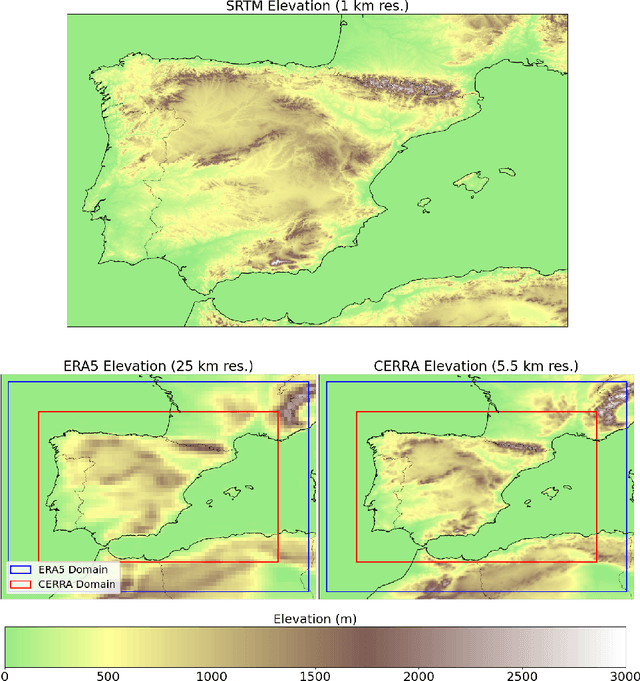
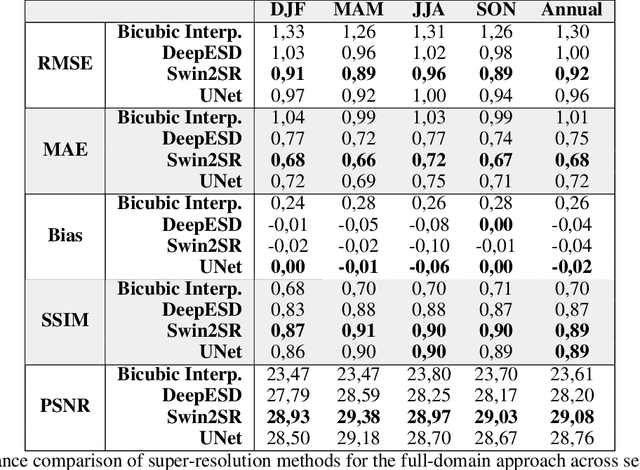
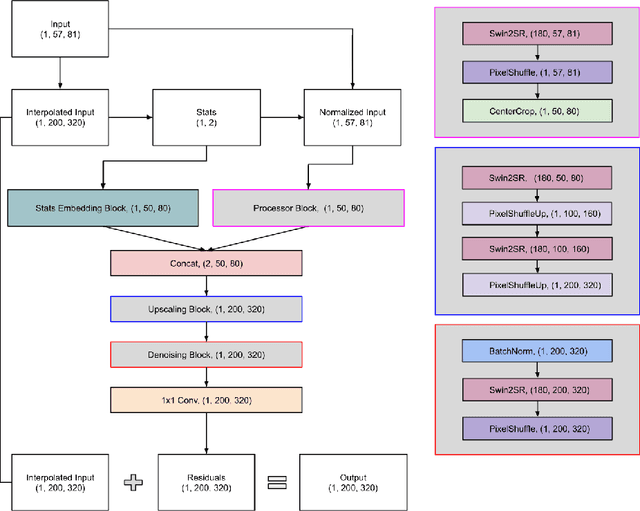
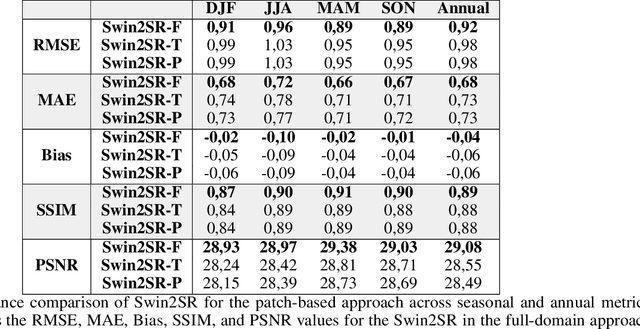
Super-resolution (SR) is a promising cost-effective downscaling methodology for producing high-resolution climate information from coarser counterparts. A particular application is downscaling regional reanalysis outputs (predictand) from the driving global counterparts (predictor). This study conducts an intercomparison of various SR downscaling methods focusing on temperature and using the CERRA reanalysis (5.5 km resolution, produced with a regional atmospheric model driven by ERA5) as example. The method proposed in this work is the Swin transformer and two alternative methods are used as benchmark (fully convolutional U-Net and convolutional and dense DeepESD) as well as the simple bicubic interpolation. We compare two approaches, the standard one using the full domain as input and a more scalable tiling approach, dividing the full domain into tiles that are used as input. The methods are trained to downscale CERRA surface temperature, based on temperature information from the driving ERA5; in addition, the tiling approach includes static orographic information. We show that the tiling approach, which requires spatial transferability, comes at the cost of a lower performance (although it outperforms some full-domain benchmarks), but provides an efficient scalable solution that allows SR reduction on a pan-European scale and is valuable for real-time applications.