 Add to Chrome
 Add to Firefox
 Add to Edge
ADK Arena: Evaluating Agent Development Kits via LLM-as-a-Developer
Jun 04, 2026
The rapid proliferation of Agent Development Kits (ADKs), SDK-level frameworks for building LLM-powered autonomous agents, has outpaced any empirical understanding of how framework choice affects agent performance. We propose \textbf{LLM-as-a-Developer}, a methodology that replaces human developers with an LLM coding agent that learns each framework's API from documentation, writes agent code, and iteratively repairs it through a validate-and-feedback loop until tests pass. By holding the developer constant and varying only the framework, generation effort becomes a quantitative proxy for API usability and the resulting agents provide a controlled measure of framework effectiveness. We implement this in \textbf{ADK Arena}, a fully automated pipeline with per-framework Docker isolation, a three-level validation pipeline, and benchmark adapters for SWE-bench, $τ^2$-bench, Terminal-Bench, and MCP-Atlas. Evaluating all 51 popular Python ADK frameworks (204 agent--benchmark pairs), we find that: (1)~generation succeeds for 57\% of runs, and its cost varies 5.6$\times$ across frameworks (\$0.6 to \$3.4 per agent), a quantitative proxy for API complexity, though cost alone does not predict success; (2)~no single framework dominates: the best single-benchmark ADK agents resolve up to 80\% of tasks and can even \emph{beat} general-purpose frontier coding agents at a fraction of the cost, yet the median framework resolves only 32\%; (3)~across information-source ablations, genuine framework usage stays within a narrow 28--40\% band (highest with raw source access and still 33\% with no reference material at all), indicating that documentation, source code, and parametric knowledge are largely substitutable rather than any one being a hard bottleneck.

AgentLens: Revealing The Lucky Pass Problem in SWE-Agent Evaluation
May 13, 2026Evaluation of software engineering (SWE) agents is dominated by a binary signal: whether the final patch passes the tests. This outcome-only view treats a principled solution and a chaotic trial-and-error process as equivalent. We show that this equivalence is empirically false. We evaluate 2,614 OpenHands trajectories from eight model backends on 60 SWE-bench Verified tasks. Of these, 47 have enough passing trajectories to construct task-level process references, yielding a 1,815-trajectory evaluation subset. Among passing trajectories in this subset, 10.7% exhibit behavior we call a Lucky Pass: regression cycles, blind retries, missing verification, or temporally disordered exploration, implementation, and verification. We introduce AgentLens, a framework for process-level assessment of SWE-agent trajectories, and release AgentLens-Bench, a dataset of 1,815 trajectories annotated with quality scores, waste signals, divergence points, and 47 task-level Prefix Tree Acceptor (PTA) references. AgentLens builds PTA references by merging multiple passing solutions for the same task, and uses a context-sensitive intent labeler to assign actions to Exploration, Implementation, Verification, or Orchestration based on trajectory history rather than tool identity alone. On AgentLens-Bench, the quality score separates passing trajectories into Lucky, Solid, and Ideal tiers and further decomposes Lucky Passes into five recurring mechanisms. Across the eight model backends, Lucky rates range from 0.5% to 23.2%, and some models move by as many as five rank positions when ranked by quality score instead of pass rate. We release the anonymized project repository, including the AgentLens-Bench dataset and AgentLens SDK, at https://github.com/microsoft/code-agent-state-trajectories/.
Multi-Rollout On-Policy Distillation via Peer Successes and Failures
May 12, 2026Large language models are often post-trained with sparse verifier rewards, which indicate whether a sampled trajectory succeeds but provide limited guidance about where reasoning succeeds or fails. On-policy distillation (OPD) offers denser token-level supervision by training on student-generated trajectories, yet existing methods typically distill each rollout independently and ignore the other attempts sampled for the same prompt. We introduce Multi-Rollout On-Policy Distillation (MOPD), a peer-conditioned distillation framework that uses the student's local rollout group to construct more informative teacher signals. MOPD conditions the teacher on both successful and failed peer rollouts: successes provide positive evidence for valid reasoning patterns, while failures provide structured negative evidence about plausible mistakes to avoid. We study two peer-context constructions: positive peer imitation and contrastive success-failure conditioning. Experiments on competitive programming, mathematical reasoning, scientific question answering, and tool-use benchmarks show that MOPD consistently improves over standard on-policy baselines. Further teacher-signal analysis shows that mixed success-failure contexts better align teacher scores with verifier rewards, indicating that the gains arise from more faithful, instance-adaptive supervision. These results indicate that effective on-policy distillation should exploit the student's multi-rollout trial-and-error behavior rather than treating rollouts as isolated samples.
Learning Correct Behavior from Examples: Validating Sequential Execution in Autonomous Agents
May 04, 2026As autonomous agents become increasingly sophisticated, validating their sequential behavior presents a significant challenge. Traditional testing approaches require manual specification, exact sequence matching, or thousands of training examples. We present a novel algorithm that automatically learns correct behavior from just 2-10 passing execution traces and validates new executions against this learned model. Our approach combines dominator analysis from compiler theory with multimodal large language model-powered semantic understanding to identify essential states and handle non-deterministic behavior. The system constructs a generalized ground truth model using Prefix Tree Acceptors, merges traces through multi-tiered equivalence detection, and validates new executions via topological subsequence matching. In controlled experiments, our system achieved high accuracy in detecting product bugs and false successes using only 3 training traces. This approach provides explainable validation results with coverage metrics and works across diverse domains including UI testing, code generation, and robotic processes.
See, Point, Refine: Multi-Turn Approach to GUI Grounding with Visual Feedback
Apr 14, 2026Computer Use Agents (CUAs) fundamentally rely on graphical user interface (GUI) grounding to translate language instructions into executable screen actions, but editing-level grounding in dense coding interfaces, where sub-pixel accuracy is required to interact with dense IDE elements, remains underexplored. Existing approaches typically rely on single-shot coordinate prediction, which lacks a mechanism for error correction and often fails in high-density interfaces. In this technical report, we conduct an empirical study of pixel-precise cursor localization in coding environments. Instead of a single-step execution, our agent engages in an iterative refinement process, utilizing visual feedback from previous attempts to reach the target element. This closed-loop grounding mechanism allows the agent to self-correct displacement errors and adapt to dynamic UI changes. We evaluate our approach across GPT-5.4, Claude, and Qwen on a suite of complex coding benchmarks, demonstrating that multi-turn refinement significantly outperforms state-of-the-art single-shot models in both click precision and overall task success rate. Our results suggest that iterative visual reasoning is a critical component for the next generation of reliable software engineering agents. Code: https://github.com/microsoft/precision-cua-bench.
PISCES: Annotation-free Text-to-Video Post-Training via Optimal Transport-Aligned Rewards
Feb 02, 2026Text-to-video (T2V) generation aims to synthesize videos with high visual quality and temporal consistency that are semantically aligned with input text. Reward-based post-training has emerged as a promising direction to improve the quality and semantic alignment of generated videos. However, recent methods either rely on large-scale human preference annotations or operate on misaligned embeddings from pre-trained vision-language models, leading to limited scalability or suboptimal supervision. We present $\texttt{PISCES}$, an annotation-free post-training algorithm that addresses these limitations via a novel Dual Optimal Transport (OT)-aligned Rewards module. To align reward signals with human judgment, $\texttt{PISCES}$ uses OT to bridge text and video embeddings at both distributional and discrete token levels, enabling reward supervision to fulfill two objectives: (i) a Distributional OT-aligned Quality Reward that captures overall visual quality and temporal coherence; and (ii) a Discrete Token-level OT-aligned Semantic Reward that enforces semantic, spatio-temporal correspondence between text and video tokens. To our knowledge, $\texttt{PISCES}$ is the first to improve annotation-free reward supervision in generative post-training through the lens of OT. Experiments on both short- and long-video generation show that $\texttt{PISCES}$ outperforms both annotation-based and annotation-free methods on VBench across Quality and Semantic scores, with human preference studies further validating its effectiveness. We show that the Dual OT-aligned Rewards module is compatible with multiple optimization paradigms, including direct backpropagation and reinforcement learning fine-tuning.
Agentic AI Systems in Electrical Power Systems Engineering: Current State-of-the-Art and Challenges
Nov 19, 2025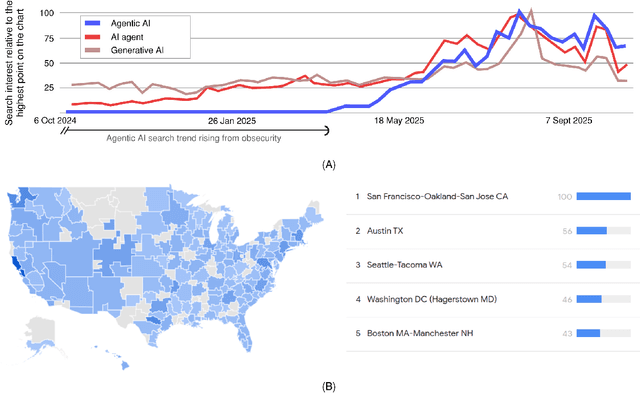
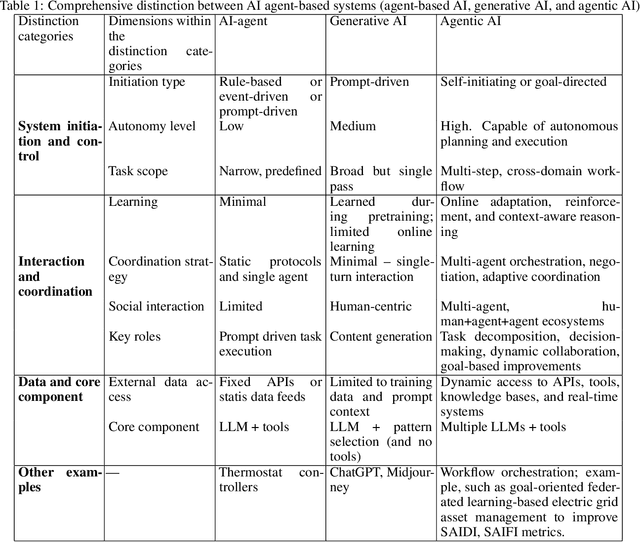
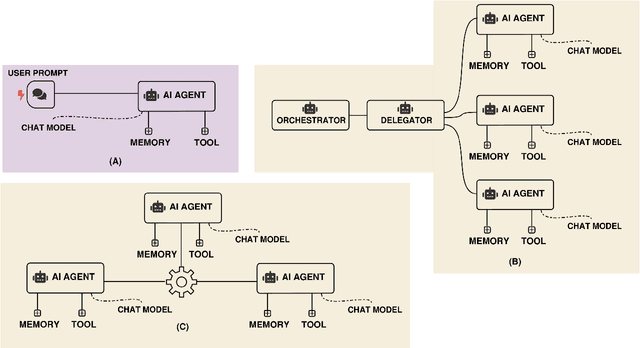
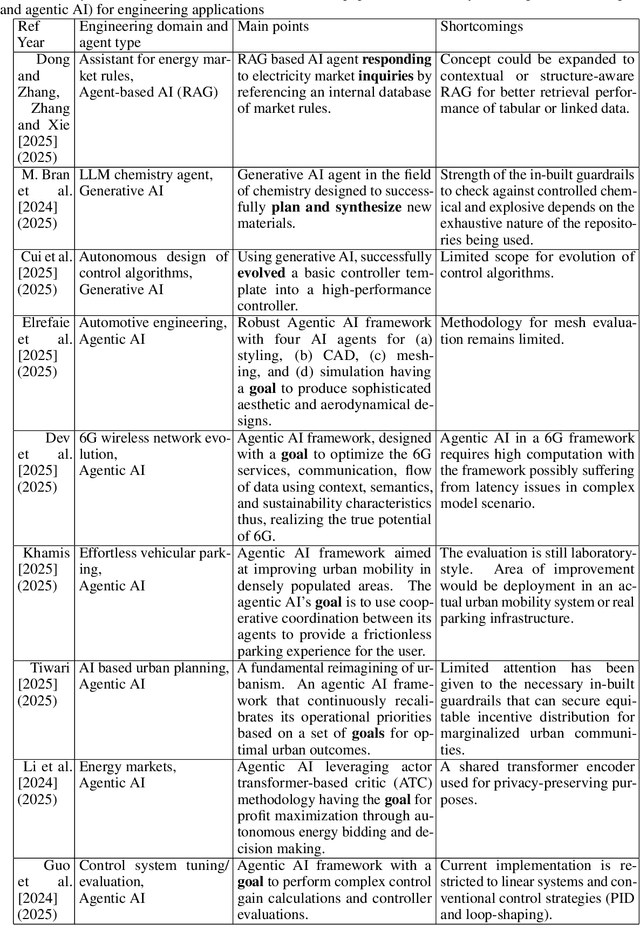
Agentic AI systems have recently emerged as a critical and transformative approach in artificial intelligence, offering capabilities that extend far beyond traditional AI agents and contemporary generative AI models. This rapid evolution necessitates a clear conceptual and taxonomical understanding to differentiate this new paradigm. Our paper addresses this gap by providing a comprehensive review that establishes a precise definition and taxonomy for "agentic AI," with the aim of distinguishing it from previous AI paradigms. The concepts are gradually introduced, starting with a highlight of its diverse applications across the broader field of engineering. The paper then presents four detailed, state-of-the-art use case applications specifically within electrical engineering. These case studies demonstrate practical impact, ranging from an advanced agentic framework for streamlining complex power system studies and benchmarking to a novel system developed for survival analysis of dynamic pricing strategies in battery swapping stations. Finally, to ensure robust deployment, the paper provides detailed failure mode investigations. From these findings, we derive actionable recommendations for the design and implementation of safe, reliable, and accountable agentic AI systems, offering a critical resource for researchers and practitioners.
Sig-DEG for Distillation: Making Diffusion Models Faster and Lighter
Aug 23, 2025Diffusion models have achieved state-of-the-art results in generative modelling but remain computationally intensive at inference time, often requiring thousands of discretization steps. To this end, we propose Sig-DEG (Signature-based Differential Equation Generator), a novel generator for distilling pre-trained diffusion models, which can universally approximate the backward diffusion process at a coarse temporal resolution. Inspired by high-order approximations of stochastic differential equations (SDEs), Sig-DEG leverages partial signatures to efficiently summarize Brownian motion over sub-intervals and adopts a recurrent structure to enable accurate global approximation of the SDE solution. Distillation is formulated as a supervised learning task, where Sig-DEG is trained to match the outputs of a fine-resolution diffusion model on a coarse time grid. During inference, Sig-DEG enables fast generation, as the partial signature terms can be simulated exactly without requiring fine-grained Brownian paths. Experiments demonstrate that Sig-DEG achieves competitive generation quality while reducing the number of inference steps by an order of magnitude. Our results highlight the effectiveness of signature-based approximations for efficient generative modeling.
DeCafNet: Delegate and Conquer for Efficient Temporal Grounding in Long Videos
May 22, 2025Long Video Temporal Grounding (LVTG) aims at identifying specific moments within lengthy videos based on user-provided text queries for effective content retrieval. The approach taken by existing methods of dividing video into clips and processing each clip via a full-scale expert encoder is challenging to scale due to prohibitive computational costs of processing a large number of clips in long videos. To address this issue, we introduce DeCafNet, an approach employing ``delegate-and-conquer'' strategy to achieve computation efficiency without sacrificing grounding performance. DeCafNet introduces a sidekick encoder that performs dense feature extraction over all video clips in a resource-efficient manner, while generating a saliency map to identify the most relevant clips for full processing by the expert encoder. To effectively leverage features from sidekick and expert encoders that exist at different temporal resolutions, we introduce DeCaf-Grounder, which unifies and refines them via query-aware temporal aggregation and multi-scale temporal refinement for accurate grounding. Experiments on two LTVG benchmark datasets demonstrate that DeCafNet reduces computation by up to 47\% while still outperforming existing methods, establishing a new state-of-the-art for LTVG in terms of both efficiency and performance. Our code is available at https://github.com/ZijiaLewisLu/CVPR2025-DeCafNet.
Hummingbird: High Fidelity Image Generation via Multimodal Context Alignment
Feb 07, 2025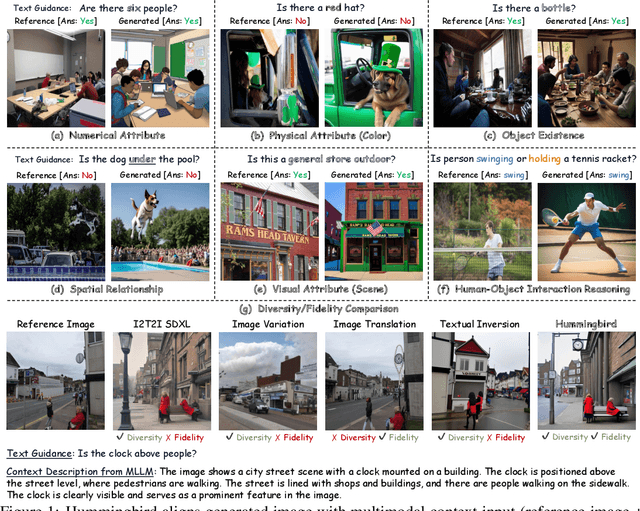


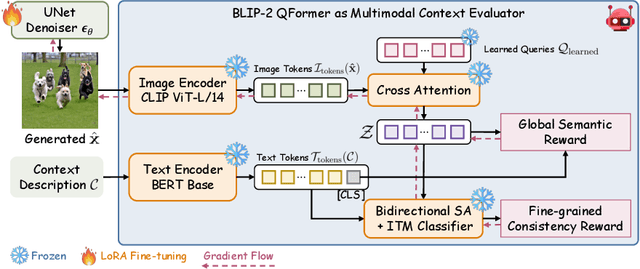
While diffusion models are powerful in generating high-quality, diverse synthetic data for object-centric tasks, existing methods struggle with scene-aware tasks such as Visual Question Answering (VQA) and Human-Object Interaction (HOI) Reasoning, where it is critical to preserve scene attributes in generated images consistent with a multimodal context, i.e. a reference image with accompanying text guidance query. To address this, we introduce Hummingbird, the first diffusion-based image generator which, given a multimodal context, generates highly diverse images w.r.t. the reference image while ensuring high fidelity by accurately preserving scene attributes, such as object interactions and spatial relationships from the text guidance. Hummingbird employs a novel Multimodal Context Evaluator that simultaneously optimizes our formulated Global Semantic and Fine-grained Consistency Rewards to ensure generated images preserve the scene attributes of reference images in relation to the text guidance while maintaining diversity. As the first model to address the task of maintaining both diversity and fidelity given a multimodal context, we introduce a new benchmark formulation incorporating MME Perception and Bongard HOI datasets. Benchmark experiments show Hummingbird outperforms all existing methods by achieving superior fidelity while maintaining diversity, validating Hummingbird's potential as a robust multimodal context-aligned image generator in complex visual tasks.