 Add to Chrome
 Add to Firefox
 Add to Edge
An Integrated Data Processing Framework for Pretraining Foundation Models
Feb 26, 2024
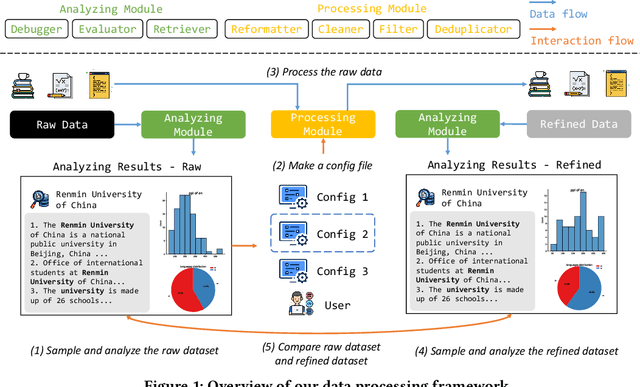
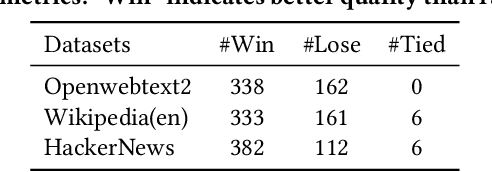
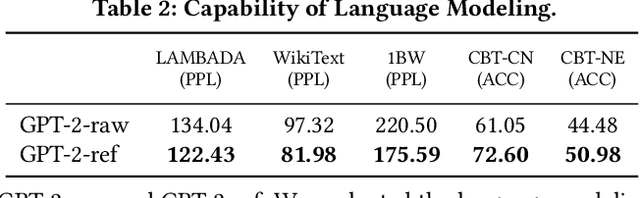
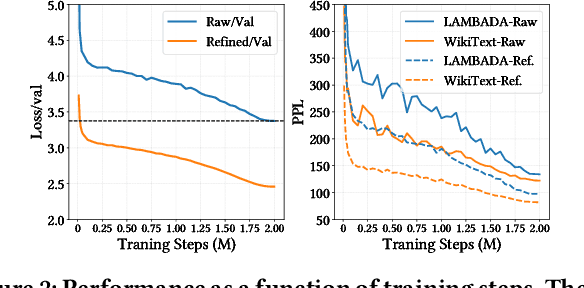
The ability of the foundation models heavily relies on large-scale, diverse, and high-quality pretraining data. In order to improve data quality, researchers and practitioners often have to manually curate datasets from difference sources and develop dedicated data cleansing pipeline for each data repository. Lacking a unified data processing framework, this process is repetitive and cumbersome. To mitigate this issue, we propose a data processing framework that integrates a Processing Module which consists of a series of operators at different granularity levels, and an Analyzing Module which supports probing and evaluation of the refined data. The proposed framework is easy to use and highly flexible. In this demo paper, we first introduce how to use this framework with some example use cases and then demonstrate its effectiveness in improving the data quality with an automated evaluation with ChatGPT and an end-to-end evaluation in pretraining the GPT-2 model. The code and demonstration videos are accessible on GitHub.

Multi-Task Contrastive Learning for 8192-Token Bilingual Text Embeddings
Feb 26, 2024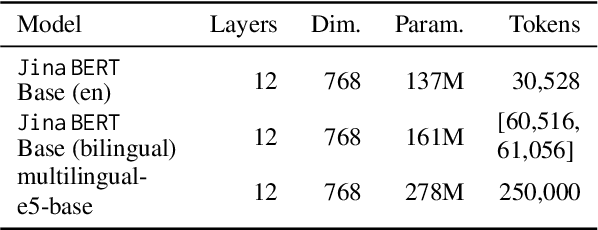


We introduce a novel suite of state-of-the-art bilingual text embedding models that are designed to support English and another target language. These models are capable of processing lengthy text inputs with up to 8192 tokens, making them highly versatile for a range of natural language processing tasks such as text retrieval, clustering, and semantic textual similarity (STS) calculations. By focusing on bilingual models and introducing a unique multi-task learning objective, we have significantly improved the model performance on STS tasks, which outperforms the capabilities of existing multilingual models in both target language understanding and cross-lingual evaluation tasks. Moreover, our bilingual models are more efficient, requiring fewer parameters and less memory due to their smaller vocabulary needs. Furthermore, we have expanded the Massive Text Embedding Benchmark (MTEB) to include benchmarks for German and Spanish embedding models. This integration aims to stimulate further research and advancement in text embedding technologies for these languages.
Low-Dose CT Reconstruction Using Dataset-free Learning
Feb 17, 2024Low-Dose computer tomography (LDCT) is an ideal alternative to reduce radiation risk in clinical applications. Although supervised-deep-learning-based reconstruction methods have demonstrated superior performance compared to conventional model-driven reconstruction algorithms, they require collecting massive pairs of low-dose and norm-dose CT images for neural network training, which limits their practical application in LDCT imaging. In this paper, we propose an unsupervised and training data-free learning reconstruction method for LDCT imaging that avoids the requirement for training data. The proposed method is a post-processing technique that aims to enhance the initial low-quality reconstruction results, and it reconstructs the high-quality images by neural work training that minimizes the $\ell_1$-norm distance between the CT measurements and their corresponding simulated sinogram data, as well as the total variation (TV) value of the reconstructed image. Moreover, the proposed method does not require to set the weights for both the data fidelity term and the plenty term. Experimental results on the AAPM challenge data and LoDoPab-CT data demonstrate that the proposed method is able to effectively suppress the noise and preserve the tiny structures. And these results also shows the proposed method's low computational cost and rapid convergence. The source code is available at \url{https://github.com/linfengyu77/IRLDCT}.
Seismic Traveltime Tomography with Label-free Learning
Feb 01, 2024Deep learning techniques have been used to build velocity models (VMs) for seismic traveltime tomography and have shown encouraging performance in recent years. However, they need to generate labeled samples (i.e., pairs of input and label) to train the deep neural network (NN) with end-to-end learning, and the real labels for field data inversion are usually missing or very expensive. Some traditional tomographic methods can be implemented quickly, but their effectiveness is often limited by prior assumptions. To avoid generating labeled samples, we propose a novel method by integrating deep learning and dictionary learning to enhance the VMs with low resolution by using the traditional tomography-least square method (LSQR). We first design a type of shallow and simple NN to reduce computational cost followed by proposing a two-step strategy to enhance the VMs with low resolution: (1) Warming up. An initial dictionary is trained from the estimation by LSQR through dictionary learning method; (2) Dictionary optimization. The initial dictionary obtained in the warming-up step will be optimized by the NN, and then it will be used to reconstruct high-resolution VMs with the reference slowness and the estimation by LSQR. Furthermore, we design a loss function to minimize traveltime misfit to ensure that NN training is label-free, and the optimized dictionary can be obtained after each epoch of NN training. We demonstrate the effectiveness of the proposed method through numerical tests.
LightHouse: A Survey of AGI Hallucination
Jan 17, 2024With the development of artificial intelligence, large-scale models have become increasingly intelligent. However, numerous studies indicate that hallucinations within these large models are a bottleneck hindering the development of AI research. In the pursuit of achieving strong artificial intelligence, a significant volume of research effort is being invested in the AGI (Artificial General Intelligence) hallucination research. Previous explorations have been conducted in researching hallucinations within LLMs (Large Language Models). As for multimodal AGI, research on hallucinations is still in an early stage. To further the progress of research in the domain of hallucinatory phenomena, we present a bird's eye view of hallucinations in AGI, summarizing the current work on AGI hallucinations and proposing some directions for future research.
City Scene Super-Resolution via Geometric Error Minimization
Jan 14, 2024Super-resolution techniques are crucial in improving image granularity, particularly in complex urban scenes, where preserving geometric structures is vital for data-informed cultural heritage applications. In this paper, we propose a city scene super-resolution method via geometric error minimization. The geometric-consistent mechanism leverages the Hough Transform to extract regular geometric features in city scenes, enabling the computation of geometric errors between low-resolution and high-resolution images. By minimizing mixed mean square error and geometric align error during the super-resolution process, the proposed method efficiently restores details and geometric regularities. Extensive validations on the SET14, BSD300, Cityscapes and GSV-Cities datasets demonstrate that the proposed method outperforms existing state-of-the-art methods, especially in urban scenes.
Energy-Efficient Data Offloading for Earth Observation Satellite Networks
Jan 12, 2024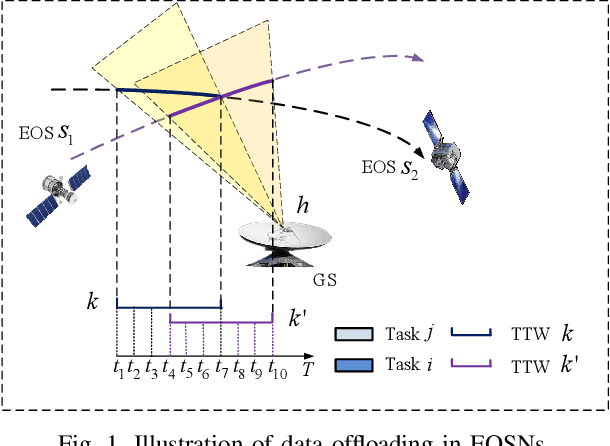
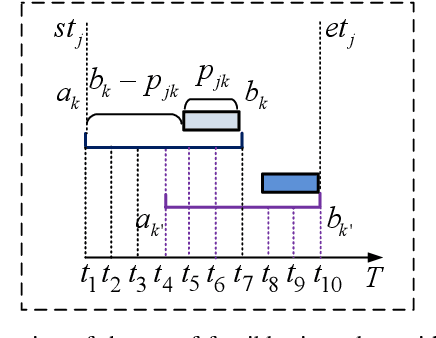
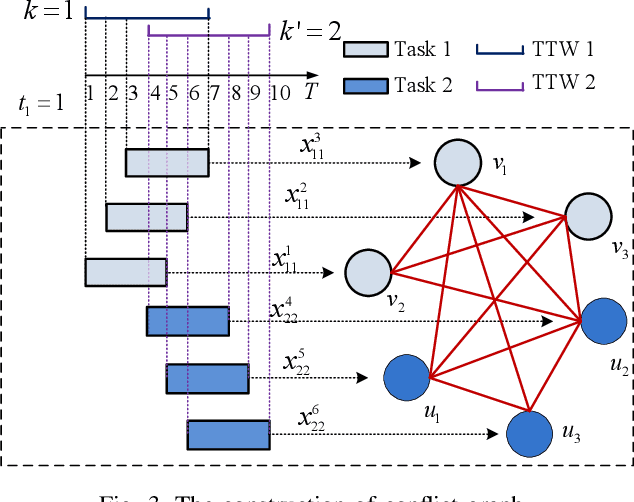
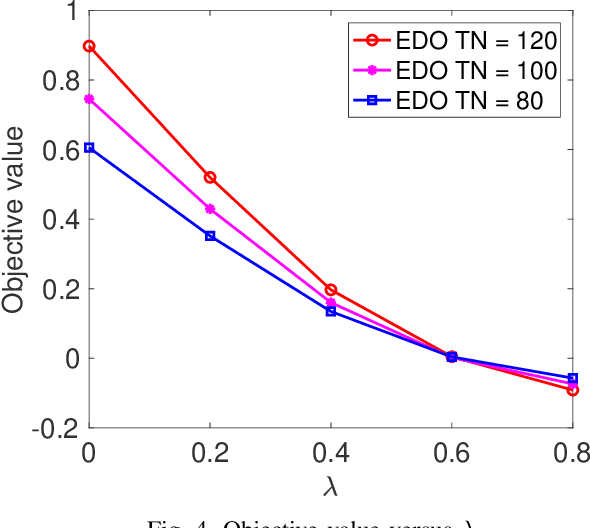
In Earth Observation Satellite Networks (EOSNs) with a large number of battery-carrying satellites, proper power allocation and task scheduling are crucial to improving the data offloading efficiency. As such, we jointly optimize power allocation and task scheduling to achieve energy-efficient data offloading in EOSNs, aiming to balance the objectives of reducing the total energy consumption and increasing the sum weights of tasks. First, we derive the optimal power allocation solution to the joint optimization problem when the task scheduling policy is given. Second, leveraging the conflict graph model, we transform the original joint optimization problem into a maximum weight independent set problem when the power allocation strategy is given. Finally, we utilize the genetic framework to combine the above special solutions as a two-layer solution for the joint optimization problem. Simulation results demonstrate that our proposed solution can properly balance the sum weights of tasks and the total energy consumption, achieving superior system performance over the current best alternatives.
Efficient Deformable ConvNets: Rethinking Dynamic and Sparse Operator for Vision Applications
Jan 11, 2024


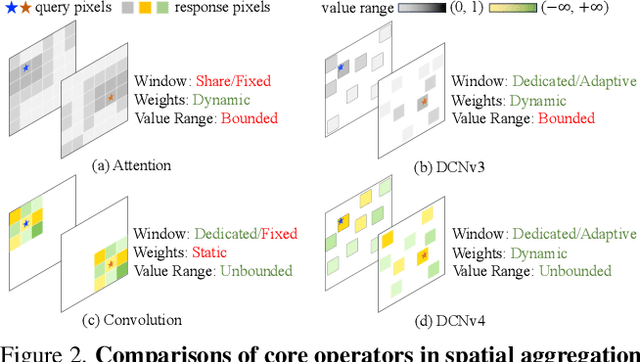
We introduce Deformable Convolution v4 (DCNv4), a highly efficient and effective operator designed for a broad spectrum of vision applications. DCNv4 addresses the limitations of its predecessor, DCNv3, with two key enhancements: 1. removing softmax normalization in spatial aggregation to enhance its dynamic property and expressive power and 2. optimizing memory access to minimize redundant operations for speedup. These improvements result in a significantly faster convergence compared to DCNv3 and a substantial increase in processing speed, with DCNv4 achieving more than three times the forward speed. DCNv4 demonstrates exceptional performance across various tasks, including image classification, instance and semantic segmentation, and notably, image generation. When integrated into generative models like U-Net in the latent diffusion model, DCNv4 outperforms its baseline, underscoring its possibility to enhance generative models. In practical applications, replacing DCNv3 with DCNv4 in the InternImage model to create FlashInternImage results in up to 80% speed increase and further performance improvement without further modifications. The advancements in speed and efficiency of DCNv4, combined with its robust performance across diverse vision tasks, show its potential as a foundational building block for future vision models.
ClassWise-SAM-Adapter: Parameter Efficient Fine-tuning Adapts Segment Anything to SAR Domain for Semantic Segmentation
Jan 04, 2024In the realm of artificial intelligence, the emergence of foundation models, backed by high computing capabilities and extensive data, has been revolutionary. Segment Anything Model (SAM), built on the Vision Transformer (ViT) model with millions of parameters and vast training dataset SA-1B, excels in various segmentation scenarios relying on its significance of semantic information and generalization ability. Such achievement of visual foundation model stimulates continuous researches on specific downstream tasks in computer vision. The ClassWise-SAM-Adapter (CWSAM) is designed to adapt the high-performing SAM for landcover classification on space-borne Synthetic Aperture Radar (SAR) images. The proposed CWSAM freezes most of SAM's parameters and incorporates lightweight adapters for parameter efficient fine-tuning, and a classwise mask decoder is designed to achieve semantic segmentation task. This adapt-tuning method allows for efficient landcover classification of SAR images, balancing the accuracy with computational demand. In addition, the task specific input module injects low frequency information of SAR images by MLP-based layers to improve the model performance. Compared to conventional state-of-the-art semantic segmentation algorithms by extensive experiments, CWSAM showcases enhanced performance with fewer computing resources, highlighting the potential of leveraging foundational models like SAM for specific downstream tasks in the SAR domain. The source code is available at: https://github.com/xypu98/CWSAM.
QGFace: Quality-Guided Joint Training For Mixed-Quality Face Recognition
Dec 29, 2023The quality of a face crop in an image is decided by many factors such as camera resolution, distance, and illumination condition. This makes the discrimination of face images with different qualities a challenging problem in realistic applications. However, most existing approaches are designed specifically for high-quality (HQ) or low-quality (LQ) images, and the performances would degrade for the mixed-quality images. Besides, many methods ask for pre-trained feature extractors or other auxiliary structures to support the training and the evaluation. In this paper, we point out that the key to better understand both the HQ and the LQ images simultaneously is to apply different learning methods according to their qualities. We propose a novel quality-guided joint training approach for mixed-quality face recognition, which could simultaneously learn the images of different qualities with a single encoder. Based on quality partition, classification-based method is employed for HQ data learning. Meanwhile, for the LQ images which lack identity information, we learn them with self-supervised image-image contrastive learning. To effectively catch up the model update and improve the discriminability of contrastive learning in our joint training scenario, we further propose a proxy-updated real-time queue to compose the contrastive pairs with features from the genuine encoder. Experiments on the low-quality datasets SCface and Tinyface, the mixed-quality dataset IJB-B, and five high-quality datasets demonstrate the effectiveness of our proposed approach in recognizing face images of different qualities.