 Add to Chrome
 Add to Firefox
 Add to Edge
EHR-RAGp: Retrieval-Augmented Prototype-Guided Foundation Model for Electronic Health Records
May 12, 2026
Electronic Health Records (EHR) contain rich longitudinal patient information and are widely used in predictive modeling applications. However, effectively leveraging historical data remains challenging due to long trajectories, heterogeneous events, temporal irregularity, and the varying relevance of past clinical context. Existing approaches often rely on fixed windows or uniform aggregation, which can obscure clinically important signals. In this work, we introduce EHR-RAGp, a retrieval-augmented foundation model that dynamically integrates the most relevant patient history across diverse clinical event types. We propose a prototype-guided retrieval module that acts as an alignment mechanism and estimates the relevance of retrieved historical chunks with respect to a given prediction task, guiding the model towards the most informative context. Across multiple clinical prediction tasks, EHR-RAGp consistently outperforms state-of-the-art EHR foundation models and transformer-based baselines. Furthermore, integrating EHR-RAGp with existing clinical foundation models yields substantial performance gains. Overall, EHR-RAGp provides a scalable and efficient framework for leveraging long-range clinical context to improve downstream performance.

AgentRx: A Benchmark Study of LLM Agents for Multimodal Clinical Prediction Tasks
May 11, 2026Building effective clinical decision support systems requires the synthesis of complex heterogeneous multimodal data. Such modalities include temporal electronic health records data, medical images, radiology reports, and clinical notes. Large language model (LLM)-based agents have shown impressive performance in various healthcare tasks, especially those involving textual modalities. Considering the fragmentation of healthcare data across hospital systems, collaborative agent frameworks present a promising direction to mitigate data sharing challenges. However, the effectiveness of LLM agents for multimodal clinical risk prediction remains largely unexamined. In this work, we conduct a systematic evaluation of LLM-based agents for clinical prediction tasks using large-scale real-world data. We assess performance in unimodal and multimodal settings and quantify performance gaps between single agent and multi-agent systems. Our findings highlight that single agent frameworks outperform naive multi-agent systems, are better at handling multimodal data, and are better calibrated. This underscores a critical need for improving multi-agent collaboration to better handle heterogeneous inputs. By open-sourcing our code and evaluation framework, this work offers a new benchmark to support future developments relating to agentic systems in healthcare.
Data-Driven Priors for Uncertainty-Aware Deterioration Risk Prediction with Multimodal Data
Mar 09, 2026Safe predictions are a crucial requirement for integrating predictive models into clinical decision support systems. One approach for ensuring trustworthiness is to enable models' ability to express their uncertainty about individual predictions. However, current machine learning models frequently lack reliable uncertainty estimation, hindering real-world deployment. This is further observed in multimodal settings, where the goal is to enable effective information fusion. In this work, we propose $\texttt{MedCertAIn}$, a predictive uncertainty framework that leverages multimodal clinical data for in-hospital risk prediction to improve model performance and reliability. We design data-driven priors over neural network parameters using a hybrid strategy that considers cross-modal similarity in self-supervised latent representations and modality-specific data corruptions. We train and evaluate the models with such priors using clinical time-series and chest X-ray images from the publicly-available datasets MIMIC-IV and MIMIC-CXR. Our results show that $\texttt{MedCertAIn}$ significantly improves predictive performance and uncertainty quantification compared to state-of-the-art deterministic baselines and alternative Bayesian methods. These findings highlight the promise of data-driven priors in advancing robust, uncertainty-aware AI tools for high-stakes clinical applications.
An Empirical Analysis of Calibration and Selective Prediction in Multimodal Clinical Condition Classification
Mar 03, 2026As artificial intelligence systems move toward clinical deployment, ensuring reliable prediction behavior is fundamental for safety-critical decision-making tasks. One proposed safeguard is selective prediction, where models can defer uncertain predictions to human experts for review. In this work, we empirically evaluate the reliability of uncertainty-based selective prediction in multilabel clinical condition classification using multimodal ICU data. Across a range of state-of-the-art unimodal and multimodal models, we find that selective prediction can substantially degrade performance despite strong standard evaluation metrics. This failure is driven by severe class-dependent miscalibration, whereby models assign high uncertainty to correct predictions and low uncertainty to incorrect ones, particularly for underrepresented clinical conditions. Our results show that commonly used aggregate metrics can obscure these effects, limiting their ability to assess selective prediction behavior in this setting. Taken together, our findings characterize a task-specific failure mode of selective prediction in multimodal clinical condition classification and highlight the need for calibration-aware evaluation to provide strong guarantees of safety and robustness in clinical AI.
MedErrBench: A Fine-Grained Multilingual Benchmark for Medical Error Detection and Correction with Clinical Expert Annotations
Feb 05, 2026Inaccuracies in existing or generated clinical text may lead to serious adverse consequences, especially if it is a misdiagnosis or incorrect treatment suggestion. With Large Language Models (LLMs) increasingly being used across diverse healthcare applications, comprehensive evaluation through dedicated benchmarks is crucial. However, such datasets remain scarce, especially across diverse languages and contexts. In this paper, we introduce MedErrBench, the first multilingual benchmark for error detection, localization, and correction, developed under the guidance of experienced clinicians. Based on an expanded taxonomy of ten common error types, MedErrBench covers English, Arabic and Chinese, with natural clinical cases annotated and reviewed by domain experts. We assessed the performance of a range of general-purpose, language-specific, and medical-domain language models across all three tasks. Our results reveal notable performance gaps, particularly in non-English settings, highlighting the need for clinically grounded, language-aware systems. By making MedErrBench and our evaluation protocols publicly-available, we aim to advance multilingual clinical NLP to promote safer and more equitable AI-based healthcare globally. The dataset is available in the supplementary material. An anonymized version of the dataset is available at: https://github.com/congboma/MedErrBench.
Cross-Lingual Empirical Evaluation of Large Language Models for Arabic Medical Tasks
Feb 05, 2026In recent years, Large Language Models (LLMs) have become widely used in medical applications, such as clinical decision support, medical education, and medical question answering. Yet, these models are often English-centric, limiting their robustness and reliability for linguistically diverse communities. Recent work has highlighted discrepancies in performance in low-resource languages for various medical tasks, but the underlying causes remain poorly understood. In this study, we conduct a cross-lingual empirical analysis of LLM performance on Arabic and English medical question and answering. Our findings reveal a persistent language-driven performance gap that intensifies with increasing task complexity. Tokenization analysis exposes structural fragmentation in Arabic medical text, while reliability analysis suggests that model-reported confidence and explanations exhibit limited correlation with correctness. Together, these findings underscore the need for language-aware design and evaluation strategies in LLMs for medical tasks.
MedAraBench: Large-Scale Arabic Medical Question Answering Dataset and Benchmark
Feb 02, 2026Arabic remains one of the most underrepresented languages in natural language processing research, particularly in medical applications, due to the limited availability of open-source data and benchmarks. The lack of resources hinders efforts to evaluate and advance the multilingual capabilities of Large Language Models (LLMs). In this paper, we introduce MedAraBench, a large-scale dataset consisting of Arabic multiple-choice question-answer pairs across various medical specialties. We constructed the dataset by manually digitizing a large repository of academic materials created by medical professionals in the Arabic-speaking region. We then conducted extensive preprocessing and split the dataset into training and test sets to support future research efforts in the area. To assess the quality of the data, we adopted two frameworks, namely expert human evaluation and LLM-as-a-judge. Our dataset is diverse and of high quality, spanning 19 specialties and five difficulty levels. For benchmarking purposes, we assessed the performance of eight state-of-the-art open-source and proprietary models, such as GPT-5, Gemini 2.0 Flash, and Claude 4-Sonnet. Our findings highlight the need for further domain-specific enhancements. We release the dataset and evaluation scripts to broaden the diversity of medical data benchmarks, expand the scope of evaluation suites for LLMs, and enhance the multilingual capabilities of models for deployment in clinical settings.
MedArabiQ: Benchmarking Large Language Models on Arabic Medical Tasks
May 06, 2025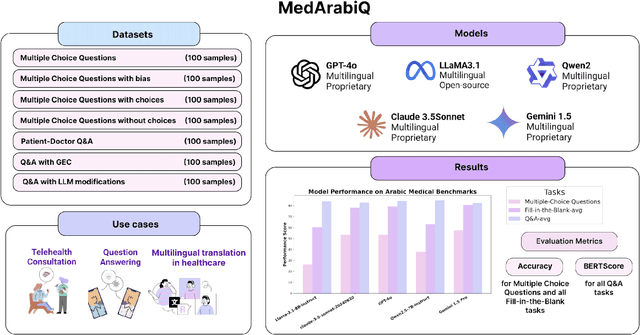
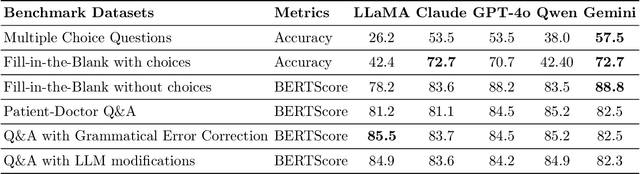
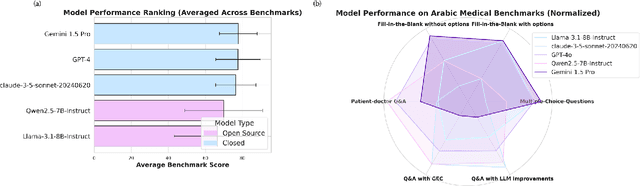
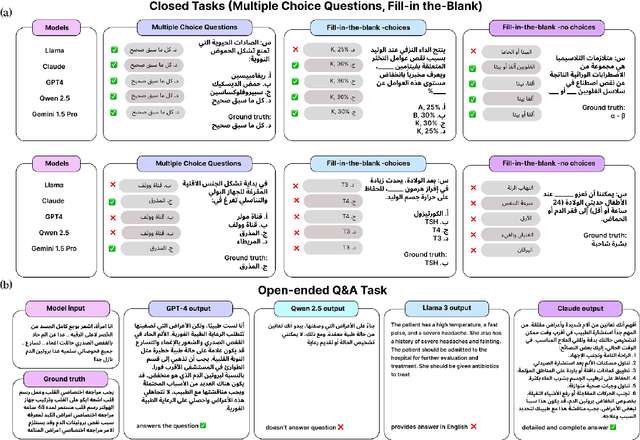
Large Language Models (LLMs) have demonstrated significant promise for various applications in healthcare. However, their efficacy in the Arabic medical domain remains unexplored due to the lack of high-quality domain-specific datasets and benchmarks. This study introduces MedArabiQ, a novel benchmark dataset consisting of seven Arabic medical tasks, covering multiple specialties and including multiple choice questions, fill-in-the-blank, and patient-doctor question answering. We first constructed the dataset using past medical exams and publicly available datasets. We then introduced different modifications to evaluate various LLM capabilities, including bias mitigation. We conducted an extensive evaluation with five state-of-the-art open-source and proprietary LLMs, including GPT-4o, Claude 3.5-Sonnet, and Gemini 1.5. Our findings highlight the need for the creation of new high-quality benchmarks that span different languages to ensure fair deployment and scalability of LLMs in healthcare. By establishing this benchmark and releasing the dataset, we provide a foundation for future research aimed at evaluating and enhancing the multilingual capabilities of LLMs for the equitable use of generative AI in healthcare.
Multimodal Deep Learning for Stroke Prediction and Detection using Retinal Imaging and Clinical Data
May 05, 2025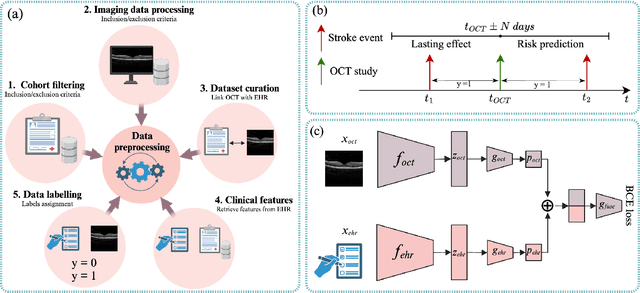
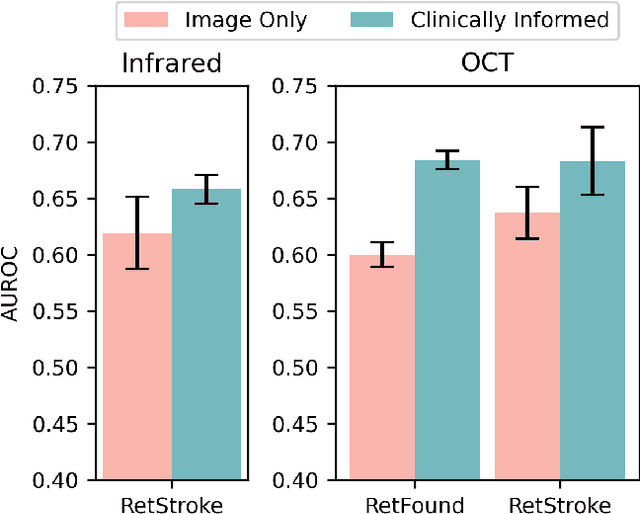
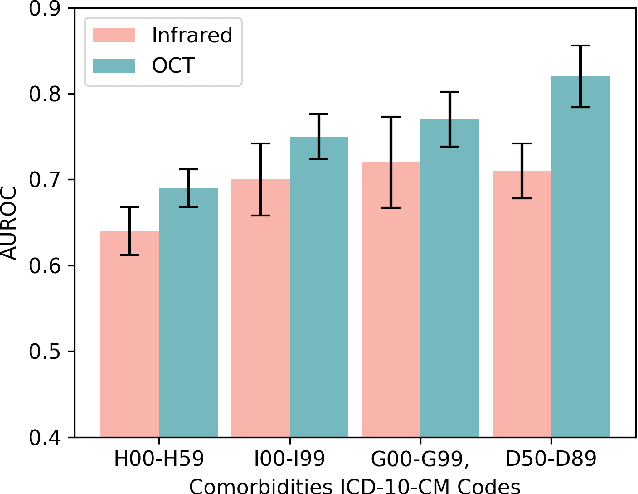
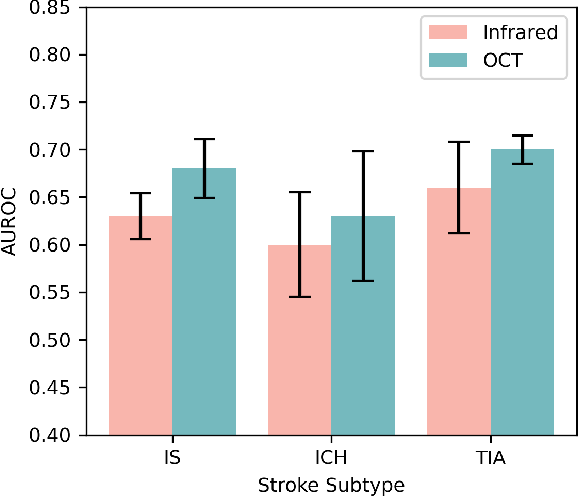
Stroke is a major public health problem, affecting millions worldwide. Deep learning has recently demonstrated promise for enhancing the diagnosis and risk prediction of stroke. However, existing methods rely on costly medical imaging modalities, such as computed tomography. Recent studies suggest that retinal imaging could offer a cost-effective alternative for cerebrovascular health assessment due to the shared clinical pathways between the retina and the brain. Hence, this study explores the impact of leveraging retinal images and clinical data for stroke detection and risk prediction. We propose a multimodal deep neural network that processes Optical Coherence Tomography (OCT) and infrared reflectance retinal scans, combined with clinical data, such as demographics, vital signs, and diagnosis codes. We pretrained our model using a self-supervised learning framework using a real-world dataset consisting of $37$ k scans, and then fine-tuned and evaluated the model using a smaller labeled subset. Our empirical findings establish the predictive ability of the considered modalities in detecting lasting effects in the retina associated with acute stroke and forecasting future risk within a specific time horizon. The experimental results demonstrate the effectiveness of our proposed framework by achieving $5$\% AUROC improvement as compared to the unimodal image-only baseline, and $8$\% improvement compared to an existing state-of-the-art foundation model. In conclusion, our study highlights the potential of retinal imaging in identifying high-risk patients and improving long-term outcomes.
Uncertainty Quantification for Machine Learning in Healthcare: A Survey
May 04, 2025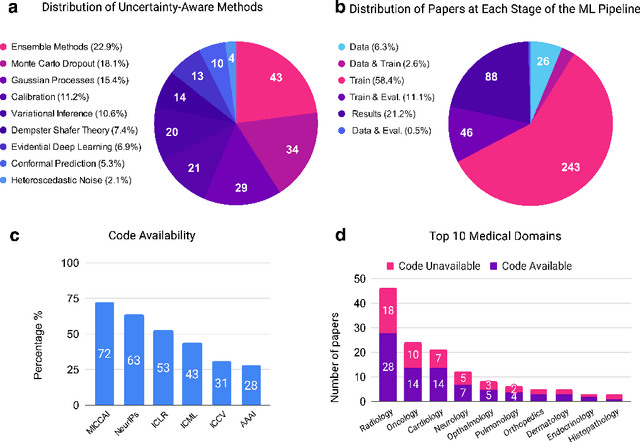
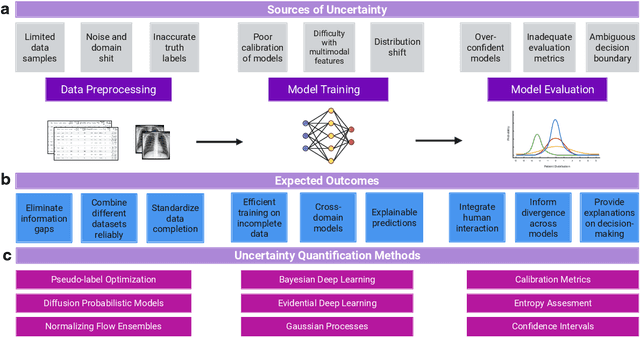
Uncertainty Quantification (UQ) is pivotal in enhancing the robustness, reliability, and interpretability of Machine Learning (ML) systems for healthcare, optimizing resources and improving patient care. Despite the emergence of ML-based clinical decision support tools, the lack of principled quantification of uncertainty in ML models remains a major challenge. Current reviews have a narrow focus on analyzing the state-of-the-art UQ in specific healthcare domains without systematically evaluating method efficacy across different stages of model development, and despite a growing body of research, its implementation in healthcare applications remains limited. Therefore, in this survey, we provide a comprehensive analysis of current UQ in healthcare, offering an informed framework that highlights how different methods can be integrated into each stage of the ML pipeline including data processing, training and evaluation. We also highlight the most popular methods used in healthcare and novel approaches from other domains that hold potential for future adoption in the medical context. We expect this study will provide a clear overview of the challenges and opportunities of implementing UQ in the ML pipeline for healthcare, guiding researchers and practitioners in selecting suitable techniques to enhance the reliability, safety and trust from patients and clinicians on ML-driven healthcare solutions.