 Add to Chrome
 Add to Firefox
 Add to Edge
Data-Driven Priors for Uncertainty-Aware Deterioration Risk Prediction with Multimodal Data
Mar 09, 2026
Safe predictions are a crucial requirement for integrating predictive models into clinical decision support systems. One approach for ensuring trustworthiness is to enable models' ability to express their uncertainty about individual predictions. However, current machine learning models frequently lack reliable uncertainty estimation, hindering real-world deployment. This is further observed in multimodal settings, where the goal is to enable effective information fusion. In this work, we propose $\texttt{MedCertAIn}$, a predictive uncertainty framework that leverages multimodal clinical data for in-hospital risk prediction to improve model performance and reliability. We design data-driven priors over neural network parameters using a hybrid strategy that considers cross-modal similarity in self-supervised latent representations and modality-specific data corruptions. We train and evaluate the models with such priors using clinical time-series and chest X-ray images from the publicly-available datasets MIMIC-IV and MIMIC-CXR. Our results show that $\texttt{MedCertAIn}$ significantly improves predictive performance and uncertainty quantification compared to state-of-the-art deterministic baselines and alternative Bayesian methods. These findings highlight the promise of data-driven priors in advancing robust, uncertainty-aware AI tools for high-stakes clinical applications.

An Empirical Analysis of Calibration and Selective Prediction in Multimodal Clinical Condition Classification
Mar 03, 2026As artificial intelligence systems move toward clinical deployment, ensuring reliable prediction behavior is fundamental for safety-critical decision-making tasks. One proposed safeguard is selective prediction, where models can defer uncertain predictions to human experts for review. In this work, we empirically evaluate the reliability of uncertainty-based selective prediction in multilabel clinical condition classification using multimodal ICU data. Across a range of state-of-the-art unimodal and multimodal models, we find that selective prediction can substantially degrade performance despite strong standard evaluation metrics. This failure is driven by severe class-dependent miscalibration, whereby models assign high uncertainty to correct predictions and low uncertainty to incorrect ones, particularly for underrepresented clinical conditions. Our results show that commonly used aggregate metrics can obscure these effects, limiting their ability to assess selective prediction behavior in this setting. Taken together, our findings characterize a task-specific failure mode of selective prediction in multimodal clinical condition classification and highlight the need for calibration-aware evaluation to provide strong guarantees of safety and robustness in clinical AI.
Uncertainty Quantification for Machine Learning in Healthcare: A Survey
May 04, 2025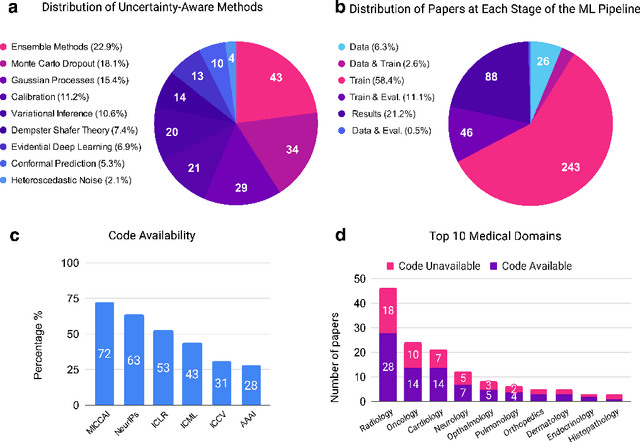
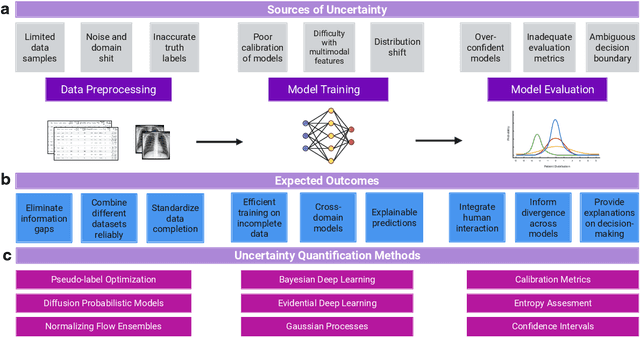
Uncertainty Quantification (UQ) is pivotal in enhancing the robustness, reliability, and interpretability of Machine Learning (ML) systems for healthcare, optimizing resources and improving patient care. Despite the emergence of ML-based clinical decision support tools, the lack of principled quantification of uncertainty in ML models remains a major challenge. Current reviews have a narrow focus on analyzing the state-of-the-art UQ in specific healthcare domains without systematically evaluating method efficacy across different stages of model development, and despite a growing body of research, its implementation in healthcare applications remains limited. Therefore, in this survey, we provide a comprehensive analysis of current UQ in healthcare, offering an informed framework that highlights how different methods can be integrated into each stage of the ML pipeline including data processing, training and evaluation. We also highlight the most popular methods used in healthcare and novel approaches from other domains that hold potential for future adoption in the medical context. We expect this study will provide a clear overview of the challenges and opportunities of implementing UQ in the ML pipeline for healthcare, guiding researchers and practitioners in selecting suitable techniques to enhance the reliability, safety and trust from patients and clinicians on ML-driven healthcare solutions.