 Add to Chrome
 Add to Firefox
 Add to Edge
From Garbage to Gold: A Data-Architectural Theory of Predictive Robustness
Mar 08, 2026
Tabular machine learning presents a paradox: modern models achieve state-of-the-art performance using high-dimensional (high-D), collinear, error-prone data, defying the "Garbage In, Garbage Out" mantra. To help resolve this, we synthesize principles from Information Theory, Latent Factor Models, and Psychometrics, clarifying that predictive robustness arises not solely from data cleanliness, but from the synergy between data architecture and model capacity. Partitioning predictor-space "noise" into "Predictor Error" and "Structural Uncertainty" (informational deficits from stochastic generative mappings), we prove that leveraging high-D sets of error-prone predictors asymptotically overcomes both types of noise, whereas cleaning a low-D set is fundamentally bounded by Structural Uncertainty. We demonstrate why "Informative Collinearity" (dependencies from shared latent causes) enhances reliability and convergence efficiency, and explain why increased dimensionality reduces the latent inference burden, enabling feasibility with finite samples. To address practical constraints, we propose "Proactive Data-Centric AI" to identify predictors that enable robustness efficiently. We also derive boundaries for Systematic Error Regimes and show why models that absorb "rogue" dependencies can mitigate assumption violations. Linking latent architecture to Benign Overfitting, we offer a first step towards a unified view of robustness to Outcome Error and predictor-space noise, while also delineating when traditional DCAI's focus on label cleaning remains powerful. By redefining data quality from item-level perfection to portfolio-level architecture, we provide a theoretical rationale for "Local Factories" -- learning from live, uncurated enterprise "data swamps" -- supporting a deployment paradigm shift from "Model Transfer" to "Methodology Transfer'' to overcome static generalizability limitations.

Multimodal Deep Learning for Stroke Prediction and Detection using Retinal Imaging and Clinical Data
May 05, 2025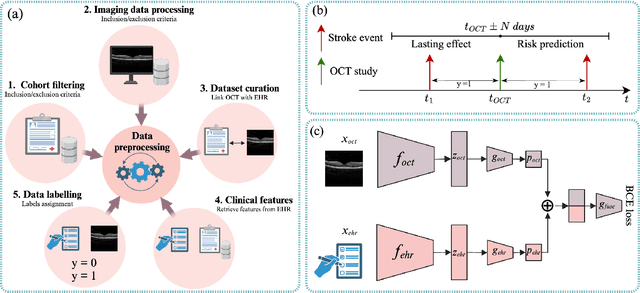
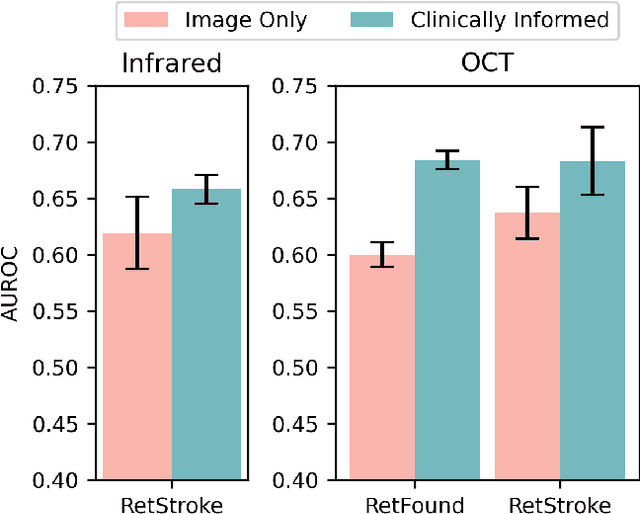
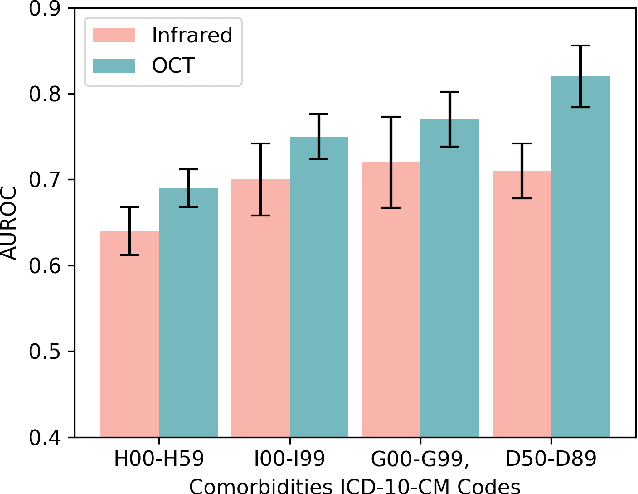
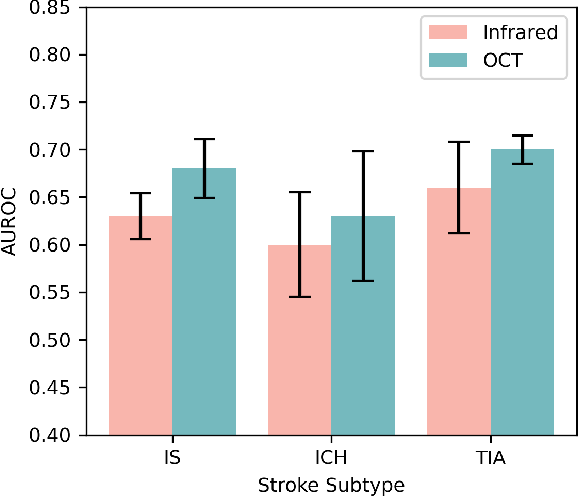
Stroke is a major public health problem, affecting millions worldwide. Deep learning has recently demonstrated promise for enhancing the diagnosis and risk prediction of stroke. However, existing methods rely on costly medical imaging modalities, such as computed tomography. Recent studies suggest that retinal imaging could offer a cost-effective alternative for cerebrovascular health assessment due to the shared clinical pathways between the retina and the brain. Hence, this study explores the impact of leveraging retinal images and clinical data for stroke detection and risk prediction. We propose a multimodal deep neural network that processes Optical Coherence Tomography (OCT) and infrared reflectance retinal scans, combined with clinical data, such as demographics, vital signs, and diagnosis codes. We pretrained our model using a self-supervised learning framework using a real-world dataset consisting of $37$ k scans, and then fine-tuned and evaluated the model using a smaller labeled subset. Our empirical findings establish the predictive ability of the considered modalities in detecting lasting effects in the retina associated with acute stroke and forecasting future risk within a specific time horizon. The experimental results demonstrate the effectiveness of our proposed framework by achieving $5$\% AUROC improvement as compared to the unimodal image-only baseline, and $8$\% improvement compared to an existing state-of-the-art foundation model. In conclusion, our study highlights the potential of retinal imaging in identifying high-risk patients and improving long-term outcomes.