 Add to Chrome
 Add to Firefox
 Add to Edge
MedAraBench: Large-Scale Arabic Medical Question Answering Dataset and Benchmark
Feb 02, 2026
Arabic remains one of the most underrepresented languages in natural language processing research, particularly in medical applications, due to the limited availability of open-source data and benchmarks. The lack of resources hinders efforts to evaluate and advance the multilingual capabilities of Large Language Models (LLMs). In this paper, we introduce MedAraBench, a large-scale dataset consisting of Arabic multiple-choice question-answer pairs across various medical specialties. We constructed the dataset by manually digitizing a large repository of academic materials created by medical professionals in the Arabic-speaking region. We then conducted extensive preprocessing and split the dataset into training and test sets to support future research efforts in the area. To assess the quality of the data, we adopted two frameworks, namely expert human evaluation and LLM-as-a-judge. Our dataset is diverse and of high quality, spanning 19 specialties and five difficulty levels. For benchmarking purposes, we assessed the performance of eight state-of-the-art open-source and proprietary models, such as GPT-5, Gemini 2.0 Flash, and Claude 4-Sonnet. Our findings highlight the need for further domain-specific enhancements. We release the dataset and evaluation scripts to broaden the diversity of medical data benchmarks, expand the scope of evaluation suites for LLMs, and enhance the multilingual capabilities of models for deployment in clinical settings.

AraHealthQA 2025: The First Shared Task on Arabic Health Question Answering
Aug 28, 2025We introduce {AraHealthQA 2025}, the {Comprehensive Arabic Health Question Answering Shared Task}, held in conjunction with {ArabicNLP 2025} (co-located with EMNLP 2025). This shared task addresses the paucity of high-quality Arabic medical QA resources by offering two complementary tracks: {MentalQA}, focusing on Arabic mental health Q\&A (e.g., anxiety, depression, stigma reduction), and {MedArabiQ}, covering broader medical domains such as internal medicine, pediatrics, and clinical decision making. Each track comprises multiple subtasks, evaluation datasets, and standardized metrics, facilitating fair benchmarking. The task was structured to promote modeling under realistic, multilingual, and culturally nuanced healthcare contexts. We outline the dataset creation, task design and evaluation framework, participation statistics, baseline systems, and summarize the overall outcomes. We conclude with reflections on the performance trends observed and prospects for future iterations in Arabic health QA.
MedArabiQ: Benchmarking Large Language Models on Arabic Medical Tasks
May 06, 2025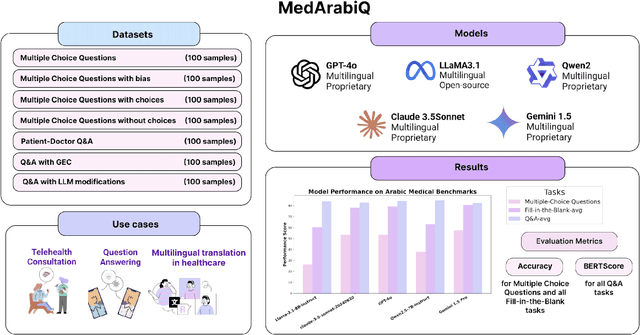
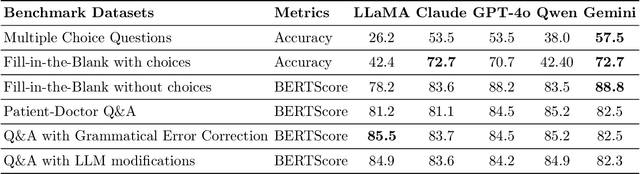
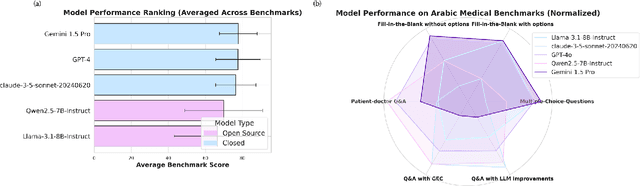
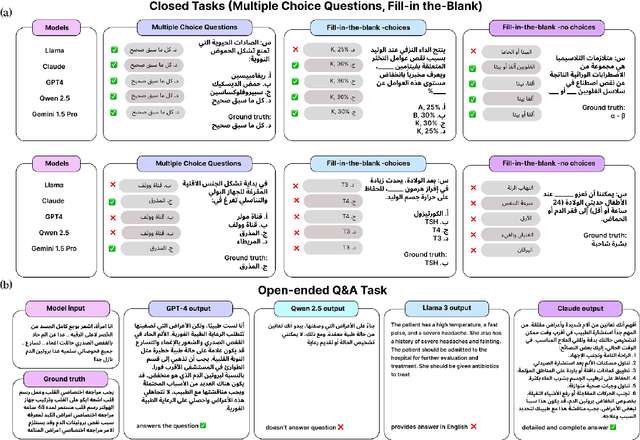
Large Language Models (LLMs) have demonstrated significant promise for various applications in healthcare. However, their efficacy in the Arabic medical domain remains unexplored due to the lack of high-quality domain-specific datasets and benchmarks. This study introduces MedArabiQ, a novel benchmark dataset consisting of seven Arabic medical tasks, covering multiple specialties and including multiple choice questions, fill-in-the-blank, and patient-doctor question answering. We first constructed the dataset using past medical exams and publicly available datasets. We then introduced different modifications to evaluate various LLM capabilities, including bias mitigation. We conducted an extensive evaluation with five state-of-the-art open-source and proprietary LLMs, including GPT-4o, Claude 3.5-Sonnet, and Gemini 1.5. Our findings highlight the need for the creation of new high-quality benchmarks that span different languages to ensure fair deployment and scalability of LLMs in healthcare. By establishing this benchmark and releasing the dataset, we provide a foundation for future research aimed at evaluating and enhancing the multilingual capabilities of LLMs for the equitable use of generative AI in healthcare.