 Add to Chrome
 Add to Firefox
 Add to Edge
ContactFlow: A video action conditioning that transfers across embodiments
Jul 29, 2026
World models offer a promising route toward robot planning by enabling agents to imagine and verify the consequences of actions before execution. However, current video-based world models often struggle to capture the physical constraints that govern manipulation, particularly contact. Further, their action conditioning is often constrained to specific embodiments such as parallel grippers. We propose \emph{Contact Flow}, an embodiment-agnostic action representation that encodes manipulation through the trajectory of 3D contact points between an actor and a target object. By discarding actor-specific appearance and kinematics, Contact Flow provides a shared conditioning signal for both human demonstrations and robotic execution. Therefore, we can train a large-scale video generative model on both human and robotic object interaction videos conditioned on Contact Flow, yielding a world model that predicts physically plausible manipulation outcomes. We integrate this model into a propose-imagine-verify-act pipeline, where generated rollouts are assessed by a vision-language model before execution. Experiments on the DROID dataset and real-world tabletop manipulation tasks demonstrate that Contact Flow enables transfer between human demonstrations and different robotic embodiments.

Forecasting the Number of Harvest-ready Fruits of Sweet Peppers Using Multimodal Time-Series Data
Jul 22, 2026Accurate yield forecasting at the individual-plant level is critical for precision agriculture and supply-chain planning, yet public datasets capturing both visual growth dynamics and per-plant measurement labels are scarce. In this paper, we introduce a novel, annotated image time-series dataset of 691 sweet pepper plants monitored over two growing seasons, comprising 4837 images with per-plant fruit counts categorized by maturity. We propose a multimodal deep learning framework that fuses high-dimensional image features, extracted using the DinoV3 encoder, with numerical count measurements. Our architecture utilizes a Long Short-Term Memory (LSTM) network to model temporal dependencies and handles irregular sampling intervals common in greenhouse monitoring. Through quantitative experiments, we demonstrate that this multimodal approach reduces RMSE over a persistence baseline by 33% and 38% in the 2022 and 2023 seasons, respectively, with a further 1.2% average gain over a measurement-only model. Furthermore, we employ Deep Ensembles and Gaussian Negative Log-Likelihood (NLL) to provide calibrated uncertainty estimates, with an Uncertainty Calibration Error (UCE) ranging from 0.39 to 0.89 depending on the cross-season evaluation direction, offering a principled confidence signal for real-world agricultural decision-making. We release the dataset and code to support reproducible research and to accelerate development of data-driven yield forecasting methods for horticultural crops.
Still image and spatial-temporal tomato data enabling detection, segmentation, tracking, and video-instance segmentation using strong and weak labels
Jul 16, 2026In this manuscript we release two datasets for visual sensing of tomato plants grown in commercial-like settings and acquired using a robot. The first is BUTom21 which consists of still images and manual annotations. The second is BUTom-ST21 which consists of video-based data and semi-automated annotations through AI-based methods, referred to as pseudo-labels. In both cases, we provide pixel-level labels for the ripeness of the fruit. The aim is to provide the research community a challenging set of real-world imagery to explore methods to sense and estimate the state of tomato plants and their fruit, which is an important horticultural crop. Importantly, the spatial-temporal dataset provides individual fruit count and ripeness information enabling researchers to push the boundaries of field-based phenotyping.
SyncVP: Joint Diffusion for Synchronous Multi-Modal Video Prediction
Mar 24, 2025Predicting future video frames is essential for decision-making systems, yet RGB frames alone often lack the information needed to fully capture the underlying complexities of the real world. To address this limitation, we propose a multi-modal framework for Synchronous Video Prediction (SyncVP) that incorporates complementary data modalities, enhancing the richness and accuracy of future predictions. SyncVP builds on pre-trained modality-specific diffusion models and introduces an efficient spatio-temporal cross-attention module to enable effective information sharing across modalities. We evaluate SyncVP on standard benchmark datasets, such as Cityscapes and BAIR, using depth as an additional modality. We furthermore demonstrate its generalization to other modalities on SYNTHIA with semantic information and ERA5-Land with climate data. Notably, SyncVP achieves state-of-the-art performance, even in scenarios where only one modality is present, demonstrating its robustness and potential for a wide range of applications.
Race Against the Machine: a Fully-annotated, Open-design Dataset of Autonomous and Piloted High-speed Flight
Nov 05, 2023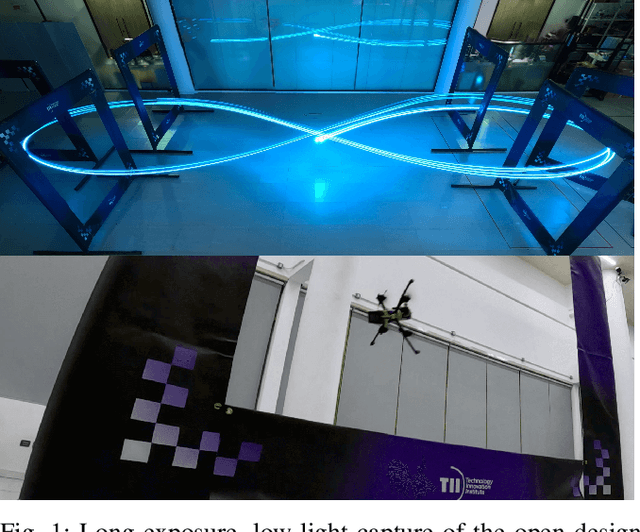
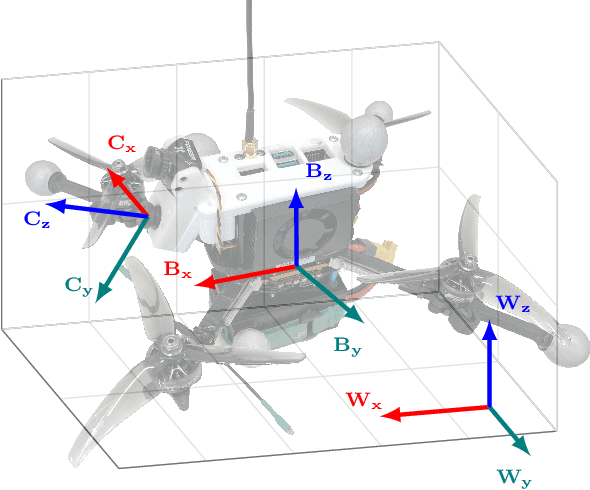
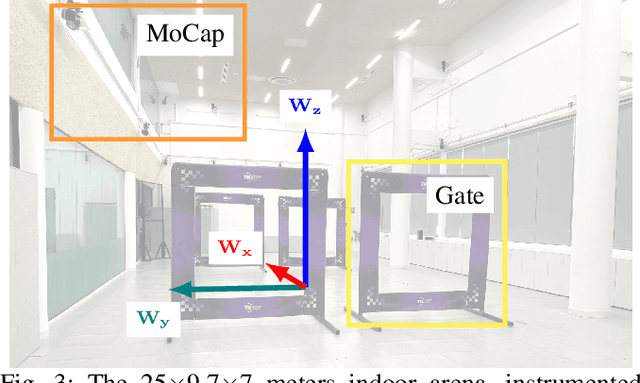
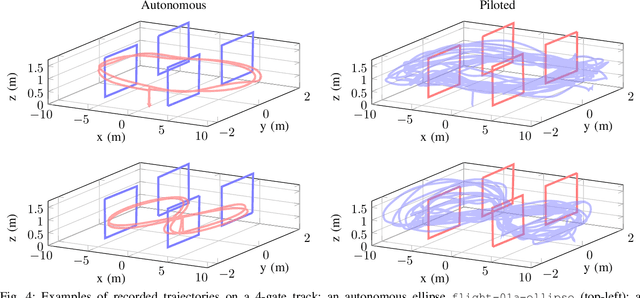
Unmanned aerial vehicles, and multi-rotors in particular, can now perform dexterous tasks in impervious environments, from infrastructure monitoring to emergency deliveries. Autonomous drone racing has emerged as an ideal benchmark to develop and evaluate these capabilities. Its challenges include accurate and robust visual-inertial odometry during aggressive maneuvers, complex aerodynamics, and constrained computational resources. As researchers increasingly channel their efforts into it, they also need the tools to timely and equitably compare their results and advances. With this dataset, we want to (i) support the development of new methods and (ii) establish quantitative comparisons for approaches coming from the broader robotics, controls, and artificial intelligence communities. We want to provide a one-stop resource that is comprehensive of (i) aggressive autonomous and piloted flight, (ii) high-resolution, high-frequency visual, inertial, and motion capture data, (iii) commands and control inputs, (iv) multiple light settings, and (v) corner-level labeling of drone racing gates. We also release the complete specifications to recreate our flight platform, using commercial off-the-shelf components and the open-source flight controller Betaflight. Our dataset, open-source scripts, and drone design are available at: https://github.com/tii-racing/drone-racing-dataset.