 Add to Chrome
 Add to Firefox
 Add to Edge
StrAD: A Streaming Method and Benchmark for Audio Description Generation for Long-form Videos
Aug 12, 2026
Visual content is the dominant medium of communication, yet without audio descriptions (ADs), it remains inaccessible to blind and low-vision people. ADs narrate context-relevant visual events during natural audio pauses. Manually creating ADs is expensive, limiting coverage to a small fraction of available content. Most existing automatic AD generation methods frame the task as video clip captioning, requiring ground-truth timestamps and additional context cues such as character databases. Current benchmarks reinforce this framing, consisting of short video segments paired with automatic or task-mismatched annotations. We introduce StrAD, a benchmark for long-form AD generation on full-length videos spanning diverse genres such as movies, documentaries, short films, performances, and video games. We reformulate AD generation as streaming dense video captioning. Our approach processes full-length videos with a sliding window, inserting ADs into existing transcripts without ground-truth timestamps, and supports both fine-tuned models and zero-shot prompting of vision-language models. On the segment-level task with given timestamps, our fine-tuned StrAD-FT sets the state of the art on CMD-AD with 36.3 CIDEr (+10.0 over Shot-by-shot), establishes a reference point on StrAD (51.0 CIDEr), and remains competitive on MAD-Eval at 24.9 CIDEr. On the full-video streaming task, StrAD-FT reaches a SODA score of 2.4 against 1.1 for our zero-shot baseline StrAD-Zero, though both exhibit limitations in temporal localization and narrative coherence. While prior work has tackled full-video AD generation in an offline, multi-stage fashion, ours is the first streaming approach, generating ADs on the fly without ground-truth timestamps. StrAD makes progress on full-video AD generation measurable, a prerequisite for scaling accessibility.

ContactFlow: A video action conditioning that transfers across embodiments
Jul 29, 2026World models offer a promising route toward robot planning by enabling agents to imagine and verify the consequences of actions before execution. However, current video-based world models often struggle to capture the physical constraints that govern manipulation, particularly contact. Further, their action conditioning is often constrained to specific embodiments such as parallel grippers. We propose \emph{Contact Flow}, an embodiment-agnostic action representation that encodes manipulation through the trajectory of 3D contact points between an actor and a target object. By discarding actor-specific appearance and kinematics, Contact Flow provides a shared conditioning signal for both human demonstrations and robotic execution. Therefore, we can train a large-scale video generative model on both human and robotic object interaction videos conditioned on Contact Flow, yielding a world model that predicts physically plausible manipulation outcomes. We integrate this model into a propose-imagine-verify-act pipeline, where generated rollouts are assessed by a vision-language model before execution. Experiments on the DROID dataset and real-world tabletop manipulation tasks demonstrate that Contact Flow enables transfer between human demonstrations and different robotic embodiments.
Slot-MPC: Goal-Conditioned Model Predictive Control with Object-Centric Representations
May 14, 2026Predictive world models enable agents to model scene dynamics and reason about the consequences of their actions. Inspired by human perception, object-centric world models capture scene dynamics using object-level representations, which can be used for downstream applications such as action planning. However, most object-centric world models and reinforcement learning (RL) approaches learn reactive policies that are fixed at inference time, limiting generalization to novel situations. We propose Slot-MPC, an object-centric world modeling framework that enables planning through Model Predictive Control (MPC). Slot-MPC leverages vision encoders to learn slot-based representations, which encode individual objects in the scene, and uses these structured representations to learn an action-conditioned object-centric dynamics model. At inference time, the learned dynamics model enables action planning via MPC, allowing agents to adapt to previously unseen situations. Since the learned world model is differentiable, we can use gradient-based MPC to directly optimize actions, which is computationally more efficient than relying on gradient-free, sampling-based MPC methods. Experiments on simulated robotic manipulation tasks show that Slot-MPC improves both task performance and planning efficiency compared to non-object-centric world model baselines. In the considered offline setting with limited state-action coverage, we find that gradient-based MPC performs better than gradient-free, sampling-based MPC. Our results demonstrate that explicitly structured, object-centric representations provide a strong inductive bias for controllable and generalizable decision-making. Code and additional results are available at https://slot-mpc.github.io.
Dream-MPC: Gradient-Based Model Predictive Control with Latent Imagination
May 06, 2026State-of-the-art model-based Reinforcement Learning (RL) approaches either use gradient-free, population-based methods for planning, learned policy networks, or a combination of policy networks and planning. Hybrid approaches that combine Model Predictive Control (MPC) with a learned model and a policy prior to leverage the advantages of both paradigms have shown promising results. However, these approaches typically rely on gradient-free optimization methods, which can be computationally expensive for high-dimensional control tasks. While gradient-based methods are a promising alternative, recent works have empirically shown that gradient-based methods often perform worse than their gradient-free counterparts. We propose Dream-MPC, a novel approach that generates few candidate trajectories from a rolled-out policy and optimizes each trajectory by gradient ascent using a learned world model, uncertainty regularization and amortization of optimization iterations over time by reusing previously optimized actions. Our results on 24 continuous control tasks show that Dream-MPC can significantly improve the performance of the underlying policy and can outperform gradient-free MPC and state-of-the-art baselines. We will open source our code and more at https://dream-mpc.github.io.
Efficient Image Annotation via Semi-Supervised Object Segmentation with Label Propagation
Apr 24, 2026Reliable object perception is necessary for general-purpose service robots. Open-vocabulary detectors struggle to generalize beyond a few classes and fully supervised training of object detectors requires time-intensive annotations. We present a semi-supervised label propagation approach for household object segmentation. A segment proposer generates class-agnostic masks, and an ensemble of Hopfield networks assigns labels by learning representative embeddings in complementary foundation model embedding spaces (CLIP, ViT, Theia). Our approach scales to 50 object classes with limited annotation overhead and can automatically label 60% of the data in a RoboCup@Home setting, where preparation time is severely constrained. Dataset and code are publicly available at https://github.com/ais-bonn/label_propagation.
MonoEM-GS: Monocular Expectation-Maximization Gaussian Splatting SLAM
Apr 12, 2026Feed-forward geometric foundation models can infer dense point clouds and camera motion directly from RGB streams, providing priors for monocular SLAM. However, their predictions are often view-dependent and noisy: geometry can vary across viewpoints and under image transformations, and local metric properties may drift between frames. We present MonoEM-GS, a monocular mapping pipeline that integrates such geometric predictions into a global Gaussian Splatting representation while explicitly addressing these inconsistencies. MonoEM-GS couples Gaussian Splatting with an Expectation--Maximization formulation to stabilize geometry, and employs ICP-based alignment for monocular pose estimation. Beyond geometry, MonoEM-GS parameterizes Gaussians with multi-modal features, enabling in-place open-set segmentation and other downstream queries directly on the reconstructed map. We evaluate MonoEM-GS on 7-Scenes, TUM RGB-D and Replica, and compare against recent baselines.
OMCL: Open-vocabulary Monte Carlo Localization
Dec 17, 2025Robust robot localization is an important prerequisite for navigation planning. If the environment map was created from different sensors, robot measurements must be robustly associated with map features. In this work, we extend Monte Carlo Localization using vision-language features. These open-vocabulary features enable to robustly compute the likelihood of visual observations, given a camera pose and a 3D map created from posed RGB-D images or aligned point clouds. The abstract vision-language features enable to associate observations and map elements from different modalities. Global localization can be initialized by natural language descriptions of the objects present in the vicinity of locations. We evaluate our approach using Matterport3D and Replica for indoor scenes and demonstrate generalization on SemanticKITTI for outdoor scenes.
Aerial Assistance System for Automated Firefighting during Turntable Ladder Operations
Nov 18, 2025Fires in industrial facilities pose special challenges to firefighters, e.g., due to the sheer size and scale of the buildings. The resulting visual obstructions impair firefighting accuracy, further compounded by inaccurate assessments of the fire's location. Such imprecision simultaneously increases the overall damage and prolongs the fire-brigades operation unnecessarily. We propose an automated assistance system for firefighting using a motorized fire monitor on a turntable ladder with aerial support from an unmanned aerial vehicle (UAV). The UAV flies autonomously within an obstacle-free flight funnel derived from geodata, detecting and localizing heat sources. An operator supervises the operation on a handheld controller and selects a fire target in reach. After the selection, the UAV automatically plans and traverses between two triangulation poses for continued fire localization. Simultaneously, our system steers the fire monitor to ensure the water jet reaches the detected heat source. In preliminary tests, our assistance system successfully localized multiple heat sources and directed a water jet towards the fires.
Perception-aware Exploration for Consumer-grade UAVs
Nov 18, 2025In our work, we extend the current state-of-the-art approach for autonomous multi-UAV exploration to consumer-level UAVs, such as the DJI Mini 3 Pro. We propose a pipeline that selects viewpoint pairs from which the depth can be estimated and plans the trajectory that satisfies motion constraints necessary for odometry estimation. For the multi-UAV exploration, we propose a semi-distributed communication scheme that distributes the workload in a balanced manner. We evaluate our model performance in simulation for different numbers of UAVs and prove its ability to safely explore the environment and reconstruct the map even with the hardware limitations of consumer-grade UAVs.
EL3DD: Extended Latent 3D Diffusion for Language Conditioned Multitask Manipulation
Nov 17, 2025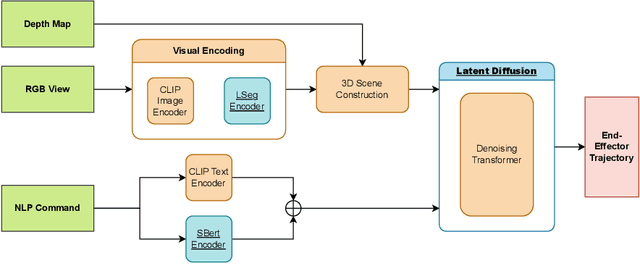
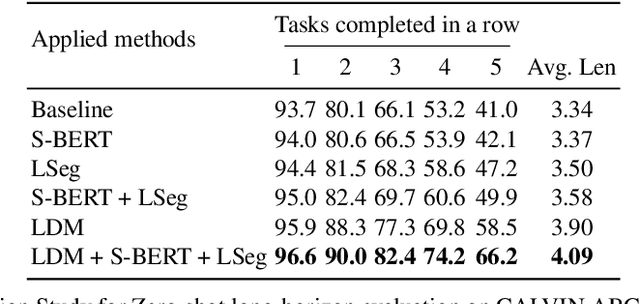
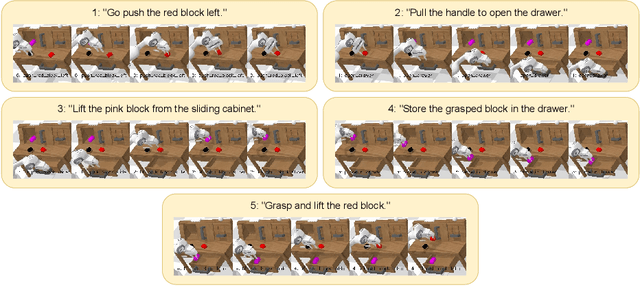
Acting in human environments is a crucial capability for general-purpose robots, necessitating a robust understanding of natural language and its application to physical tasks. This paper seeks to harness the capabilities of diffusion models within a visuomotor policy framework that merges visual and textual inputs to generate precise robotic trajectories. By employing reference demonstrations during training, the model learns to execute manipulation tasks specified through textual commands within the robot's immediate environment. The proposed research aims to extend an existing model by leveraging improved embeddings, and adapting techniques from diffusion models for image generation. We evaluate our methods on the CALVIN dataset, proving enhanced performance on various manipulation tasks and an increased long-horizon success rate when multiple tasks are executed in sequence. Our approach reinforces the usefulness of diffusion models and contributes towards general multitask manipulation.