 Add to Chrome
 Add to Firefox
 Add to Edge
ST-LoRA: Single Trajectory LoRA Ensemble for Uncertainty Aware Agricultural Segmentation
Aug 02, 2026
Reliable decision-support in digital agriculture requires accurate predictions and well-calibrated uncertainty estimates, particularly for dense prediction tasks such as semantic segmentation. Ensemble methods provide strong uncertainty quantification, but their computational and memory demands limit practical use, while single-model approximations often trade off uncertainty quality for efficiency. We propose ST-LoRA, a parameter-efficient ensemble framework that builds diverse ensemble members from a single training trajectory by combining Low-Rank Adaptation (LoRA) with snapshot ensembling. Each member shares a frozen pretrained backbone and differs only in lightweight low-rank adapters, reducing trainable parameters to under 10% of the full model while preserving ensemble diversity. We evaluate across two agricultural datasets - GrowliFlower-L (cauliflower, open field) and BUP20 (sweet pepper, glasshouse) - using SegFormer and Mask2Former, covering in-distribution performance, calibration under distribution shift, and out-of-distribution detection. Ablations show feed-forward layers, not attention layers, are the critical LoRA target for dense prediction, contrary to the attention-only convention from language models. ST-LoRA matches or exceeds full-rank ensembles in segmentation accuracy and calibration across both datasets and architectures, while substantially reducing training time, inference latency, memory footprint, and storage requirements. Against efficient baselines - Snapshot Ensemble, MC Dropout, and Deep Deterministic Uncertainty - ST-LoRA consistently matches or outperforms them in image/pixel-level OoD detection, calibration stability under shift, and cross-seed variance, with far fewer parameters and lower compute. These results show LoRA-efficient ensemble adaptation is a highly effective, practical approach for uncertainty-aware agricultural vision systems.

Forecasting the Number of Harvest-ready Fruits of Sweet Peppers Using Multimodal Time-Series Data
Jul 22, 2026Accurate yield forecasting at the individual-plant level is critical for precision agriculture and supply-chain planning, yet public datasets capturing both visual growth dynamics and per-plant measurement labels are scarce. In this paper, we introduce a novel, annotated image time-series dataset of 691 sweet pepper plants monitored over two growing seasons, comprising 4837 images with per-plant fruit counts categorized by maturity. We propose a multimodal deep learning framework that fuses high-dimensional image features, extracted using the DinoV3 encoder, with numerical count measurements. Our architecture utilizes a Long Short-Term Memory (LSTM) network to model temporal dependencies and handles irregular sampling intervals common in greenhouse monitoring. Through quantitative experiments, we demonstrate that this multimodal approach reduces RMSE over a persistence baseline by 33% and 38% in the 2022 and 2023 seasons, respectively, with a further 1.2% average gain over a measurement-only model. Furthermore, we employ Deep Ensembles and Gaussian Negative Log-Likelihood (NLL) to provide calibrated uncertainty estimates, with an Uncertainty Calibration Error (UCE) ranging from 0.39 to 0.89 depending on the cross-season evaluation direction, offering a principled confidence signal for real-world agricultural decision-making. We release the dataset and code to support reproducible research and to accelerate development of data-driven yield forecasting methods for horticultural crops.
Still image and spatial-temporal tomato data enabling detection, segmentation, tracking, and video-instance segmentation using strong and weak labels
Jul 16, 2026In this manuscript we release two datasets for visual sensing of tomato plants grown in commercial-like settings and acquired using a robot. The first is BUTom21 which consists of still images and manual annotations. The second is BUTom-ST21 which consists of video-based data and semi-automated annotations through AI-based methods, referred to as pseudo-labels. In both cases, we provide pixel-level labels for the ripeness of the fruit. The aim is to provide the research community a challenging set of real-world imagery to explore methods to sense and estimate the state of tomato plants and their fruit, which is an important horticultural crop. Importantly, the spatial-temporal dataset provides individual fruit count and ripeness information enabling researchers to push the boundaries of field-based phenotyping.
GemNav: Discrete-Token Visual Robot Navigation using a Multimodal Large Language Model
Jul 08, 2026Visual navigation policies built on large pretrained models have so far followed a common recipe: a dedicated visual encoder, a bespoke action head, and training on thousands of hours of cross-embodiment datasets. We ask whether this recipe is necessary. In this paper, we introduce GemNav, a visual robot navigation policy that adapts a frozen Multimodal Large Language Model (MLLM) for short-to-medium horizon waypoint navigation using Low-Rank Adaptation (LoRA) on the language tower alone, with no auxiliary visual encoder and no continuous regression head. Waypoints and categorical navigation signals share a single discrete token vocabulary generated by the language-model head, and a soft-decoded auxiliary loss recovers the metric structure that pure cross-entropy training discards. On a single 8.7-hour open corpus, roughly three orders of magnitude smaller than competing training sets, the policy transfers zero-shot to four physically distinct unseen environments and stops within 0.25-0.42m of the goal across 20 real-world trials covering an open carpark, an obstacle carpark, a long outdoor chemical yard, and an indoor warehouse. Conditioning on short image histories improves offline metrics but yields no robot benefit, pointing to a ceiling on what temporal context adds once pretrained vision features are in place. These results indicate that discrete-token adaptation of frozen MLLMs can provide a data-efficient, deployable alternative for foundation model robot navigation.
A Dataset and Benchmark for Shape Completion of Fruits for Agricultural Robotics
Jul 18, 2024As the population is expected to reach 10 billion by 2050, our agricultural production system needs to double its productivity despite a decline of human workforce in the agricultural sector. Autonomous robotic systems are one promising pathway to increase productivity by taking over labor-intensive manual tasks like fruit picking. To be effective, such systems need to monitor and interact with plants and fruits precisely, which is challenging due to the cluttered nature of agricultural environments causing, for example, strong occlusions. Thus, being able to estimate the complete 3D shapes of objects in presence of occlusions is crucial for automating operations such as fruit harvesting. In this paper, we propose the first publicly available 3D shape completion dataset for agricultural vision systems. We provide an RGB-D dataset for estimating the 3D shape of fruits. Specifically, our dataset contains RGB-D frames of single sweet peppers in lab conditions but also in a commercial greenhouse. For each fruit, we additionally collected high-precision point clouds that we use as ground truth. For acquiring the ground truth shape, we developed a measuring process that allows us to record data of real sweet pepper plants, both in the lab and in the greenhouse with high precision, and determine the shape of the sensed fruits. We release our dataset, consisting of almost 7000 RGB-D frames belonging to more than 100 different fruits. We provide segmented RGB-D frames, with camera instrinsics to easily obtain colored point clouds, together with the corresponding high-precision, occlusion-free point clouds obtained with a high-precision laser scanner. We additionally enable evaluation ofshape completion approaches on a hidden test set through a public challenge on a benchmark server.
BonnBot-I Plus: A Bio-diversity Aware Precise Weed Management Robotic Platform
May 15, 2024In this article, we focus on the critical tasks of plant protection in arable farms, addressing a modern challenge in agriculture: integrating ecological considerations into the operational strategy of precision weeding robots like \bbot. This article presents the recent advancements in weed management algorithms and the real-world performance of \bbot\ at the University of Bonn's Klein-Altendorf campus. We present a novel Rolling-view observation model for the BonnBot-Is weed monitoring section which leads to an average absolute weeding performance enhancement of $3.4\%$. Furthermore, for the first time, we show how precision weeding robots could consider bio-diversity-aware concerns in challenging weeding scenarios. We carried out comprehensive weeding experiments in sugar-beet fields, covering both weed-only and mixed crop-weed situations, and introduced a new dataset compatible with precision weeding. Our real-field experiments revealed that our weeding approach is capable of handling diverse weed distributions, with a minimal loss of only $11.66\%$ attributable to intervention planning and $14.7\%$ to vision system limitations highlighting required improvements of the vision system.
PAg-NeRF: Towards fast and efficient end-to-end panoptic 3D representations for agricultural robotics
Sep 11, 2023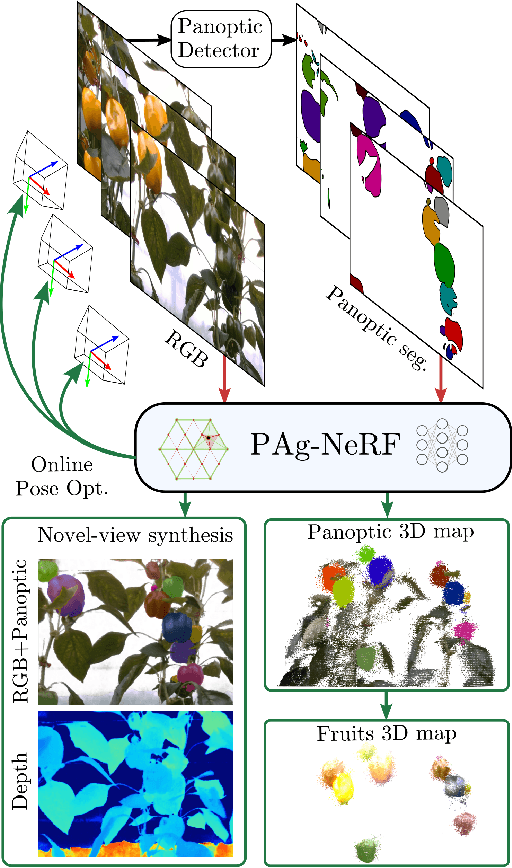
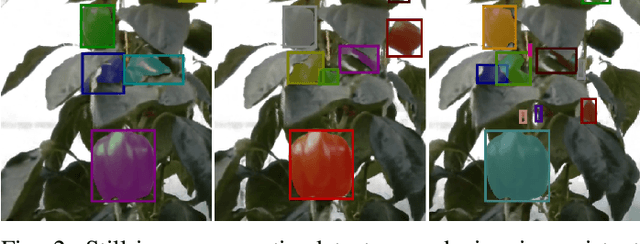
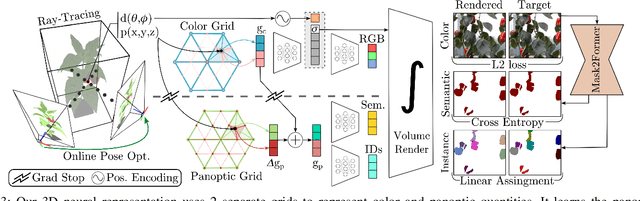
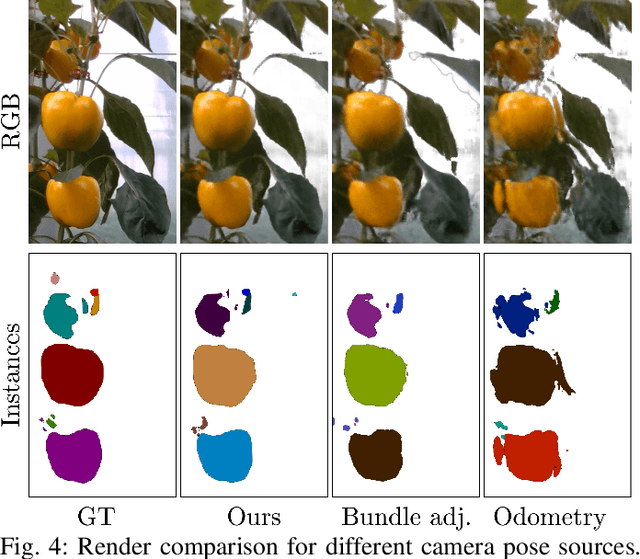
Precise scene understanding is key for most robot monitoring and intervention tasks in agriculture. In this work we present PAg-NeRF which is a novel NeRF-based system that enables 3D panoptic scene understanding. Our representation is trained using an image sequence with noisy robot odometry poses and automatic panoptic predictions with inconsistent IDs between frames. Despite this noisy input, our system is able to output scene geometry, photo-realistic renders and 3D consistent panoptic representations with consistent instance IDs. We evaluate this novel system in a very challenging horticultural scenario and in doing so demonstrate an end-to-end trainable system that can make use of noisy robot poses rather than precise poses that have to be pre-calculated. Compared to a baseline approach the peak signal to noise ratio is improved from 21.34dB to 23.37dB while the panoptic quality improves from 56.65% to 70.08%. Furthermore, our approach is faster and can be tuned to improve inference time by more than a factor of 2 while being memory efficient with approximately 12 times fewer parameters.
BonnBot-I: A Precise Weed Management and Crop Monitoring Platform
Jul 24, 2023Cultivation and weeding are two of the primary tasks performed by farmers today. A recent challenge for weeding is the desire to reduce herbicide and pesticide treatments while maintaining crop quality and quantity. In this paper we introduce BonnBot-I a precise weed management platform which can also performs field monitoring. Driven by crop monitoring approaches which can accurately locate and classify plants (weed and crop) we further improve their performance by fusing the platform available GNSS and wheel odometry. This improves tracking accuracy of our crop monitoring approach from a normalized average error of 8.3% to 3.5%, evaluated on a new publicly available corn dataset. We also present a novel arrangement of weeding tools mounted on linear actuators evaluated in simulated environments. We replicate weed distributions from a real field, using the results from our monitoring approach, and show the validity of our work-space division techniques which require significantly less movement (a 50% reduction) to achieve similar results. Overall, BonnBot-I is a significant step forward in precise weed management with a novel method of selectively spraying and controlling weeds in an arable field
Panoptic One-Click Segmentation: Applied to Agricultural Data
Mar 15, 2023In weed control, precision agriculture can help to greatly reduce the use of herbicides, resulting in both economical and ecological benefits. A key element is the ability to locate and segment all the plants from image data. Modern instance segmentation techniques can achieve this, however, training such systems requires large amounts of hand-labelled data which is expensive and laborious to obtain. Weakly supervised training can help to greatly reduce labelling efforts and costs. We propose panoptic one-click segmentation, an efficient and accurate offline tool to produce pseudo-labels from click inputs which reduces labelling effort. Our approach jointly estimates the pixel-wise location of all N objects in the scene, compared to traditional approaches which iterate independently through all N objects; this greatly reduces training time. Using just 10% of the data to train our panoptic one-click segmentation approach yields 68.1% and 68.8% mean object intersection over union (IoU) on challenging sugar beet and corn image data respectively, providing comparable performance to traditional one-click approaches while being approximately 12 times faster to train. We demonstrate the applicability of our system by generating pseudo-labels from clicks on the remaining 90% of the data. These pseudo-labels are then used to train Mask R-CNN, in a semi-supervised manner, improving the absolute performance (of mean foreground IoU) by 9.4 and 7.9 points for sugar beet and corn data respectively. Finally, we show that our technique can recover missed clicks during annotation outlining a further benefit over traditional approaches.
Panoptic Mapping with Fruit Completion and Pose Estimation for Horticultural Robots
Mar 15, 2023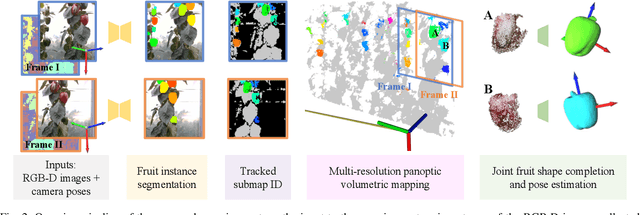
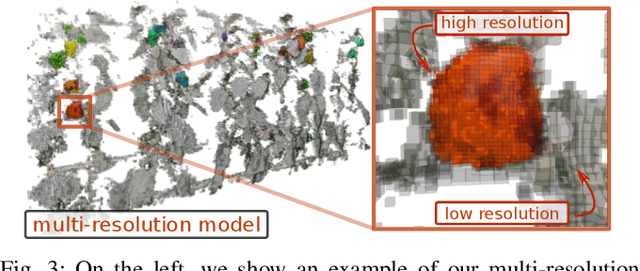
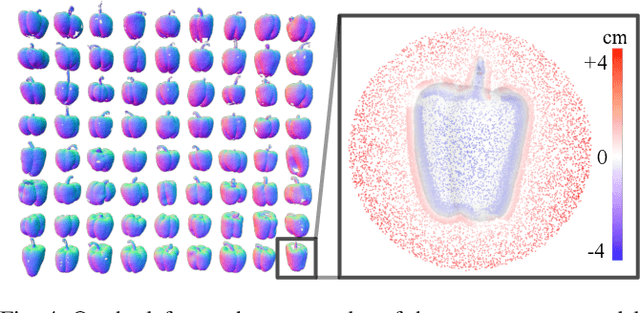
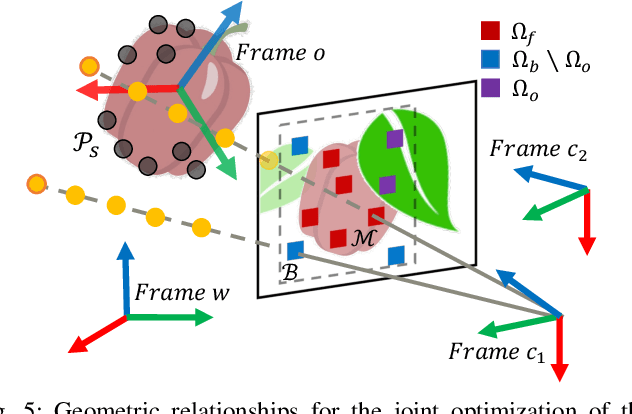
Monitoring plants and fruits at high resolution play a key role in the future of agriculture. Accurate 3D information can pave the way to a diverse number of robotic applications in agriculture ranging from autonomous harvesting to precise yield estimation. Obtaining such 3D information is non-trivial as agricultural environments are often repetitive and cluttered, and one has to account for the partial observability of fruit and plants. In this paper, we address the problem of jointly estimating complete 3D shapes of fruit and their pose in a 3D multi-resolution map built by a mobile robot. To this end, we propose an online multi-resolution panoptic mapping system where regions of interest are represented with a higher resolution. We exploit data to learn a general fruit shape representation that we use at inference time together with an occlusion-aware differentiable rendering pipeline to complete partial fruit observations and estimate the 7 DoF pose of each fruit in the map. The experiments presented in this paper, evaluated both in the controlled environment and in a commercial greenhouse, show that our novel algorithm yields higher completion and pose estimation accuracy than existing methods, with an improvement of 41% in completion accuracy and 52% in pose estimation accuracy while keeping a low inference time of 0.6s in average.