 Add to Chrome
 Add to Firefox
 Add to Edge
Forecasting the Number of Harvest-ready Fruits of Sweet Peppers Using Multimodal Time-Series Data
Jul 22, 2026
Accurate yield forecasting at the individual-plant level is critical for precision agriculture and supply-chain planning, yet public datasets capturing both visual growth dynamics and per-plant measurement labels are scarce. In this paper, we introduce a novel, annotated image time-series dataset of 691 sweet pepper plants monitored over two growing seasons, comprising 4837 images with per-plant fruit counts categorized by maturity. We propose a multimodal deep learning framework that fuses high-dimensional image features, extracted using the DinoV3 encoder, with numerical count measurements. Our architecture utilizes a Long Short-Term Memory (LSTM) network to model temporal dependencies and handles irregular sampling intervals common in greenhouse monitoring. Through quantitative experiments, we demonstrate that this multimodal approach reduces RMSE over a persistence baseline by 33% and 38% in the 2022 and 2023 seasons, respectively, with a further 1.2% average gain over a measurement-only model. Furthermore, we employ Deep Ensembles and Gaussian Negative Log-Likelihood (NLL) to provide calibrated uncertainty estimates, with an Uncertainty Calibration Error (UCE) ranging from 0.39 to 0.89 depending on the cross-season evaluation direction, offering a principled confidence signal for real-world agricultural decision-making. We release the dataset and code to support reproducible research and to accelerate development of data-driven yield forecasting methods for horticultural crops.

Still image and spatial-temporal tomato data enabling detection, segmentation, tracking, and video-instance segmentation using strong and weak labels
Jul 16, 2026In this manuscript we release two datasets for visual sensing of tomato plants grown in commercial-like settings and acquired using a robot. The first is BUTom21 which consists of still images and manual annotations. The second is BUTom-ST21 which consists of video-based data and semi-automated annotations through AI-based methods, referred to as pseudo-labels. In both cases, we provide pixel-level labels for the ripeness of the fruit. The aim is to provide the research community a challenging set of real-world imagery to explore methods to sense and estimate the state of tomato plants and their fruit, which is an important horticultural crop. Importantly, the spatial-temporal dataset provides individual fruit count and ripeness information enabling researchers to push the boundaries of field-based phenotyping.
PAg-NeRF: Towards fast and efficient end-to-end panoptic 3D representations for agricultural robotics
Sep 11, 2023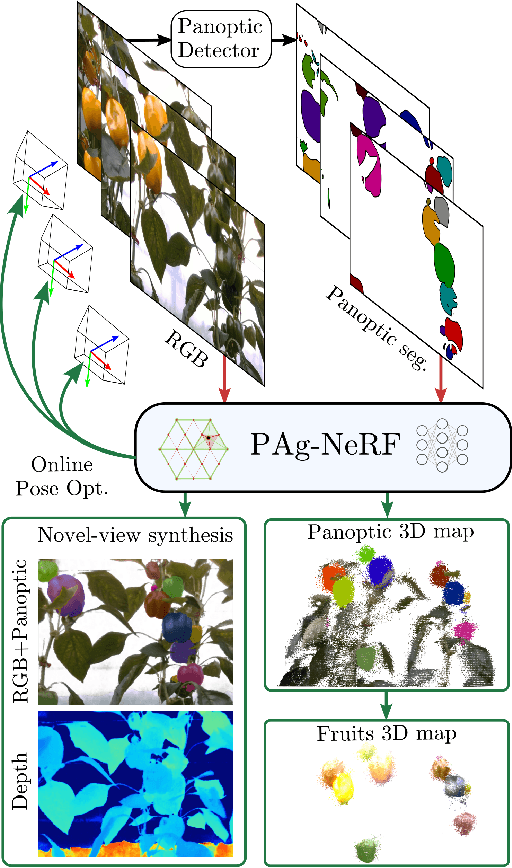
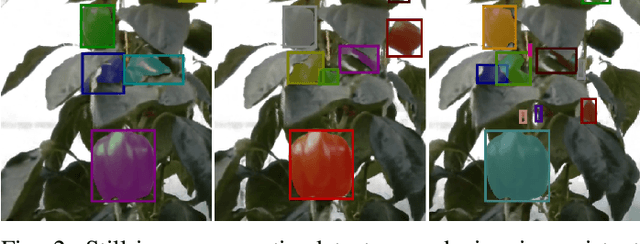
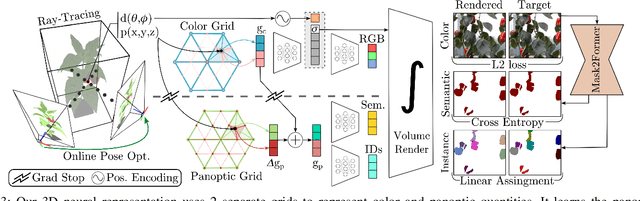
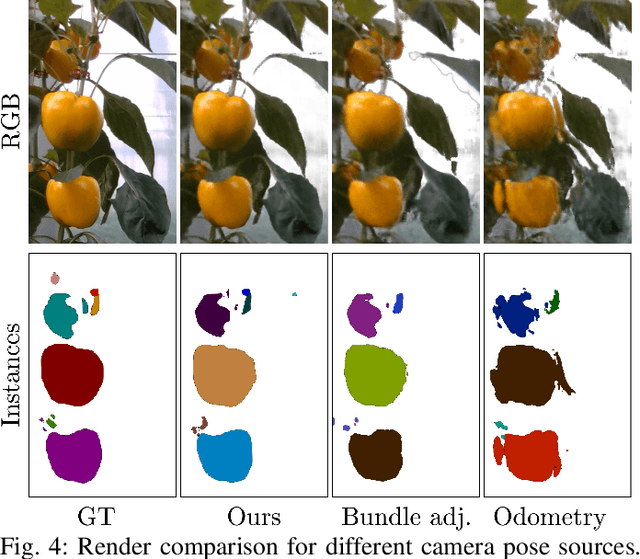
Precise scene understanding is key for most robot monitoring and intervention tasks in agriculture. In this work we present PAg-NeRF which is a novel NeRF-based system that enables 3D panoptic scene understanding. Our representation is trained using an image sequence with noisy robot odometry poses and automatic panoptic predictions with inconsistent IDs between frames. Despite this noisy input, our system is able to output scene geometry, photo-realistic renders and 3D consistent panoptic representations with consistent instance IDs. We evaluate this novel system in a very challenging horticultural scenario and in doing so demonstrate an end-to-end trainable system that can make use of noisy robot poses rather than precise poses that have to be pre-calculated. Compared to a baseline approach the peak signal to noise ratio is improved from 21.34dB to 23.37dB while the panoptic quality improves from 56.65% to 70.08%. Furthermore, our approach is faster and can be tuned to improve inference time by more than a factor of 2 while being memory efficient with approximately 12 times fewer parameters.