 Add to Chrome
 Add to Firefox
 Add to Edge
Training Therapeutic Judges and Multi-Agent Systems for Human-Aligned Mental Health Support
Jun 29, 2026
Large language models show promise for mental health support, yet therapeutic quality improves only when evaluation functions as an actionable control signal rather than a passive metric. We introduce a framework that formulates therapeutic response generation as a decision-refinement problem driven by multi-dimensional, human-aligned evaluation. In Stage I, we introduce TheraJudge, an open-source therapeutic evaluator trained via preference-based optimization on human-annotated data to produce reliable judgments across 7 psychological dimensions. In Stage II, we introduce TheraAgent, which operationalizes TheraJudge's evaluations through a coordinated refinement process with specialized Critic, Coach, and Therapist roles that translate evaluative signals into targeted response revisions. Empirically, TheraJudge achieves strong agreement with clinician ratings, with intraclass correlation coefficients (ICC = 0.87-0.95), surpassing supervised baselines and strong closed-source judges, particularly on critical dimensions such as Safety, Relevance, and Empathy. Acting on these evaluations, TheraAgent yields a +0.43 improvement in human-rated therapeutic quality (on a 5-point scale) under blind evaluation, with 96\% clinician inter-rater reliability. Low-quality responses ($\leq 3$) improve by +2.45 points with a 94\% recovery rate, demonstrating targeted correction of unsafe outputs. Overall, our results indicate that effective alignment of mental-health LLMs stems from acting on human-aligned evaluation, rather than relying solely on stronger generation. We release code at https://github.com/vis-nlp/TheraAlign.

DATAREEL: Automated Data-Driven Video Story Generation with Animations
Apr 28, 2026Data videos are a powerful medium for visual data based storytelling, combining animated, chart-centric visualizations with synchronized narration. Widely used in journalism, education, and public communication, they help audiences understand complex data through clear and engaging visual explanations. Despite their growing impact, generating data-driven video stories remains challenging, as it requires careful coordination of visual encoding, temporal progression, and narration and substantial expertise in visualization design, animation, and video-editing tools. Recent advances in large language models offer new opportunities to automate this process; however, there is currently no benchmark for rigorously evaluating models on animated visualization-based video storytelling. To address this gap, we introduce DataReel, a benchmark for automated data-driven video story generation comprising 328 real-world stories. Each story pairs structured data, a chart visualization, and a narration transcript, enabling systematic evaluation of models' abilities to generate animated data video stories. We further propose a multi-agent framework that decomposes the task into planning, generation, and verification stages, mirroring key aspects of the human storytelling process. Experiments show that this multi-agent approach outperforms direct prompting baselines under both automatic and human evaluations, while revealing persistent challenges in coordinating animation, narration, and visual emphasis. We release DataReel at https://github.com/vis-nlp/DataReel.
Lost in Translation: Do LVLM Judges Generalize Across Languages?
Apr 21, 2026Automatic evaluators such as reward models play a central role in the alignment and evaluation of large vision-language models (LVLMs). Despite their growing importance, these evaluators are almost exclusively assessed on English-centric benchmarks, leaving open the question of how well these evaluators generalize across languages. To answer this question, we introduce MM-JudgeBench, the first large-scale benchmark for multilingual and multimodal judge model evaluation, which includes over 60K pairwise preference instances spanning 25 typologically diverse languages. MM-JudgeBench integrates two complementary subsets: a general vision-language preference evaluation subset extending VL-RewardBench, and a chart-centric visual-text reasoning subset derived from OpenCQA, enabling systematic analysis of reward models (i.e., LVLM judges) across diverse settings. We additionally release a multilingual training set derived from MM-RewardBench, disjoint from our evaluation data, to support domain adaptation. By evaluating 22 LVLMs (15 open-source, 7 proprietary), we uncover substantial cross-lingual performance variance in our proposed benchmark. Our analysis further shows that model size and architecture are poor predictors of multilingual robustness, and that even state-of-the-art LVLM judges exhibit inconsistent behavior across languages. Together, these findings expose fundamental limitations of current reward modeling and underscore the necessity of multilingual, multimodal benchmarks for developing reliable automated evaluators.
Aligning Text, Code, and Vision: A Multi-Objective Reinforcement Learning Framework for Text-to-Visualization
Jan 08, 2026Text-to-Visualization (Text2Vis) systems translate natural language queries over tabular data into concise answers and executable visualizations. While closed-source LLMs generate functional code, the resulting charts often lack semantic alignment and clarity, qualities that can only be assessed post-execution. Open-source models struggle even more, frequently producing non-executable or visually poor outputs. Although supervised fine-tuning can improve code executability, it fails to enhance overall visualization quality, as traditional SFT loss cannot capture post-execution feedback. To address this gap, we propose RL-Text2Vis, the first reinforcement learning framework for Text2Vis generation. Built on Group Relative Policy Optimization (GRPO), our method uses a novel multi-objective reward that jointly optimizes textual accuracy, code validity, and visualization quality using post-execution feedback. By training Qwen2.5 models (7B and 14B), RL-Text2Vis achieves a 22% relative improvement in chart quality over GPT-4o on the Text2Vis benchmark and boosts code execution success from 78% to 97% relative to its zero-shot baseline. Our models significantly outperform strong zero-shot and supervised baselines and also demonstrate robust generalization to out-of-domain datasets like VIS-Eval and NVBench. These results establish GRPO as an effective strategy for structured, multimodal reasoning in visualization generation. We release our code at https://github.com/vis-nlp/RL-Text2Vis.
DashboardQA: Benchmarking Multimodal Agents for Question Answering on Interactive Dashboards
Aug 24, 2025Dashboards are powerful visualization tools for data-driven decision-making, integrating multiple interactive views that allow users to explore, filter, and navigate data. Unlike static charts, dashboards support rich interactivity, which is essential for uncovering insights in real-world analytical workflows. However, existing question-answering benchmarks for data visualizations largely overlook this interactivity, focusing instead on static charts. This limitation severely constrains their ability to evaluate the capabilities of modern multimodal agents designed for GUI-based reasoning. To address this gap, we introduce DashboardQA, the first benchmark explicitly designed to assess how vision-language GUI agents comprehend and interact with real-world dashboards. The benchmark includes 112 interactive dashboards from Tableau Public and 405 question-answer pairs with interactive dashboards spanning five categories: multiple-choice, factoid, hypothetical, multi-dashboard, and conversational. By assessing a variety of leading closed- and open-source GUI agents, our analysis reveals their key limitations, particularly in grounding dashboard elements, planning interaction trajectories, and performing reasoning. Our findings indicate that interactive dashboard reasoning is a challenging task overall for all the VLMs evaluated. Even the top-performing agents struggle; for instance, the best agent based on Gemini-Pro-2.5 achieves only 38.69% accuracy, while the OpenAI CUA agent reaches just 22.69%, demonstrating the benchmark's significant difficulty. We release DashboardQA at https://github.com/vis-nlp/DashboardQA
Judging the Judges: Can Large Vision-Language Models Fairly Evaluate Chart Comprehension and Reasoning?
May 13, 2025Charts are ubiquitous as they help people understand and reason with data. Recently, various downstream tasks, such as chart question answering, chart2text, and fact-checking, have emerged. Large Vision-Language Models (LVLMs) show promise in tackling these tasks, but their evaluation is costly and time-consuming, limiting real-world deployment. While using LVLMs as judges to assess the chart comprehension capabilities of other LVLMs could streamline evaluation processes, challenges like proprietary datasets, restricted access to powerful models, and evaluation costs hinder their adoption in industrial settings. To this end, we present a comprehensive evaluation of 13 open-source LVLMs as judges for diverse chart comprehension and reasoning tasks. We design both pairwise and pointwise evaluation tasks covering criteria like factual correctness, informativeness, and relevancy. Additionally, we analyze LVLM judges based on format adherence, positional consistency, length bias, and instruction-following. We focus on cost-effective LVLMs (<10B parameters) suitable for both research and commercial use, following a standardized evaluation protocol and rubric to measure the LVLM judge's accuracy. Experimental results reveal notable variability: while some open LVLM judges achieve GPT-4-level evaluation performance (about 80% agreement with GPT-4 judgments), others struggle (below ~10% agreement). Our findings highlight that state-of-the-art open-source LVLMs can serve as cost-effective automatic evaluators for chart-related tasks, though biases such as positional preference and length bias persist.
ChartQAPro: A More Diverse and Challenging Benchmark for Chart Question Answering
Apr 10, 2025Charts are ubiquitous, as people often use them to analyze data, answer questions, and discover critical insights. However, performing complex analytical tasks with charts requires significant perceptual and cognitive effort. Chart Question Answering (CQA) systems automate this process by enabling models to interpret and reason with visual representations of data. However, existing benchmarks like ChartQA lack real-world diversity and have recently shown performance saturation with modern large vision-language models (LVLMs). To address these limitations, we introduce ChartQAPro, a new benchmark that includes 1,341 charts from 157 diverse sources, spanning various chart types, including infographics and dashboards, and featuring 1,948 questions in various types, such as multiple-choice, conversational, hypothetical, and unanswerable questions, to better reflect real-world challenges. Our evaluations with 21 models show a substantial performance drop for LVLMs on ChartQAPro; e.g., Claude Sonnet 3.5 scores 90.5% on ChartQA but only 55.81% on ChartQAPro, underscoring the complexity of chart reasoning. We complement our findings with detailed error analyses and ablation studies, identifying key challenges and opportunities for advancing LVLMs in chart understanding and reasoning. We release ChartQAPro at https://github.com/vis-nlp/ChartQAPro.
AlignVLM: Bridging Vision and Language Latent Spaces for Multimodal Understanding
Feb 03, 2025
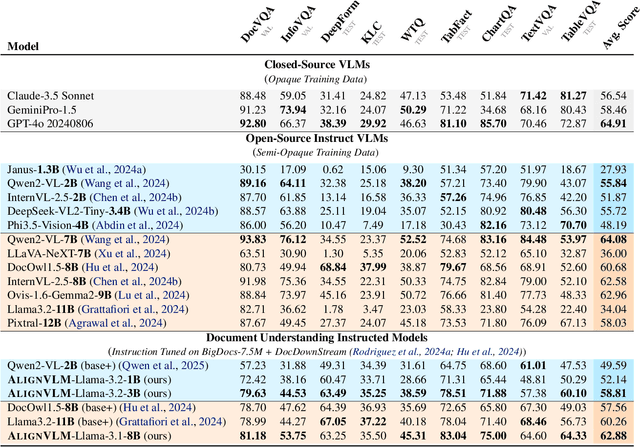

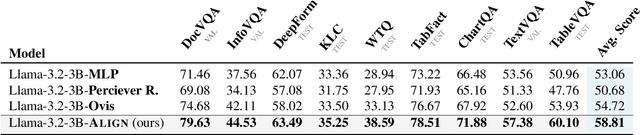
Aligning visual features with language embeddings is a key challenge in vision-language models (VLMs). The performance of such models hinges on having a good connector that maps visual features generated by a vision encoder to a shared embedding space with the LLM while preserving semantic similarity. Existing connectors, such as multilayer perceptrons (MLPs), often produce out-of-distribution or noisy inputs, leading to misalignment between the modalities. In this work, we propose a novel vision-text alignment method, AlignVLM, that maps visual features to a weighted average of LLM text embeddings. Our approach leverages the linguistic priors encoded by the LLM to ensure that visual features are mapped to regions of the space that the LLM can effectively interpret. AlignVLM is particularly effective for document understanding tasks, where scanned document images must be accurately mapped to their textual content. Our extensive experiments show that AlignVLM achieves state-of-the-art performance compared to prior alignment methods. We provide further analysis demonstrating improved vision-text feature alignment and robustness to noise.
Open-RAG: Enhanced Retrieval-Augmented Reasoning with Open-Source Large Language Models
Oct 02, 2024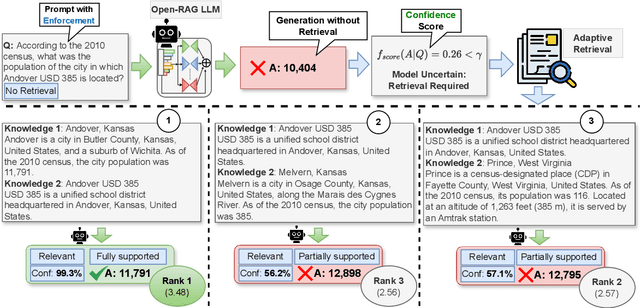
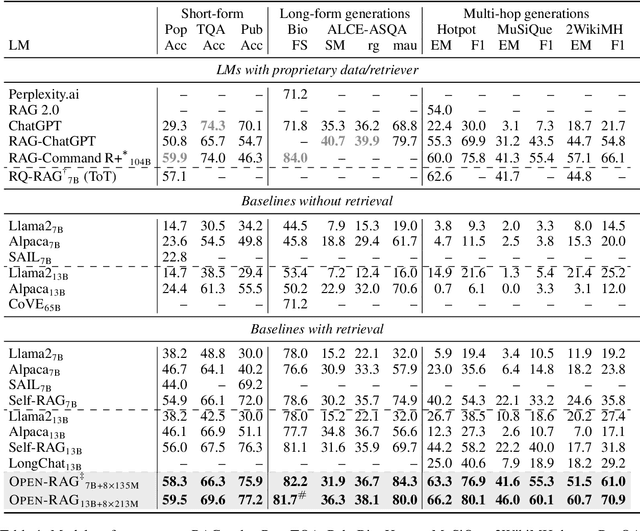
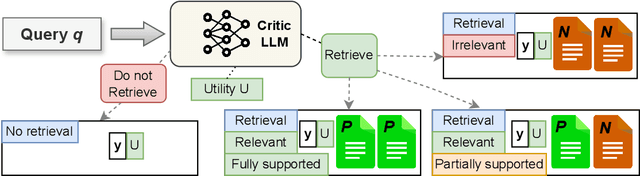
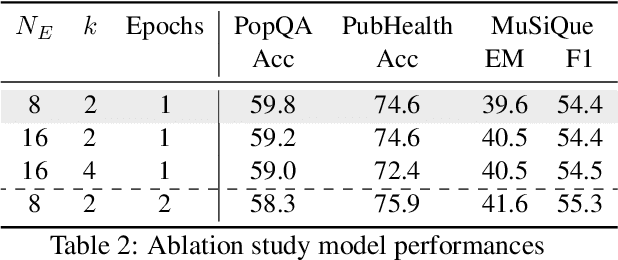
Retrieval-Augmented Generation (RAG) has been shown to enhance the factual accuracy of Large Language Models (LLMs), but existing methods often suffer from limited reasoning capabilities in effectively using the retrieved evidence, particularly when using open-source LLMs. To mitigate this gap, we introduce a novel framework, Open-RAG, designed to enhance reasoning capabilities in RAG with open-source LLMs. Our framework transforms an arbitrary dense LLM into a parameter-efficient sparse mixture of experts (MoE) model capable of handling complex reasoning tasks, including both single- and multi-hop queries. Open-RAG uniquely trains the model to navigate challenging distractors that appear relevant but are misleading. As a result, Open-RAG leverages latent learning, dynamically selecting relevant experts and integrating external knowledge effectively for more accurate and contextually relevant responses. In addition, we propose a hybrid adaptive retrieval method to determine retrieval necessity and balance the trade-off between performance gain and inference speed. Experimental results show that the Llama2-7B-based Open-RAG outperforms state-of-the-art LLMs and RAG models such as ChatGPT, Self-RAG, and Command R+ in various knowledge-intensive tasks. We open-source our code and models at https://openragmoe.github.io/
Natural Language Generation for Visualizations: State of the Art, Challenges and Future Directions
Sep 29, 2024Natural language and visualization are two complementary modalities of human communication that play a crucial role in conveying information effectively. While visualizations help people discover trends, patterns, and anomalies in data, natural language descriptions help explain these insights. Thus, combining text with visualizations is a prevalent technique for effectively delivering the core message of the data. Given the rise of natural language generation (NLG), there is a growing interest in automatically creating natural language descriptions for visualizations, which can be used as chart captions, answering questions about charts, or telling data-driven stories. In this survey, we systematically review the state of the art on NLG for visualizations and introduce a taxonomy of the problem. The NLG tasks fall within the domain of Natural Language Interfaces (NLI) for visualization, an area that has garnered significant attention from both the research community and industry. To narrow down the scope of the survey, we primarily concentrate on the research works that focus on text generation for visualizations. To characterize the NLG problem and the design space of proposed solutions, we pose five Wh-questions, why and how NLG tasks are performed for visualizations, what the task inputs and outputs are, as well as where and when the generated texts are integrated with visualizations. We categorize the solutions used in the surveyed papers based on these "five Wh-questions." Finally, we discuss the key challenges and potential avenues for future research in this domain.