 Add to Chrome
 Add to Firefox
 Add to Edge
DATAREEL: Automated Data-Driven Video Story Generation with Animations
Apr 28, 2026
Data videos are a powerful medium for visual data based storytelling, combining animated, chart-centric visualizations with synchronized narration. Widely used in journalism, education, and public communication, they help audiences understand complex data through clear and engaging visual explanations. Despite their growing impact, generating data-driven video stories remains challenging, as it requires careful coordination of visual encoding, temporal progression, and narration and substantial expertise in visualization design, animation, and video-editing tools. Recent advances in large language models offer new opportunities to automate this process; however, there is currently no benchmark for rigorously evaluating models on animated visualization-based video storytelling. To address this gap, we introduce DataReel, a benchmark for automated data-driven video story generation comprising 328 real-world stories. Each story pairs structured data, a chart visualization, and a narration transcript, enabling systematic evaluation of models' abilities to generate animated data video stories. We further propose a multi-agent framework that decomposes the task into planning, generation, and verification stages, mirroring key aspects of the human storytelling process. Experiments show that this multi-agent approach outperforms direct prompting baselines under both automatic and human evaluations, while revealing persistent challenges in coordinating animation, narration, and visual emphasis. We release DataReel at https://github.com/vis-nlp/DataReel.

VisionTrap: Unanswerable Questions On Visual Data
Jul 23, 2025Visual Question Answering (VQA) has been a widely studied topic, with extensive research focusing on how VLMs respond to answerable questions based on real-world images. However, there has been limited exploration of how these models handle unanswerable questions, particularly in cases where they should abstain from providing a response. This research investigates VQA performance on unrealistically generated images or asking unanswerable questions, assessing whether models recognize the limitations of their knowledge or attempt to generate incorrect answers. We introduced a dataset, VisionTrap, comprising three categories of unanswerable questions across diverse image types: (1) hybrid entities that fuse objects and animals, (2) objects depicted in unconventional or impossible scenarios, and (3) fictional or non-existent figures. The questions posed are logically structured yet inherently unanswerable, testing whether models can correctly recognize their limitations. Our findings highlight the importance of incorporating such questions into VQA benchmarks to evaluate whether models tend to answer, even when they should abstain.
When Not to Answer: Evaluating Prompts on GPT Models for Effective Abstention in Unanswerable Math Word Problems
Oct 16, 2024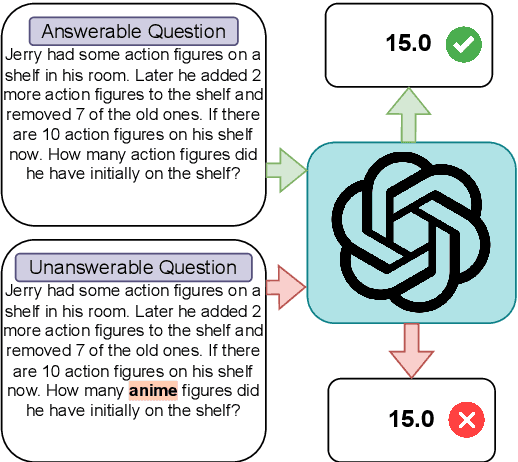
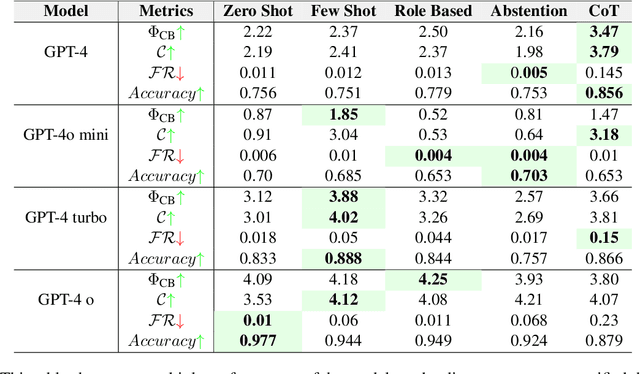
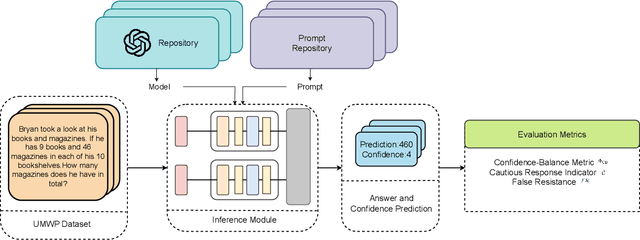

Large language models (LLMs) are increasingly relied upon to solve complex mathematical word problems. However, being susceptible to hallucination, they may generate inaccurate results when presented with unanswerable questions, raising concerns about their potential harm. While GPT models are now widely used and trusted, the exploration of how they can effectively abstain from answering unanswerable math problems and the enhancement of their abstention capabilities has not been rigorously investigated. In this paper, we investigate whether GPTs can appropriately respond to unanswerable math word problems by applying prompts typically used in solvable mathematical scenarios. Our experiments utilize the Unanswerable Word Math Problem (UWMP) dataset, directly leveraging GPT model APIs. Evaluation metrics are introduced, which integrate three key factors: abstention, correctness and confidence. Our findings reveal critical gaps in GPT models and the hallucination it suffers from for unsolvable problems, highlighting the need for improved models capable of better managing uncertainty and complex reasoning in math word problem-solving contexts.