 Add to Chrome
 Add to Firefox
 Add to Edge
Diversify Diffusion with Temperature Sampling and Variance-Corrective Time Shifting
Jul 12, 2026
Diffusion models faithfully reproduce their training distribution, but also inherit its imbalances and leave rare or under-represented modes hard to reach. A natural inference-time remedy is to sample from the high-temperature target $p^{(γ)}_0(x) \propto p_0(x)^γ$ for $0 < γ< 1$, which flattens dominant modes and lifts rare ones. However, naive score scaling while correctly reweighting modes also inflates the per-mode variance, breaking the reverse diffusion process and degrading sample quality. We introduce variance-corrective time shifting, a training-free fix that queries the network at a shifted timestep and scales the resulting score by $γ$, canceling the variance inflation while preserving the mode reweighting. The correction turns simple temperature sampling into a practical diversity knob for pretrained diffusion and flow-matching backbones with no retraining, and we demonstrate consistent gains at minimal cost to sample quality and condition fidelity across DiT, Stable Diffusion and Motion Diffusion models. We further show that the timing of the temperature intervention enables coarse-to-fine control: high-noise stages drive compositional diversity across modes, while low-noise stages drive local appearance variation under a fixed composition.

DCGrasp: Distance-aware Controllable Grasp Generation
Jun 29, 2026Generating 3D hand-object interactions is essential for applications in robotics, XR, and synthetic data generation, where flexible controllability and strong generalization to diverse object geometries are required. However, existing methods rarely satisfy these requirements, limiting their practical applicability. We present DCGrasp, a distance-aware controllable grasp generation system built on a novel grasp energy term. This term computes Distance Profile, a signed distance from each hand vertex to the nearest object point, coupled with distance-aware weighting, effectively capturing the semantically similar hand-object interaction in near-contact regions while remaining invariant to object and hand identity. Given various controllable signals, DCGrasp first generates a Distance Profile based on a Diffusion Transformer, together with a corresponding candidate hand pose. We then refine the candidate pose through optimization, enforcing consistency between the optimized hand pose and the generated Distance Profile in near-contact regions. Our experiments show that DCGrasp produces high-quality, physically plausible grasps with flexible user control, generalizing to diverse object and hand shapes and scales. Our work establishes a robust and versatile pipeline for the synthesis of controllable 3D hand-object interactions.
VEPHand: View-Efficient Photometric Hand Performance Capture at Scale
Jun 18, 2026Robust, high-fidelity 3D hand capture, while fundamental to digital human creation, remains challenging with practical multi-view systems that balance rich photometry with the geometric ambiguities of reconstruction arising from limited viewpoint density. This paper presents an end-to-end pipeline for dynamic hand performance capture and registration, specifically designed for view-efficient setups ($\sim$20 views). We address key challenges with two primary innovations. First, to overcome reconstruction difficulties like limited view overlap and background clutter, our mask-free neural method robustly extracts detailed hand geometry and appearance from unmasked images using scene parameterization and scenario-specific density regularization. Second, addressing registration challenges such as accurately capturing non-linear skin deformations and ensuring plausible results during severe self-contact, we propose a physics-inspired framework. It aligns reconstructions to a personalized hand model by optimizing intrinsic volumetric offsets within its canonical tetrahedral mesh, alongside pose parameters. This approach, supported by robust losses and optimization, captures fine surface deformations, ensures plausible results under severe articulation and self-contact, and demonstrates strong tolerance to input noise. We demonstrate the scalability and robustness of our automated pipeline on an extensive dataset of over 12,000 sequences, from which we also derive a large-scale, high-quality synthetic 2D/3D hand dataset for training downstream tasks. This showcases its effectiveness for single hands, intricate two-hand interactions, and natural hand-object manipulations. Our method achieves state-of-the-art reconstruction fidelity in view-efficient, unmasked scenarios and highly accurate registration. Our project page are available at https://vephand.github.io/.
ECHO: Ego-Centric modeling of Human-Object interactions
Aug 29, 2025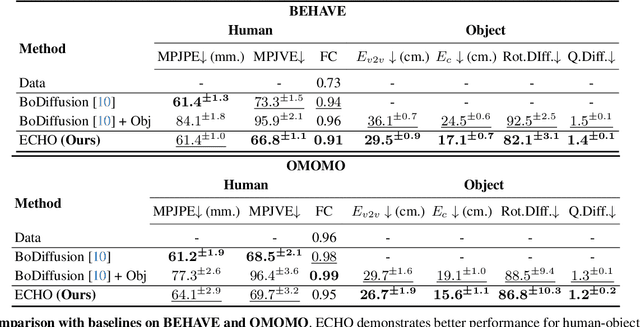
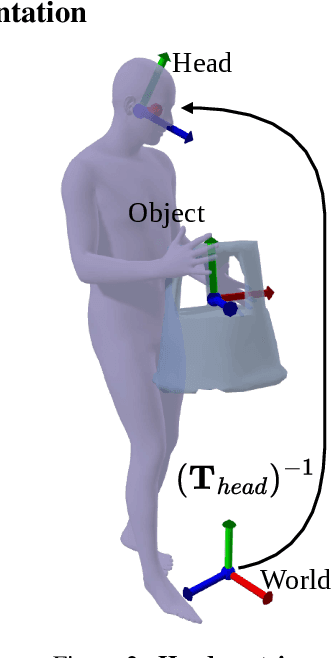
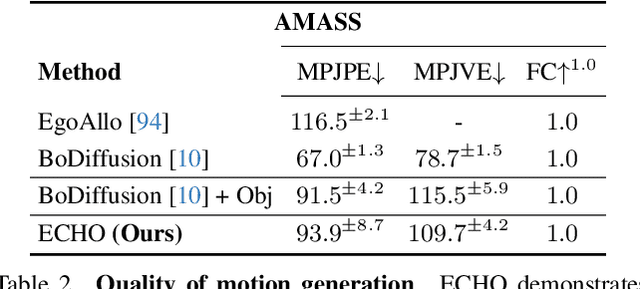
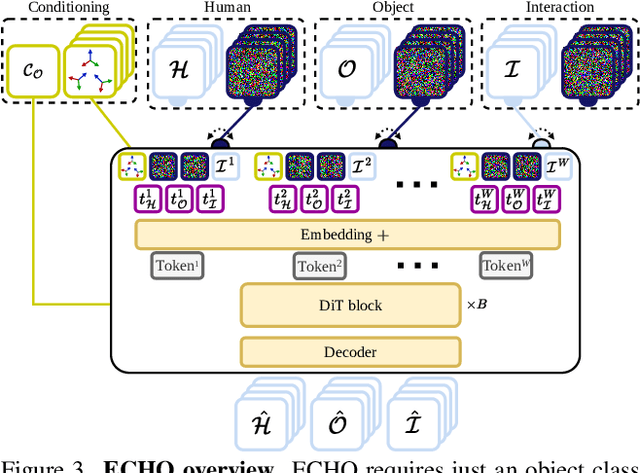
Modeling human-object interactions (HOI) from an egocentric perspective is a largely unexplored yet important problem due to the increasing adoption of wearable devices, such as smart glasses and watches. We investigate how much information about interaction can be recovered from only head and wrists tracking. Our answer is ECHO (Ego-Centric modeling of Human-Object interactions), which, for the first time, proposes a unified framework to recover three modalities: human pose, object motion, and contact from such minimal observation. ECHO employs a Diffusion Transformer architecture and a unique three-variate diffusion process, which jointly models human motion, object trajectory, and contact sequence, allowing for flexible input configurations. Our method operates in a head-centric canonical space, enhancing robustness to global orientation. We propose a conveyor-based inference, which progressively increases the diffusion timestamp with the frame position, allowing us to process sequences of any length. Through extensive evaluation, we demonstrate that ECHO outperforms existing methods that do not offer the same flexibility, setting a state-of-the-art in egocentric HOI reconstruction.
Optimizing Diffusion Noise Can Serve As Universal Motion Priors
Dec 19, 2023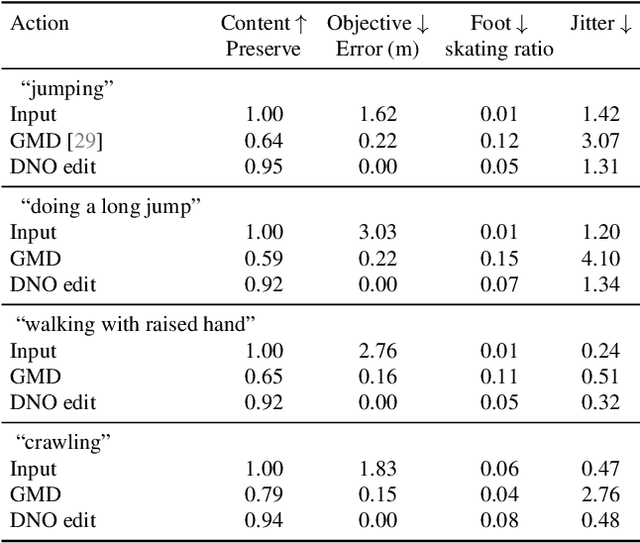
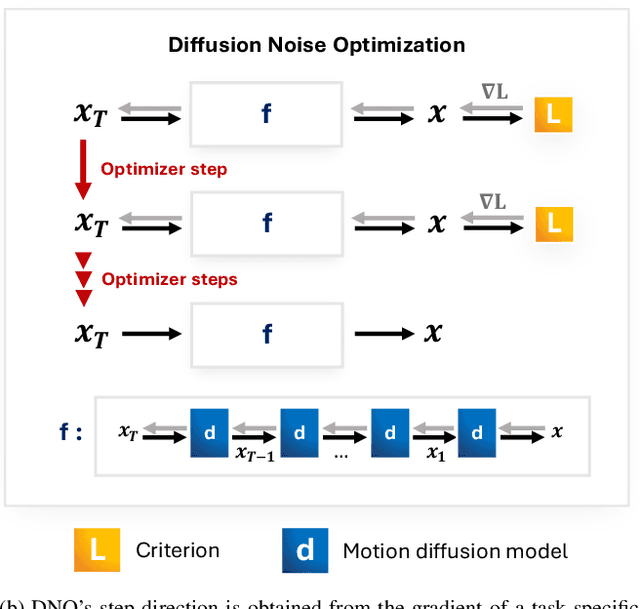
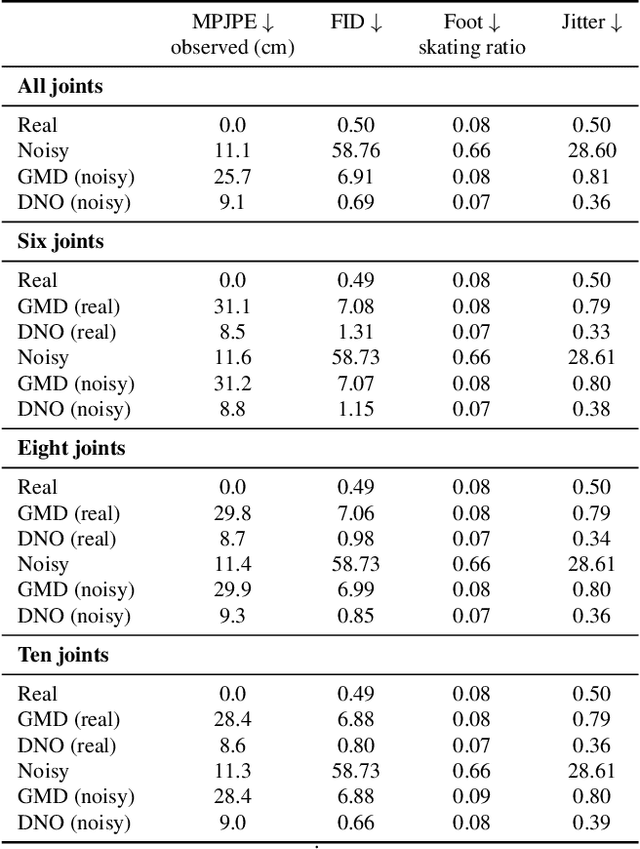
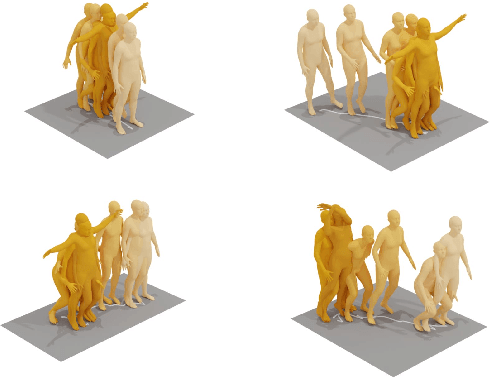
We propose Diffusion Noise Optimization (DNO), a new method that effectively leverages existing motion diffusion models as motion priors for a wide range of motion-related tasks. Instead of training a task-specific diffusion model for each new task, DNO operates by optimizing the diffusion latent noise of an existing pre-trained text-to-motion model. Given the corresponding latent noise of a human motion, it propagates the gradient from the target criteria defined on the motion space through the whole denoising process to update the diffusion latent noise. As a result, DNO supports any use cases where criteria can be defined as a function of motion. In particular, we show that, for motion editing and control, DNO outperforms existing methods in both achieving the objective and preserving the motion content. DNO accommodates a diverse range of editing modes, including changing trajectory, pose, joint locations, or avoiding newly added obstacles. In addition, DNO is effective in motion denoising and completion, producing smooth and realistic motion from noisy and partial inputs. DNO achieves these results at inference time without the need for model retraining, offering great versatility for any defined reward or loss function on the motion representation.
Physically Plausible Full-Body Hand-Object Interaction Synthesis
Sep 14, 2023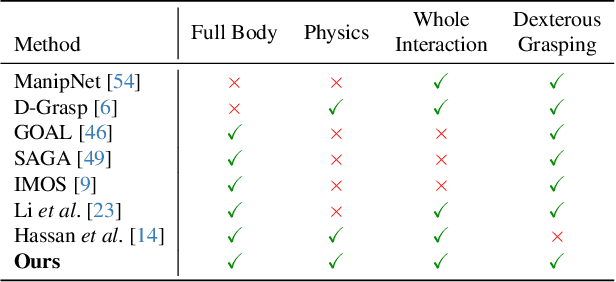
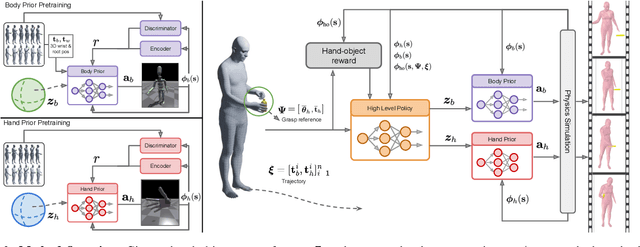
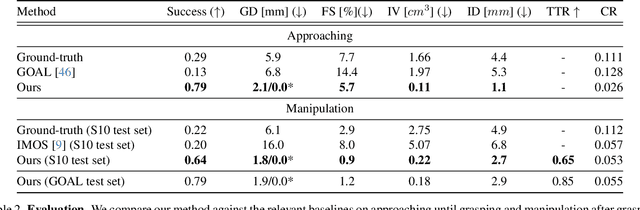

We propose a physics-based method for synthesizing dexterous hand-object interactions in a full-body setting. While recent advancements have addressed specific facets of human-object interactions, a comprehensive physics-based approach remains a challenge. Existing methods often focus on isolated segments of the interaction process and rely on data-driven techniques that may result in artifacts. In contrast, our proposed method embraces reinforcement learning (RL) and physics simulation to mitigate the limitations of data-driven approaches. Through a hierarchical framework, we first learn skill priors for both body and hand movements in a decoupled setting. The generic skill priors learn to decode a latent skill embedding into the motion of the underlying part. A high-level policy then controls hand-object interactions in these pretrained latent spaces, guided by task objectives of grasping and 3D target trajectory following. It is trained using a novel reward function that combines an adversarial style term with a task reward, encouraging natural motions while fulfilling the task incentives. Our method successfully accomplishes the complete interaction task, from approaching an object to grasping and subsequent manipulation. We compare our approach against kinematics-based baselines and show that it leads to more physically plausible motions.
Reconstructing Action-Conditioned Human-Object Interactions Using Commonsense Knowledge Priors
Sep 06, 2022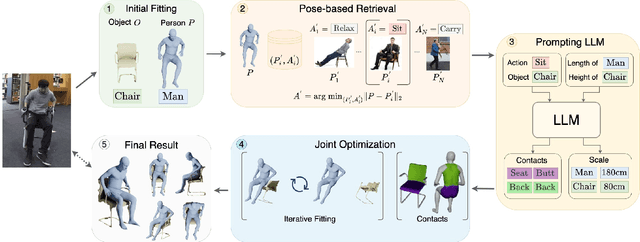
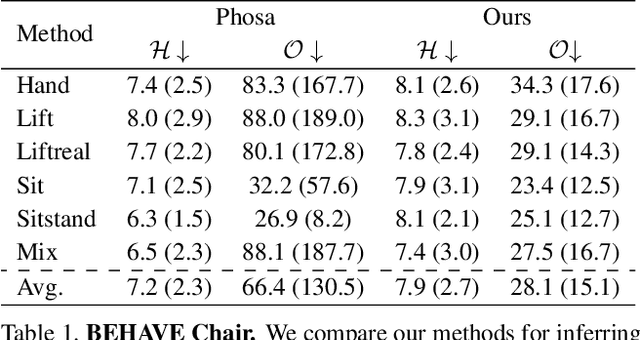
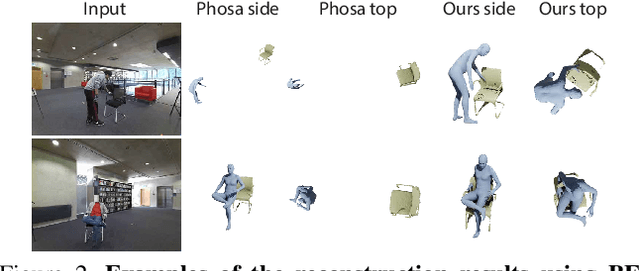
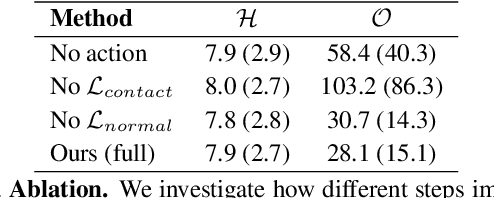
We present a method for inferring diverse 3D models of human-object interactions from images. Reasoning about how humans interact with objects in complex scenes from a single 2D image is a challenging task given ambiguities arising from the loss of information through projection. In addition, modeling 3D interactions requires the generalization ability towards diverse object categories and interaction types. We propose an action-conditioned modeling of interactions that allows us to infer diverse 3D arrangements of humans and objects without supervision on contact regions or 3D scene geometry. Our method extracts high-level commonsense knowledge from large language models (such as GPT-3), and applies them to perform 3D reasoning of human-object interactions. Our key insight is priors extracted from large language models can help in reasoning about human-object contacts from textural prompts only. We quantitatively evaluate the inferred 3D models on a large human-object interaction dataset and show how our method leads to better 3D reconstructions. We further qualitatively evaluate the effectiveness of our method on real images and demonstrate its generalizability towards interaction types and object categories.
LiP-Flow: Learning Inference-time Priors for Codec Avatars via Normalizing Flows in Latent Space
Mar 15, 2022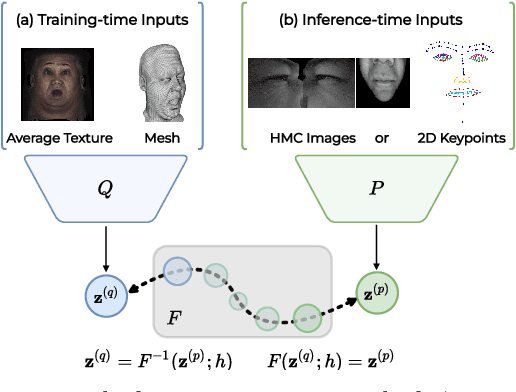
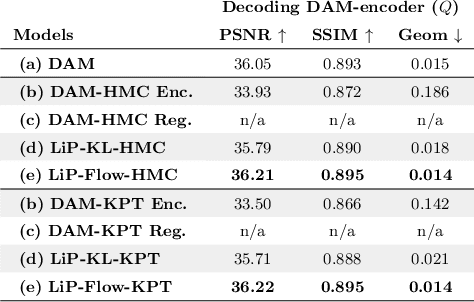
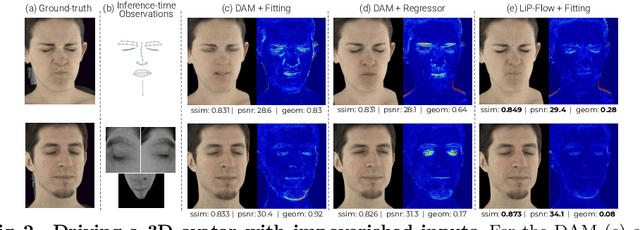
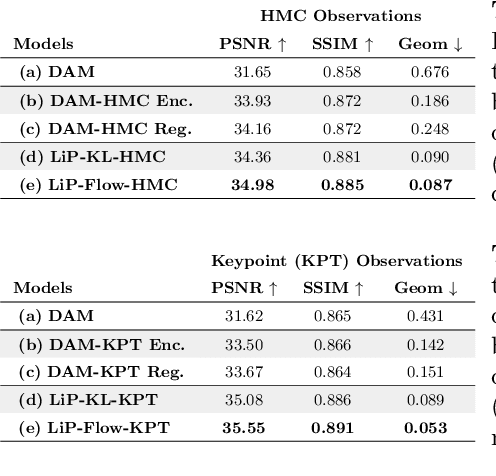
Neural face avatars that are trained from multi-view data captured in camera domes can produce photo-realistic 3D reconstructions. However, at inference time, they must be driven by limited inputs such as partial views recorded by headset-mounted cameras or a front-facing camera, and sparse facial landmarks. To mitigate this asymmetry, we introduce a prior model that is conditioned on the runtime inputs and tie this prior space to the 3D face model via a normalizing flow in the latent space. Our proposed model, LiP-Flow, consists of two encoders that learn representations from the rich training-time and impoverished inference-time observations. A normalizing flow bridges the two representation spaces and transforms latent samples from one domain to another, allowing us to define a latent likelihood objective. We trained our model end-to-end to maximize the similarity of both representation spaces and the reconstruction quality, making the 3D face model aware of the limited driving signals. We conduct extensive evaluations where the latent codes are optimized to reconstruct 3D avatars from partial or sparse observations. We show that our approach leads to an expressive and effective prior, capturing facial dynamics and subtle expressions better.
D-Grasp: Physically Plausible Dynamic Grasp Synthesis for Hand-Object Interactions
Dec 01, 2021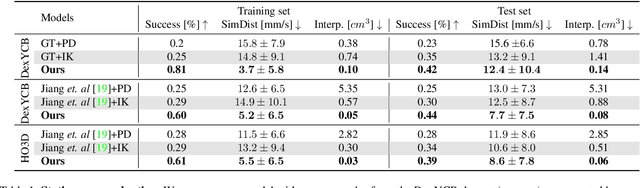
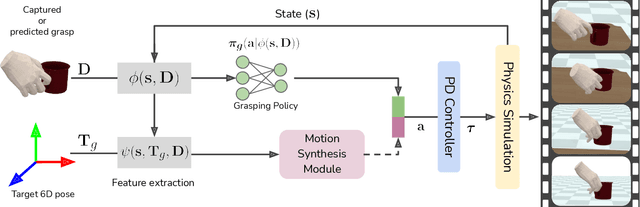
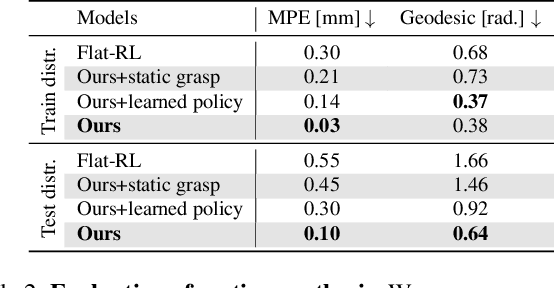
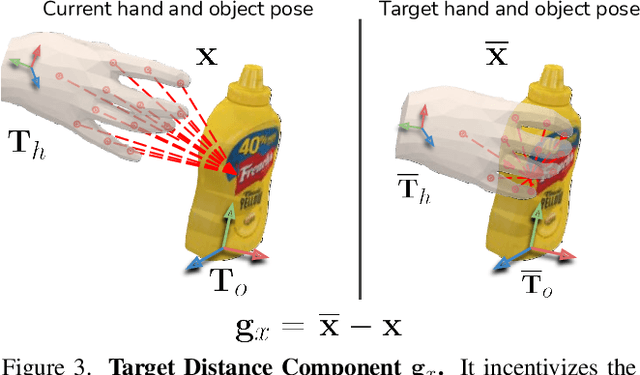
We introduce the dynamic grasp synthesis task: given an object with a known 6D pose and a grasp reference, our goal is to generate motions that move the object to a target 6D pose. This is challenging, because it requires reasoning about the complex articulation of the human hand and the intricate physical interaction with the object. We propose a novel method that frames this problem in the reinforcement learning framework and leverages a physics simulation, both to learn and to evaluate such dynamic interactions. A hierarchical approach decomposes the task into low-level grasping and high-level motion synthesis. It can be used to generate novel hand sequences that approach, grasp, and move an object to a desired location, while retaining human-likeness. We show that our approach leads to stable grasps and generates a wide range of motions. Furthermore, even imperfect labels can be corrected by our method to generate dynamic interaction sequences. Video is available at https://eth-ait.github.io/d-grasp/ .
Convolutional Autoencoders for Human Motion Infilling
Oct 22, 2020
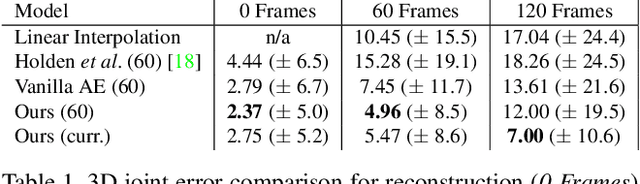
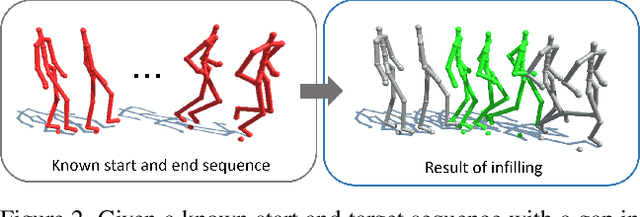
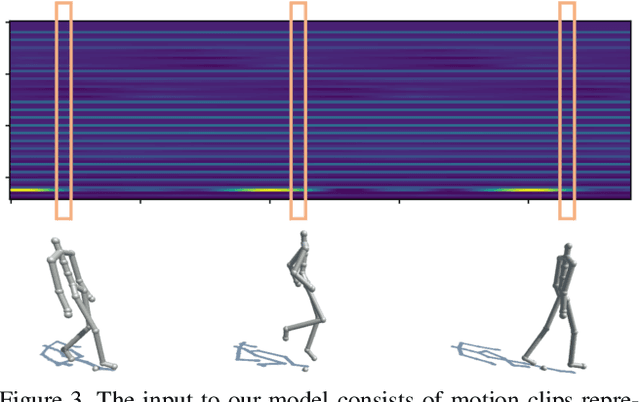
In this paper we propose a convolutional autoencoder to address the problem of motion infilling for 3D human motion data. Given a start and end sequence, motion infilling aims to complete the missing gap in between, such that the filled in poses plausibly forecast the start sequence and naturally transition into the end sequence. To this end, we propose a single, end-to-end trainable convolutional autoencoder. We show that a single model can be used to create natural transitions between different types of activities. Furthermore, our method is not only able to fill in entire missing frames, but it can also be used to complete gaps where partial poses are available (e.g. from end effectors), or to clean up other forms of noise (e.g. Gaussian). Also, the model can fill in an arbitrary number of gaps that potentially vary in length. In addition, no further post-processing on the model's outputs is necessary such as smoothing or closing discontinuities at the end of the gap. At the heart of our approach lies the idea to cast motion infilling as an inpainting problem and to train a convolutional de-noising autoencoder on image-like representations of motion sequences. At training time, blocks of columns are removed from such images and we ask the model to fill in the gaps. We demonstrate the versatility of the approach via a number of complex motion sequences and report on thorough evaluations performed to better understand the capabilities and limitations of the proposed approach.