 Add to Chrome
 Add to Firefox
 Add to Edge
GoT-CD: Graph-of-Thoughts Causal Discovery and the Fragility of Post-hoc Path-Specific Fairness Audits
Aug 03, 2026
Causal discovery recovers directed structure from observational data and is increasingly used in clinical settings to support mechanism reasoning and fairness audits of predictive models. Path-specific counterfactual fairness asks whether a protected attribute influences an outcome through illegitimate pathways, but these estimands are defined relative to a supplied causal graph and therefore inherit whatever errors the discovery step introduces. Discovery methods are routinely scored on aggregate structural metrics that weight all edges equally, and no established evaluation asks whether the specific pathway an audit depends on survives discovery---or what the audit reports when that pathway is missing. Here we show that full-graph Graph-of-Thoughts reasoning yields acyclic discovered graphs that are structurally competitive with large language model (LLM) baselines, yet that structural fidelity alone does not guarantee fairness-faithful audits. We introduce GoT-CD, in which the reasoning unit is a complete candidate edge set: multiple graphs are generated in parallel, scored by a deterministic validity function, and merged under a hard union constraint that forbids invented edges, with greedy projection enforcing a DAG before commitment. GoT-CD returns a valid DAG on all five reported benchmarks and achieves the best DAG-valid F1 score among LLM methods on Asia, Alzheimer's, and COVID-Respiratory datasets. On an Alzheimer's benchmark with known unfair path, a post-hoc path-specific audit shows that five of eight discovered graphs recover no path from the sensitive attribute to the outcome and therefore report a null overall effect while mediated effects persist, necessitating downstream path-specific fairness analysis along with structural discovery.

Beyond AHI: An Interpretable Causal-Discovery-Guided Framework for Sleep Recovery in Connected Health
Jun 16, 2026Objective sleep assessment relies on polysomnography (PSG), yet clinical impact is often better reflected in patient-reported outcomes (PROs) such as sleepiness and fatigue. Existing summary indices, including the Apnea-Hypopnea Index (AHI), provide limited insight into the multidomain physiology underlying functional recovery. We propose an interpretable, causal-discovery--guided framework for deriving a hierarchical Sleep Recovery Score (SRS) from multimodal PSG. Using two large population cohorts (MESA: n=1540; MrOS: n=825), we apply directed acyclic graph (DAG) learning to identify candidate physiological drivers spanning respiratory burden, hypoxic burden, sleep fragmentation, sleep architecture, and autonomic regulation. Although derived from clinical PSG, these domains map naturally to sensing streams increasingly available in connected health technologies, including wearable ECG, oximetry, and sleep-stage estimation devices. To preserve mechanistic plausibility, we introduce a two-stage screening process that combines physiology-based constraints with constrained LLM-assisted auditing to identify and remove structural confounders and construct-overlapping variables. Across cohorts, these five domains emerge as recurrent physiological domains associated with recovery, and the resulting SRS shows up to 2.5$\times$ stronger alignment with perceived recovery than AHI. By linking multimodal sleep physiology to patient-centered outcomes through an interpretable, bias-aware, and domain structured framework, this work provides a practical foundation for recovery modeling across both clinical sleep studies and emerging smart and connected health settings.
Personal Care Utility: Health as Everyday Infrastructure
Jun 12, 2026Healthcare is essential, expert, and episodic by design - built around the roughly one hour per year a person spends with a clinician. The 8,759 hours outside clinical settings, where eating, sleeping, movement, medication, and stress actually shape long-term health, have no comparable infrastructure. The bottleneck for personalized health is not raw data or reasoning capability; it is the absence of that infrastructure layer. This paper introduces the Personal Care Utility (PCU): a layered, event-driven architecture proposed as the missing utility for everyday health, in the way that payments, networks, and power are utilities for their domains. PCU organizes continuous personal signals into semantically meaningful life events through a Personicle, estimates dynamic health state against personal baselines, reasons about cause and context, and routes guidance through an orchestrator that separates clinical decision logic, behavioral strategy selection, and natural-language expression. This separation lets large language models support reasoning and communication while keeping safety-critical clinical decisions grounded in validated evidence. We instantiate PCU for Type 2 Diabetes - turning CGM, meal, activity, medication, sleep, stress, and clinical data into glycemic events, individualized state estimates, causal explanations, and knowledge-grounded interventions. A day-in-the-life scenario shows the same infrastructure producing real-time nudges, weekly summaries, medication check-ins, silence, or deterministic safety alerts depending on context and risk. We close with how PCU generalizes to other chronic conditions and the governance questions any always-on personal health utility must address. The result is a blueprint that treats personalization not as a final messaging layer, but as an architectural property of everyday health guidance.
CARE-ECG: Causal Agent-based Reasoning for Explainable and Counterfactual ECG Interpretation
Apr 12, 2026Large language models (LLMs) enable waveform-to-text ECG interpretation and interactive clinical questioning, yet most ECG-LLM systems still rely on weak signal-text alignment and retrieval without explicit physiological or causal structure. This limits grounding, temporal reasoning, and counterfactual "what-if" analysis central to clinical decision-making. We propose CARE-ECG, a causally structured ECG-language reasoning framework that unifies representation learning, diagnosis, and explanation in a single pipeline. CARE-ECG encodes multi-lead ECGs into temporally organized latent biomarkers, performs causal graph inference for probabilistic diagnosis, and supports counterfactual assessment via structural causal models. To improve faithfulness, CARE-ECG grounds language outputs through causal retrieval-augmented generation and a modular agentic pipeline that integrates history, diagnosis, and response with verification. Across multiple ECG benchmarks and expert QA settings, CARE-ECG improves diagnostic accuracy and explanation faithfulness while reducing hallucinations (e.g., 0.84 accuracy on Expert-ECG-QA and 0.76 on SCP-mapped PTB-XL under GPT-4). Overall, CARE-ECG provides traceable reasoning by exposing key latent drivers, causal evidence paths, and how alternative physiological states would change outcomes.
Membership Inference Attacks Expose Participation Privacy in ECG Foundation Encoders
Apr 12, 2026Foundation-style ECG encoders pretrained with self-supervised learning are increasingly reused across tasks, institutions, and deployment contexts, often through model-as-a-service interfaces that expose scalar scores or latent representations. While such reuse improves data efficiency and generalization, it raises a participation privacy concern: can an adversary infer whether a specific individual or cohort contributed ECG data to pretraining, even when raw waveforms and diagnostic labels are never disclosed? In connected-health settings, training participation itself may reveal institutional affiliation, study enrollment, or sensitive health context. We present an implementation-grounded audit of membership inference attacks (MIAs) against modern self-supervised ECG foundation encoders, covering contrastive objectives (SimCLR, TS2Vec) and masked reconstruction objectives (CNN- and Transformer-based MAE). We evaluate three realistic attacker interfaces: (i) score-only black-box access to scalar outputs, (ii) adaptive learned attackers that aggregate subject-level statistics across repeated queries, and (iii) embedding-access attackers that probe latent representation geometry. Using a subject-centric protocol with window-to-subject aggregation and calibration at fixed false-positive rates under a cross-dataset auditing setting, we observe heterogeneous and objective-dependent participation leakage: leakage is most pronounced in small or institution-specific cohorts and, for contrastive encoders, can saturate in embedding space, while larger and more diverse datasets substantially attenuate operational tail risk. Overall, our results show that restricting access to raw signals or labels is insufficient to guarantee participation privacy, underscoring the need for deployment-aware auditing of reusable biosignal foundation encoders in connected-health systems.
Evaluating Causal Discovery Algorithms for Path-Specific Fairness and Utility in Healthcare
Mar 16, 2026Causal discovery in health data faces evaluation challenges when ground truth is unknown. We address this by collaborating with experts to construct proxy ground-truth graphs, establishing benchmarks for synthetic Alzheimer's disease and heart failure clinical records data. We evaluate the Peter-Clark, Greedy Equivalence Search, and Fast Causal Inference algorithms on structural recovery and path-specific fairness decomposition, going beyond composite fairness scores. On synthetic data, Peter-Clark achieved the best structural recovery. On heart failure data, Fast Causal Inference achieved the highest utility. For path-specific effects, ejection fraction contributed 3.37 percentage points to the indirect effect in the ground truth. These differences drove variations in the fairness-utility ratio across algorithms. Our results highlight the need for graph-aware fairness evaluation and fine-grained path-specific analysis when deploying causal discovery in clinical applications.
MedSpeak: A Knowledge Graph-Aided ASR Error Correction Framework for Spoken Medical QA
Feb 01, 2026Spoken question-answering (SQA) systems relying on automatic speech recognition (ASR) often struggle with accurately recognizing medical terminology. To this end, we propose MedSpeak, a novel knowledge graph-aided ASR error correction framework that refines noisy transcripts and improves downstream answer prediction by leveraging both semantic relationships and phonetic information encoded in a medical knowledge graph, together with the reasoning power of LLMs. Comprehensive experimental results on benchmarks demonstrate that MedSpeak significantly improves the accuracy of medical term recognition and overall medical SQA performance, establishing MedSpeak as a state-of-the-art solution for medical SQA. The code is available at https://github.com/RainieLLM/MedSpeak.
CDF-RAG: Causal Dynamic Feedback for Adaptive Retrieval-Augmented Generation
Apr 17, 2025Retrieval-Augmented Generation (RAG) has significantly enhanced large language models (LLMs) in knowledge-intensive tasks by incorporating external knowledge retrieval. However, existing RAG frameworks primarily rely on semantic similarity and correlation-driven retrieval, limiting their ability to distinguish true causal relationships from spurious associations. This results in responses that may be factually grounded but fail to establish cause-and-effect mechanisms, leading to incomplete or misleading insights. To address this issue, we introduce Causal Dynamic Feedback for Adaptive Retrieval-Augmented Generation (CDF-RAG), a framework designed to improve causal consistency, factual accuracy, and explainability in generative reasoning. CDF-RAG iteratively refines queries, retrieves structured causal graphs, and enables multi-hop causal reasoning across interconnected knowledge sources. Additionally, it validates responses against causal pathways, ensuring logically coherent and factually grounded outputs. We evaluate CDF-RAG on four diverse datasets, demonstrating its ability to improve response accuracy and causal correctness over existing RAG-based methods. Our code is publicly available at https://github.com/ elakhatibi/CDF-RAG.
ALCM: Autonomous LLM-Augmented Causal Discovery Framework
May 02, 2024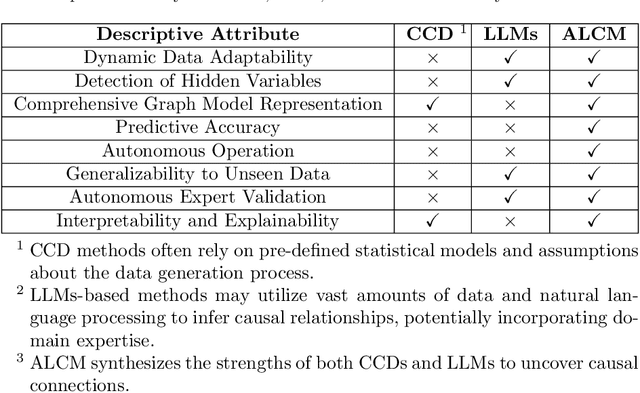
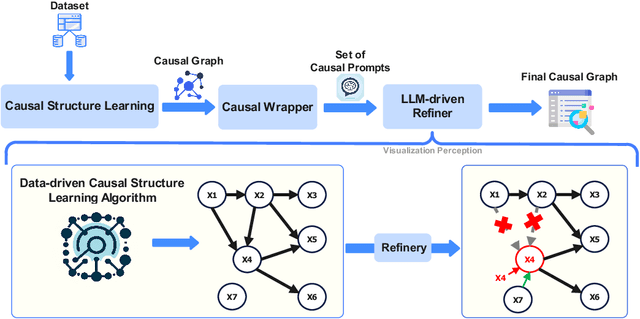
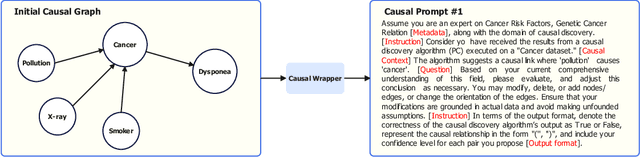
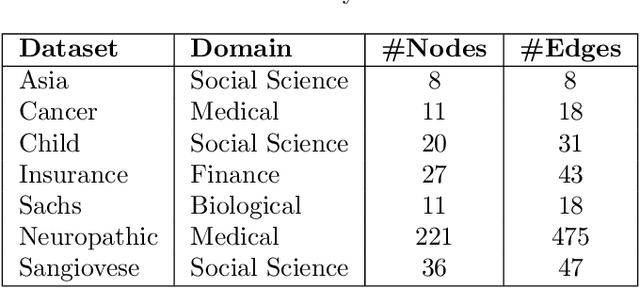
To perform effective causal inference in high-dimensional datasets, initiating the process with causal discovery is imperative, wherein a causal graph is generated based on observational data. However, obtaining a complete and accurate causal graph poses a formidable challenge, recognized as an NP-hard problem. Recently, the advent of Large Language Models (LLMs) has ushered in a new era, indicating their emergent capabilities and widespread applicability in facilitating causal reasoning across diverse domains, such as medicine, finance, and science. The expansive knowledge base of LLMs holds the potential to elevate the field of causal reasoning by offering interpretability, making inferences, generalizability, and uncovering novel causal structures. In this paper, we introduce a new framework, named Autonomous LLM-Augmented Causal Discovery Framework (ALCM), to synergize data-driven causal discovery algorithms and LLMs, automating the generation of a more resilient, accurate, and explicable causal graph. The ALCM consists of three integral components: causal structure learning, causal wrapper, and LLM-driven causal refiner. These components autonomously collaborate within a dynamic environment to address causal discovery questions and deliver plausible causal graphs. We evaluate the ALCM framework by implementing two demonstrations on seven well-known datasets. Experimental results demonstrate that ALCM outperforms existing LLM methods and conventional data-driven causal reasoning mechanisms. This study not only shows the effectiveness of the ALCM but also underscores new research directions in leveraging the causal reasoning capabilities of LLMs.
Integrating Wearable Sensor Data and Self-reported Diaries for Personalized Affect Forecasting
Mar 23, 2024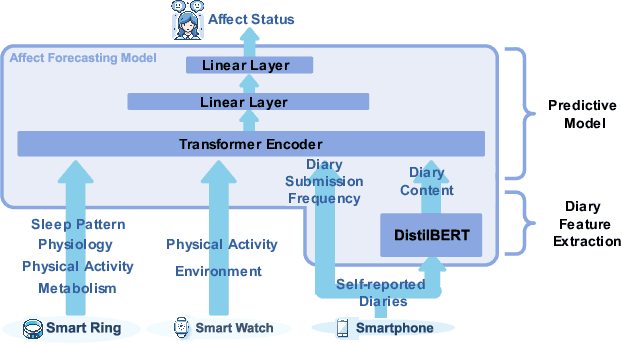
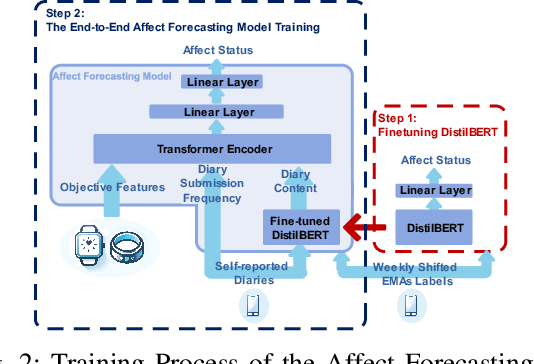
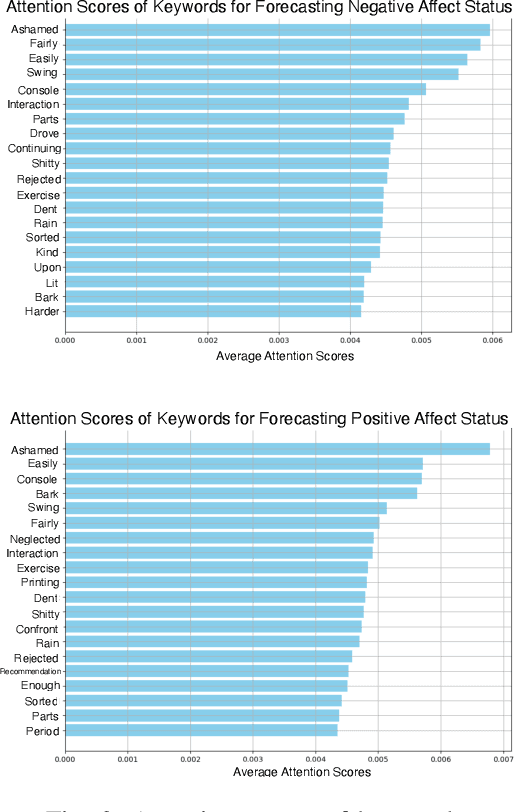
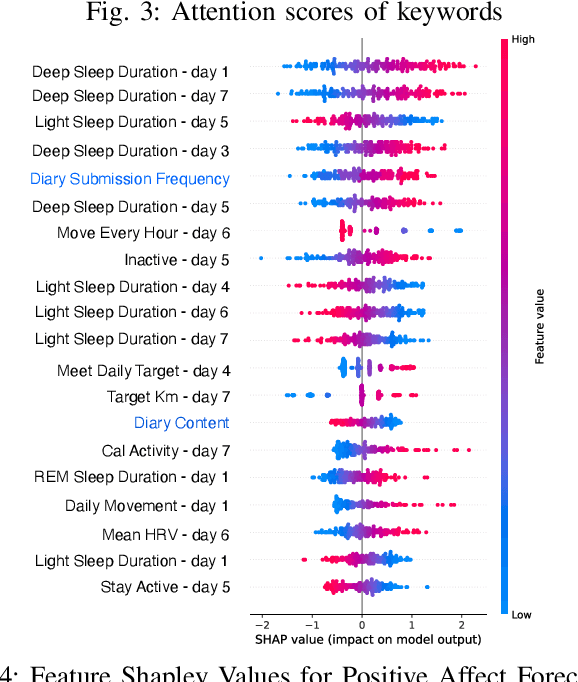
Emotional states, as indicators of affect, are pivotal to overall health, making their accurate prediction before onset crucial. Current studies are primarily centered on immediate short-term affect detection using data from wearable and mobile devices. These studies typically focus on objective sensory measures, often neglecting other forms of self-reported information like diaries and notes. In this paper, we propose a multimodal deep learning model for affect status forecasting. This model combines a transformer encoder with a pre-trained language model, facilitating the integrated analysis of objective metrics and self-reported diaries. To validate our model, we conduct a longitudinal study, enrolling college students and monitoring them over a year, to collect an extensive dataset including physiological, environmental, sleep, metabolic, and physical activity parameters, alongside open-ended textual diaries provided by the participants. Our results demonstrate that the proposed model achieves predictive accuracy of 82.50% for positive affect and 82.76% for negative affect, a full week in advance. The effectiveness of our model is further elevated by its explainability.