 Add to Chrome
 Add to Firefox
 Add to Edge
MoE Router-Guided Clustering for Heterogeneous Federated Instruction Tuning
Aug 15, 2026
Federated instruction fine-tuning enables Large Language Models (LLMs) to adapt to decentralized, privacy-sensitive data without requiring data sharing. Recent Mixture-of-Experts (MoE) LLMs are particularly attractive for federated learning because their sparse activation reduces computation and communication while scaling model capacity. However, existing federated MoE methods primarily focus on parameter aggregation and personalization, overlooking the routing behavior of MoE models as a source of information for client collaboration. Under heterogeneous instruction distributions, indiscriminate aggregation can lead to negative transfer, highlighting the need to identify which clients should collaborate during federated optimization. We propose ClientMorpher, a routing-aware, personalized federated instruction fine-tuning framework that leverages routing signatures from pretrained MoE models to organize client collaboration prior to aggregation. We investigate two complementary clustering strategies: ClientMorpher-C, which directly clusters clients using expert activation profiles, and ClientMorpher-E, which first clusters experts based on their cross-client usage signatures and then derives client collaboration groups. We evaluate ClientMorpher for federated instruction fine-tuning on the Databricks Dolly-15K dataset, using pathological and Dirichlet-based heterogeneous client distributions across multiple instruction-following tasks. Experimental results show that routing-aware collaboration consistently improves personalized performance compared to conventional federated averaging and local training, while maintaining the same communication cost. Furthermore, our study shows that client-centric and expert-centric clustering provides an effective and scalable approach for personalized federated instruction fine-tuning of sparse MoE LLMs.

Membership Inference Attacks Expose Participation Privacy in ECG Foundation Encoders
Apr 12, 2026Foundation-style ECG encoders pretrained with self-supervised learning are increasingly reused across tasks, institutions, and deployment contexts, often through model-as-a-service interfaces that expose scalar scores or latent representations. While such reuse improves data efficiency and generalization, it raises a participation privacy concern: can an adversary infer whether a specific individual or cohort contributed ECG data to pretraining, even when raw waveforms and diagnostic labels are never disclosed? In connected-health settings, training participation itself may reveal institutional affiliation, study enrollment, or sensitive health context. We present an implementation-grounded audit of membership inference attacks (MIAs) against modern self-supervised ECG foundation encoders, covering contrastive objectives (SimCLR, TS2Vec) and masked reconstruction objectives (CNN- and Transformer-based MAE). We evaluate three realistic attacker interfaces: (i) score-only black-box access to scalar outputs, (ii) adaptive learned attackers that aggregate subject-level statistics across repeated queries, and (iii) embedding-access attackers that probe latent representation geometry. Using a subject-centric protocol with window-to-subject aggregation and calibration at fixed false-positive rates under a cross-dataset auditing setting, we observe heterogeneous and objective-dependent participation leakage: leakage is most pronounced in small or institution-specific cohorts and, for contrastive encoders, can saturate in embedding space, while larger and more diverse datasets substantially attenuate operational tail risk. Overall, our results show that restricting access to raw signals or labels is insufficient to guarantee participation privacy, underscoring the need for deployment-aware auditing of reusable biosignal foundation encoders in connected-health systems.
CARE-ECG: Causal Agent-based Reasoning for Explainable and Counterfactual ECG Interpretation
Apr 12, 2026Large language models (LLMs) enable waveform-to-text ECG interpretation and interactive clinical questioning, yet most ECG-LLM systems still rely on weak signal-text alignment and retrieval without explicit physiological or causal structure. This limits grounding, temporal reasoning, and counterfactual "what-if" analysis central to clinical decision-making. We propose CARE-ECG, a causally structured ECG-language reasoning framework that unifies representation learning, diagnosis, and explanation in a single pipeline. CARE-ECG encodes multi-lead ECGs into temporally organized latent biomarkers, performs causal graph inference for probabilistic diagnosis, and supports counterfactual assessment via structural causal models. To improve faithfulness, CARE-ECG grounds language outputs through causal retrieval-augmented generation and a modular agentic pipeline that integrates history, diagnosis, and response with verification. Across multiple ECG benchmarks and expert QA settings, CARE-ECG improves diagnostic accuracy and explanation faithfulness while reducing hallucinations (e.g., 0.84 accuracy on Expert-ECG-QA and 0.76 on SCP-mapped PTB-XL under GPT-4). Overall, CARE-ECG provides traceable reasoning by exposing key latent drivers, causal evidence paths, and how alternative physiological states would change outcomes.
Exploration of Low-Power Flexible Stress Monitoring Classifiers for Conformal Wearables
Aug 27, 2025Conventional stress monitoring relies on episodic, symptom-focused interventions, missing the need for continuous, accessible, and cost-efficient solutions. State-of-the-art approaches use rigid, silicon-based wearables, which, though capable of multitasking, are not optimized for lightweight, flexible wear, limiting their practicality for continuous monitoring. In contrast, flexible electronics (FE) offer flexibility and low manufacturing costs, enabling real-time stress monitoring circuits. However, implementing complex circuits like machine learning (ML) classifiers in FE is challenging due to integration and power constraints. Previous research has explored flexible biosensors and ADCs, but classifier design for stress detection remains underexplored. This work presents the first comprehensive design space exploration of low-power, flexible stress classifiers. We cover various ML classifiers, feature selection, and neural simplification algorithms, with over 1200 flexible classifiers. To optimize hardware efficiency, fully customized circuits with low-precision arithmetic are designed in each case. Our exploration provides insights into designing real-time stress classifiers that offer higher accuracy than current methods, while being low-cost, conformable, and ensuring low power and compact size.
Defending Against Gradient Inversion Attacks for Biomedical Images via Learnable Data Perturbation
Mar 19, 2025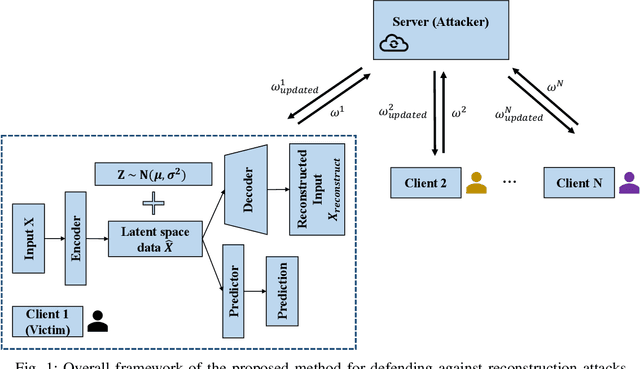
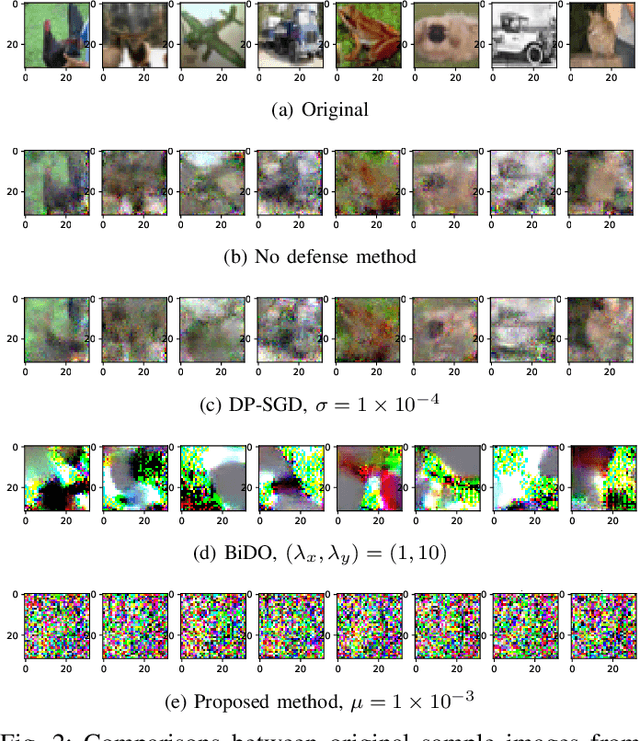
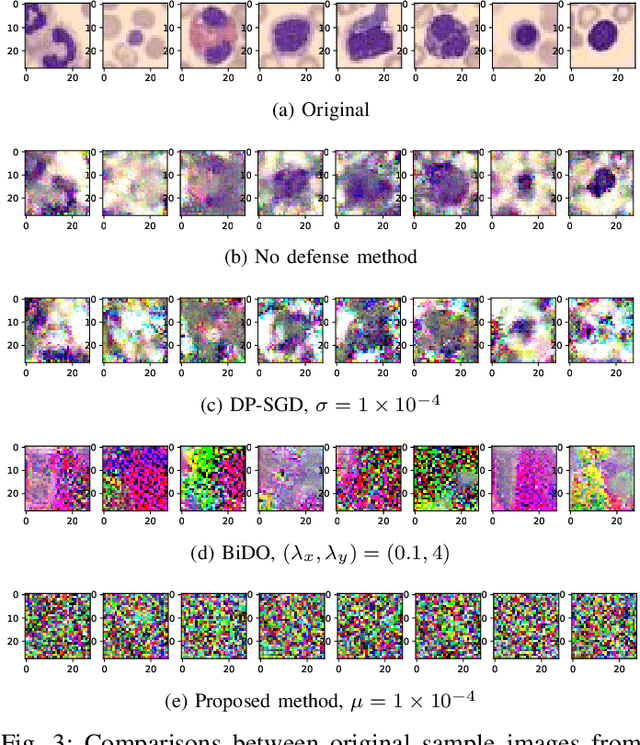
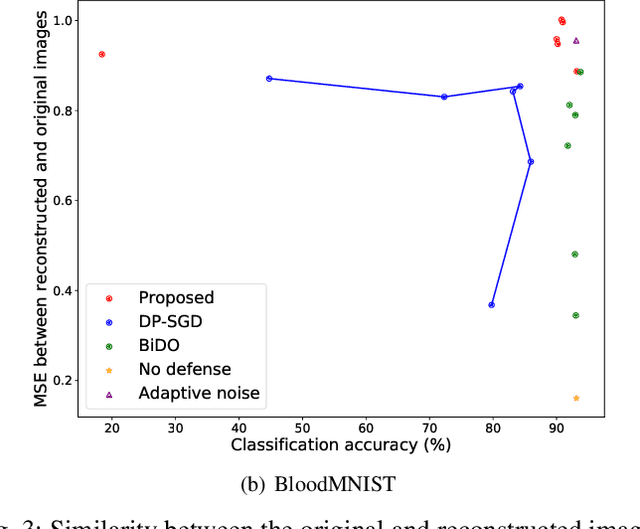
The increasing need for sharing healthcare data and collaborating on clinical research has raised privacy concerns. Health information leakage due to malicious attacks can lead to serious problems such as misdiagnoses and patient identification issues. Privacy-preserving machine learning (PPML) and privacy-enhancing technologies, particularly federated learning (FL), have emerged in recent years as innovative solutions to balance privacy protection with data utility; however, they also suffer from inherent privacy vulnerabilities. Gradient inversion attacks constitute major threats to data sharing in federated learning. Researchers have proposed many defenses against gradient inversion attacks. However, current defense methods for healthcare data lack generalizability, i.e., existing solutions may not be applicable to data from a broader range of populations. In addition, most existing defense methods are tested using non-healthcare data, which raises concerns about their applicability to real-world healthcare systems. In this study, we present a defense against gradient inversion attacks in federated learning. We achieve this using latent data perturbation and minimax optimization, utilizing both general and medical image datasets. Our method is compared to two baselines, and the results show that our approach can outperform the baselines with a reduction of 12.5% in the attacker's accuracy in classifying reconstructed images. The proposed method also yields an increase of over 12.4% in Mean Squared Error (MSE) between the original and reconstructed images at the same level of model utility of around 90% client classification accuracy. The results suggest the potential of a generalizable defense for healthcare data.