 Add to Chrome
 Add to Firefox
 Add to Edge
GoT-CD: Graph-of-Thoughts Causal Discovery and the Fragility of Post-hoc Path-Specific Fairness Audits
Aug 03, 2026
Causal discovery recovers directed structure from observational data and is increasingly used in clinical settings to support mechanism reasoning and fairness audits of predictive models. Path-specific counterfactual fairness asks whether a protected attribute influences an outcome through illegitimate pathways, but these estimands are defined relative to a supplied causal graph and therefore inherit whatever errors the discovery step introduces. Discovery methods are routinely scored on aggregate structural metrics that weight all edges equally, and no established evaluation asks whether the specific pathway an audit depends on survives discovery---or what the audit reports when that pathway is missing. Here we show that full-graph Graph-of-Thoughts reasoning yields acyclic discovered graphs that are structurally competitive with large language model (LLM) baselines, yet that structural fidelity alone does not guarantee fairness-faithful audits. We introduce GoT-CD, in which the reasoning unit is a complete candidate edge set: multiple graphs are generated in parallel, scored by a deterministic validity function, and merged under a hard union constraint that forbids invented edges, with greedy projection enforcing a DAG before commitment. GoT-CD returns a valid DAG on all five reported benchmarks and achieves the best DAG-valid F1 score among LLM methods on Asia, Alzheimer's, and COVID-Respiratory datasets. On an Alzheimer's benchmark with known unfair path, a post-hoc path-specific audit shows that five of eight discovered graphs recover no path from the sensitive attribute to the outcome and therefore report a null overall effect while mediated effects persist, necessitating downstream path-specific fairness analysis along with structural discovery.

FairDiffuseVQVAE: Sampling-Time Fairness in Tabular Diffusion via Conditional Refinement of Vector-Quantized Latents
Jul 31, 2026Synthetic tabular data is increasingly used in privacy-preserving data sharing, data augmentation, and to mitigate downstream classifier bias. State-of-the-art tabular diffusion models such as TabDDPM and TabSyn achieve excellent distributional fidelity but offer no mechanism for fairness; conversely, fairness-aware tabular generators (DECAF, FairTGAN, FairTabDDPM) impose explicit fairness penalties at training time, yielding modest fairness gains at substantial cost to either sample quality or downstream utility. We introduce FairDiffuseVQVAE, a two-stage architecture that decouples fidelity from fairness: a vector-quantized autoencoder with a row-level discriminator (Stage~1, no fairness terms) is followed by a DiffuseVAE-style continuous diffusion refiner that conditions on both the Stage-1 reconstruction and the protected attribute via classifier-free guidance (Stage~2). Fairness emerges as a property of the sampling distribution -- uniform sampling of the protected attribute at inference time enforces demographic parity by construction, rather than from competing loss terms. On the Adult, Bank and COMPAS datasets, FairDiffuseVQVAE achieves the highest mean Demographic Parity Ratio ($0.702$, $+47\%$ over FairTabDDPM) and Equalized Odds Ratio ($0.686$, $+100\%$). It also attains the lowest mean pair-wise correlation error ($0.034$) of any published method, while explicitly trading $\sim$$15$ AUC points for these fairness gains.
Evaluating Causal Discovery Algorithms for Path-Specific Fairness and Utility in Healthcare
Mar 16, 2026Causal discovery in health data faces evaluation challenges when ground truth is unknown. We address this by collaborating with experts to construct proxy ground-truth graphs, establishing benchmarks for synthetic Alzheimer's disease and heart failure clinical records data. We evaluate the Peter-Clark, Greedy Equivalence Search, and Fast Causal Inference algorithms on structural recovery and path-specific fairness decomposition, going beyond composite fairness scores. On synthetic data, Peter-Clark achieved the best structural recovery. On heart failure data, Fast Causal Inference achieved the highest utility. For path-specific effects, ejection fraction contributed 3.37 percentage points to the indirect effect in the ground truth. These differences drove variations in the fairness-utility ratio across algorithms. Our results highlight the need for graph-aware fairness evaluation and fine-grained path-specific analysis when deploying causal discovery in clinical applications.
End-to-End assessment of AR-assisted neurosurgery systems
Nov 03, 2023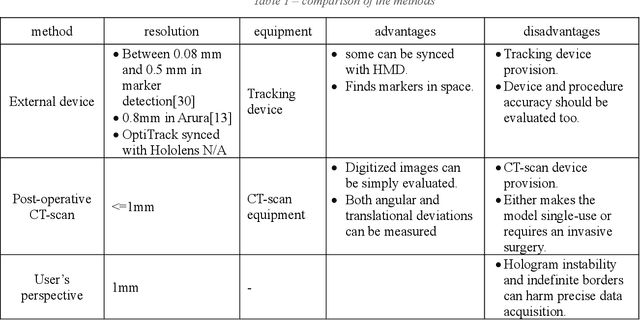
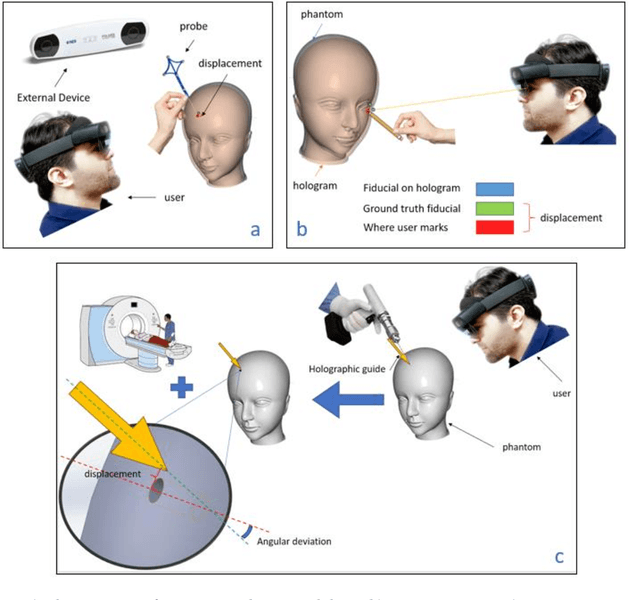

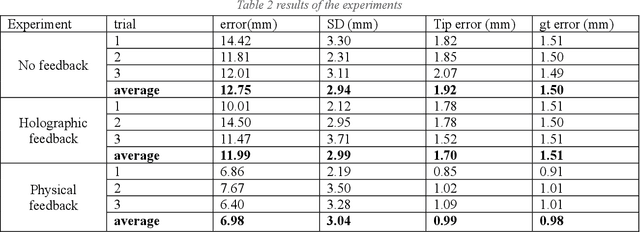
Augmented Reality (AR) has emerged as a significant advancement in surgical procedures, offering a solution to the challenges posed by traditional neuronavigation methods. These conventional techniques often necessitate surgeons to split their focus between the surgical site and a separate monitor that displays guiding images. Over the years, many systems have been developed to register and track the hologram at the targeted locations, each employed its own evaluation technique. On the other hand, hologram displacement measurement is not a straightforward task because of various factors such as occlusion, Vengence-Accomodation Conflict, and unstable holograms in space. In this study, we explore and classify different techniques for assessing an AR-assisted neurosurgery system and propose a new technique to systematize the assessment procedure. Moreover, we conduct a deeper investigation to assess surgeon error in the pre- and intra-operative phases of the surgery based on the respective feedback given. We found that although the system can undergo registration and tracking errors, physical feedback can significantly reduce the error caused by hologram displacement. However, the lack of visual feedback on the hologram does not have a significant effect on the user 3D perception.
Using Genetic Algorithm in the Evolutionary Design of Sequential Logic Circuits
Oct 05, 2011


Evolvable hardware (EHW) is a set of techniques that are based on the idea of combining reconfiguration hardware systems with evolutionary algorithms. In other word, EHW has two sections; the reconfigurable hardware and evolutionary algorithm where the configurations are under the control of an evolutionary algorithm. This paper, suggests a method to design and optimize the synchronous sequential circuits. Genetic algorithm (GA) was applied as evolutionary algorithm. In this approach, for building input combinational logic circuit of each DFF, and also output combinational logic circuit, the cell arrays have been used. The obtained results show that our method can reduce the average number of generations by limitation the search space.