 Add to Chrome
 Add to Firefox
 Add to Edge
GoT-CD: Graph-of-Thoughts Causal Discovery and the Fragility of Post-hoc Path-Specific Fairness Audits
Aug 03, 2026
Causal discovery recovers directed structure from observational data and is increasingly used in clinical settings to support mechanism reasoning and fairness audits of predictive models. Path-specific counterfactual fairness asks whether a protected attribute influences an outcome through illegitimate pathways, but these estimands are defined relative to a supplied causal graph and therefore inherit whatever errors the discovery step introduces. Discovery methods are routinely scored on aggregate structural metrics that weight all edges equally, and no established evaluation asks whether the specific pathway an audit depends on survives discovery---or what the audit reports when that pathway is missing. Here we show that full-graph Graph-of-Thoughts reasoning yields acyclic discovered graphs that are structurally competitive with large language model (LLM) baselines, yet that structural fidelity alone does not guarantee fairness-faithful audits. We introduce GoT-CD, in which the reasoning unit is a complete candidate edge set: multiple graphs are generated in parallel, scored by a deterministic validity function, and merged under a hard union constraint that forbids invented edges, with greedy projection enforcing a DAG before commitment. GoT-CD returns a valid DAG on all five reported benchmarks and achieves the best DAG-valid F1 score among LLM methods on Asia, Alzheimer's, and COVID-Respiratory datasets. On an Alzheimer's benchmark with known unfair path, a post-hoc path-specific audit shows that five of eight discovered graphs recover no path from the sensitive attribute to the outcome and therefore report a null overall effect while mediated effects persist, necessitating downstream path-specific fairness analysis along with structural discovery.

Randomized Least Squares Value Iteration itself is Joint Differentially Private
Jun 01, 2026As reinforcement learning (RL) increasingly applies to sensitive domains, such as health care and recommendation systems, privacy-preserving techniques have become essential to protect users' sensitive information. We investigate privacy-preserving RL under an episodic setting, focusing on algorithms based on randomized exploration, such as Randomized Least Squares Value Iteration (RLSVI). The overall goal is to study how randomized exploration interacts with the injected noise required by privacy mechanisms. In this work, we show a new privacy analysis that characterizes how the noise in RLSVI set for exploration simultaneously provides privacy protection. Specifically, we prove that RLSVI is $(\varepsilon(δ),δ)$-joint differentially private in tabular MDP as is with $\varepsilon(δ) = \frac{2AK}{H^2\log(2HSA)} + 2\sqrt{\frac{2AK\log(1/δ)}{H^2\log(2HSA)}}$, where $S$ and $A$ are the number of states and actions respectively, $H$ is the length of an episode and $K$ is the number of episodes.
Fairness in two-player zero-sum games with bandit feedback
May 31, 2026We study two-player zero-sum games (TPZSGs) with bandit feedback under fairness constraints requiring every action to be played with probability at least $α/m$. Existing instance-dependent results target $\textit{pure}$ Nash equilibria, while fairness generically produces $\textit{mixed}$ equilibria, a harder learning target. Our key technical tool is a reparametrization: every fair strategy decomposes as $p = (α/m)\mathbf{1} + (1-α)\widetilde{p}$ with $\widetilde{p} \in Δ_m$, and substituting into the payoff form yields $p^{\top}Aq = \widetilde{p}^{\top}\widetilde{A} q$ for a fair payoff matrix $\widetilde{A} := (1-α)A + α\mathbf{1} c^{\top}$, where $c_j = \tfrac{1}{m}\sum_i A(i,j)$ is the column-mean vector. The fair game on $A$ is then equivalent to a standard zero-sum game on $\widetilde{A}$, so equilibrium existence, KKT structure, and LP basis stability reduce to classical results applied to $\widetilde{A}$. We derive the fair minimax value, fair Nash equilibrium, fair regret, and a clean dual representation showing the price of fairness is at most $α(1-1/m)$ and vanishes whenever the unconstrained equilibrium already has full support. Our main result is an $\widetilde{O}(T^{2/3})$ regret bound for an Explore-Then-Commit algorithm, $\texttt{Fair-ETC-TPZSG}$, applicable to general mixed fair equilibria, together with a discussion of why naive action elimination does not readily improve it. When the fair equilibrium has a single dominant action, equivalently when $\widetilde{p}^{\star}$ is a vertex of $Δ_m$, the bound sharpens to instance-dependent $\widetilde{O}(1/\widetildeΔ(α)^{2})$, where $\widetildeΔ(α)$ is the LP-margin gap.
Best-of-Both-Worlds Multi-Dueling Bandits: Unified Algorithms for Stochastic and Adversarial Preferences under Condorcet and Borda Objectives
Mar 19, 2026Multi-dueling bandits, where a learner selects $m \geq 2$ arms per round and observes only the winner, arise naturally in many applications including ranking and recommendation systems, yet a fundamental question has remained open: can a single algorithm perform optimally in both stochastic and adversarial environments, without knowing which regime it faces? We answer this affirmatively, providing the first best-of-both-worlds algorithms for multi-dueling bandits under both Condorcet and Borda objectives. For the Condorcet setting, we propose \texttt{MetaDueling}, a black-box reduction that converts any dueling bandit algorithm into a multi-dueling bandit algorithm by transforming multi-way winner feedback into an unbiased pairwise signal. Instantiating our reduction with \texttt{Versatile-DB} yields the first best-of-both-worlds algorithm for multi-dueling bandits: it achieves $O(\sqrt{KT})$ pseudo-regret against adversarial preferences and the instance-optimal $O\!\left(\sum_{i \neq a^\star} \frac{\log T}{Δ_i}\right)$ pseudo-regret under stochastic preferences, both simultaneously and without prior knowledge of the regime. For the Borda setting, we propose \AlgBorda, a stochastic-and-adversarial algorithm that achieves $O\left(K^2 \log KT + K \log^2 T + \sum_{i: Δ_i^{\mathrm{B}} > 0} \frac{K\log KT}{(Δ_i^{\mathrm{B}})^2}\right)$ regret in stochastic environments and $O\left(K \sqrt{T \log KT} + K^{1/3} T^{2/3} (\log K)^{1/3}\right)$ regret against adversaries, again without prior knowledge of the regime. We complement our upper bounds with matching lower bounds for the Condorcet setting. For the Borda setting, our upper bounds are near-optimal with respect to the lower bounds (within a factor of $K$) and match the best-known results in the literature.
Evaluating Causal Discovery Algorithms for Path-Specific Fairness and Utility in Healthcare
Mar 16, 2026Causal discovery in health data faces evaluation challenges when ground truth is unknown. We address this by collaborating with experts to construct proxy ground-truth graphs, establishing benchmarks for synthetic Alzheimer's disease and heart failure clinical records data. We evaluate the Peter-Clark, Greedy Equivalence Search, and Fast Causal Inference algorithms on structural recovery and path-specific fairness decomposition, going beyond composite fairness scores. On synthetic data, Peter-Clark achieved the best structural recovery. On heart failure data, Fast Causal Inference achieved the highest utility. For path-specific effects, ejection fraction contributed 3.37 percentage points to the indirect effect in the ground truth. These differences drove variations in the fairness-utility ratio across algorithms. Our results highlight the need for graph-aware fairness evaluation and fine-grained path-specific analysis when deploying causal discovery in clinical applications.
Adversarial Multi-dueling Bandits
Jun 18, 2024We introduce the problem of regret minimization in adversarial multi-dueling bandits. While adversarial preferences have been studied in dueling bandits, they have not been explored in multi-dueling bandits. In this setting, the learner is required to select $m \geq 2$ arms at each round and observes as feedback the identity of the most preferred arm which is based on an arbitrary preference matrix chosen obliviously. We introduce a novel algorithm, MiDEX (Multi Dueling EXP3), to learn from such preference feedback that is assumed to be generated from a pairwise-subset choice model. We prove that the expected cumulative $T$-round regret of MiDEX compared to a Borda-winner from a set of $K$ arms is upper bounded by $O((K \log K)^{1/3} T^{2/3})$. Moreover, we prove a lower bound of $\Omega(K^{1/3} T^{2/3})$ for the expected regret in this setting which demonstrates that our proposed algorithm is near-optimal.
Investigating Gender Fairness in Machine Learning-driven Personalized Care for Chronic Pain
Feb 29, 2024This study investigates gender fairness in personalized pain care recommendations using machine learning algorithms. Leveraging a contextual bandits framework, personalized recommendations are formulated and evaluated using LinUCB algorithm on a dataset comprising interactions with $164$ patients across $10$ sessions each. Results indicate that while adjustments to algorithm parameters influence the quality of pain care recommendations, this impact remains consistent across genders. However, when certain patient information, such as self-reported pain measurements, is absent, the quality of pain care recommendations for women is notably inferior to that for men.
Provably Efficient Exploration in Constrained Reinforcement Learning:Posterior Sampling Is All You Need
Sep 27, 2023We present a new algorithm based on posterior sampling for learning in constrained Markov decision processes (CMDP) in the infinite-horizon undiscounted setting. The algorithm achieves near-optimal regret bounds while being advantageous empirically compared to the existing algorithms. Our main theoretical result is a Bayesian regret bound for each cost component of \tilde{O} (HS \sqrt{AT}) for any communicating CMDP with S states, A actions, and bound on the hitting time H. This regret bound matches the lower bound in order of time horizon T and is the best-known regret bound for communicating CMDPs in the infinite-horizon undiscounted setting. Empirical results show that, despite its simplicity, our posterior sampling algorithm outperforms the existing algorithms for constrained reinforcement learning.
Multi-Armed Bandits with Generalized Temporally-Partitioned Rewards
Mar 01, 2023
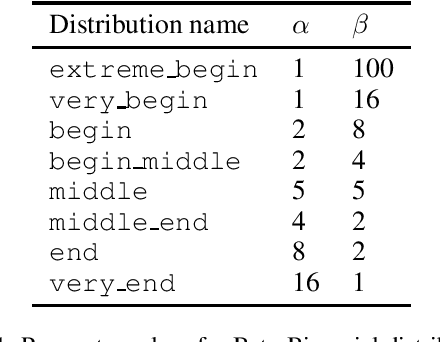
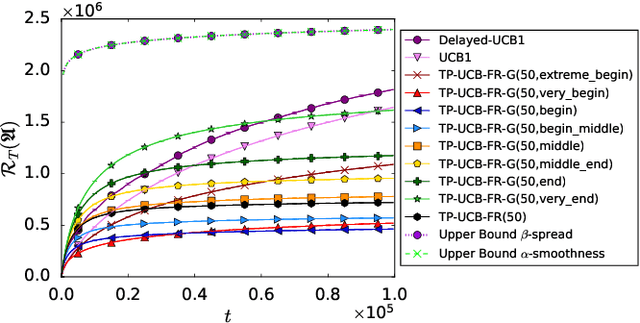
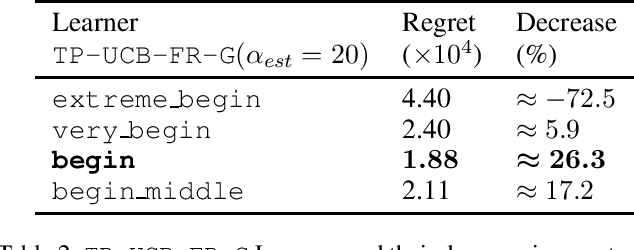
Decision-making problems of sequential nature, where decisions made in the past may have an impact on the future, are used to model many practically important applications. In some real-world applications, feedback about a decision is delayed and may arrive via partial rewards that are observed with different delays. Motivated by such scenarios, we propose a novel problem formulation called multi-armed bandits with generalized temporally-partitioned rewards. To formalize how feedback about a decision is partitioned across several time steps, we introduce $\beta$-spread property. We derive a lower bound on the performance of any uniformly efficient algorithm for the considered problem. Moreover, we provide an algorithm called TP-UCB-FR-G and prove an upper bound on its performance measure. In some scenarios, our upper bound improves upon the state of the art. We provide experimental results validating the proposed algorithm and our theoretical results.
Curiosity-driven Exploration in Sparse-reward Multi-agent Reinforcement Learning
Feb 21, 2023Sparsity of rewards while applying a deep reinforcement learning method negatively affects its sample-efficiency. A viable solution to deal with the sparsity of rewards is to learn via intrinsic motivation which advocates for adding an intrinsic reward to the reward function to encourage the agent to explore the environment and expand the sample space. Though intrinsic motivation methods are widely used to improve data-efficient learning in the reinforcement learning model, they also suffer from the so-called detachment problem. In this article, we discuss the limitations of intrinsic curiosity module in sparse-reward multi-agent reinforcement learning and propose a method called I-Go-Explore that combines the intrinsic curiosity module with the Go-Explore framework to alleviate the detachment problem.