 Add to Chrome
 Add to Firefox
 Add to Edge
MemoGuard: An Adaptive Runtime for Guarding Against Memory Traps in Communication-Limited Robot Navigation
Jul 17, 2026
Communication-limited robots in mission-critical scenarios such as disaster inspection and search-and-rescue must make reliable onboard decisions without access to remote operators or high-capacity reasoning services. Episodic memory reuse is an attractive low-cost fallback, but retrieval similarity does not guarantee execution validity, i.e., a retrieved action may match the current context yet be unsafe due to changed topology, insufficient battery margin, or unreliable prior outcomes. We call such high-similarity but execution-invalid episodes memory traps. This creates a safety-efficiency design space where similarity only reuse minimizes fallback cost but can be unsafe, while always invoking local reasoning improves safety at high computational and energy cost. This paper presents MemoGuard, a lightweight adaptive runtime that validates episodic memories against topology, resource, and outcome contracts before reuse, invoking fallback only when validation fails. In a graph-based corridor-inspection simulator, MemoGuard reduces battery safety violations by 76.6% over similarity-only top-1 reuse while reducing fallback calls by 21.4% over always reasoning. On an NVIDIA Jetson AGX Xavier with local llama3.2:3b fallback reasoning, this corresponds to 3.67 s and 36.97 J of avoided fallback-reasoning overhead per trial. We open-source MemoGuard at https://github.com/hetheiin/memoguard.

Can the Environment Speak for Itself? $T^{2}$-GRPO: A Turn-Trajectory Group Relative Policy Optimization for Caregiver Agents
Jun 07, 2026Optimizing large language models (LLMs) for long-horizon caregiver agents requires balancing delayed task objectives with immediate environment dynamics, such as patient distress and resistance. In dementia care, this balance is especially difficult: trajectory level rewards are too sparse for turn level credit assignment, while external LLM-based evaluators are costly and can misread fragmented or indirect patient responses. To address this issue, we propose \textbf{T}urn-\textbf{T}rajectory \textbf{G}roup \textbf{R}elative \textbf{P}olicy \textbf{O}ptimization (\textbf{T$^{2}$-GRPO}), a framework that decouples caregiver RL into two normalized reward horizons and enforces safety through a binary hard veto. $T^2$-GRPO derives dense turn-level rewards directly from environment state transitions, measuring changes in patient distress and resistance from a frozen dementia patient simulator. These environment-grounded rewards are combined with trajectory-level evaluations through independent centered-rank normalization, which preserves heterogeneous reward signals and mitigates reward collapse. Extensive experiments on dementia caregivers show that T $^{2}$-GRPO outperforms competitive baselines, indicating a substantial improvement for emotionally sensitive caregiver scenarios that effectively handles immediate patient feedback, long-term care outcomes, and safety constraints.
GeoReFormer: Geometry-Aware Refinement for Lane Segment Detection and Topology Reasoning
Mar 27, 2026Accurate 3D lane segment detection and topology reasoning are critical for structured online map construction in autonomous driving. Recent transformer-based approaches formulate this task as query-based set prediction, yet largely inherit decoder designs originally developed for compact object detection. However, lane segments are continuous polylines embedded in directed graphs, and generic query initialization and unconstrained refinement do not explicitly encode this geometric and relational structure. We propose GeoReFormer (Geometry-aware Refinement Transformer), a unified query-based architecture that embeds geometry- and topology-aware inductive biases directly within the transformer decoder. GeoReFormer introduces data-driven geometric priors for structured query initialization, bounded coordinate-space refinement for stable polyline deformation, and per-query gated topology propagation to selectively integrate relational context. On the OpenLane-V2 benchmark, GeoReFormer achieves state-of-the-art performance with 34.5% mAP while improving topology consistency over strong transformer baselines, demonstrating the utility of explicit geometric and relational structure encoding.
DementiaBank-Emotion: A Multi-Rater Emotion Annotation Corpus for Alzheimer's Disease Speech (Version 1.0)
Feb 04, 2026We present DementiaBank-Emotion, the first multi-rater emotion annotation corpus for Alzheimer's disease (AD) speech. Annotating 1,492 utterances from 108 speakers for Ekman's six basic emotions and neutral, we find that AD patients express significantly more non-neutral emotions (16.9%) than healthy controls (5.7%; p < .001). Exploratory acoustic analysis suggests a possible dissociation: control speakers showed substantial F0 modulation for sadness (Delta = -3.45 semitones from baseline), whereas AD speakers showed minimal change (Delta = +0.11 semitones; interaction p = .023), though this finding is based on limited samples (sadness: n=5 control, n=15 AD) and requires replication. Within AD speech, loudness differentiates emotion categories, indicating partially preserved emotion-prosody mappings. We release the corpus, annotation guidelines, and calibration workshop materials to support research on emotion recognition in clinical populations.
MedSpeak: A Knowledge Graph-Aided ASR Error Correction Framework for Spoken Medical QA
Feb 01, 2026Spoken question-answering (SQA) systems relying on automatic speech recognition (ASR) often struggle with accurately recognizing medical terminology. To this end, we propose MedSpeak, a novel knowledge graph-aided ASR error correction framework that refines noisy transcripts and improves downstream answer prediction by leveraging both semantic relationships and phonetic information encoded in a medical knowledge graph, together with the reasoning power of LLMs. Comprehensive experimental results on benchmarks demonstrate that MedSpeak significantly improves the accuracy of medical term recognition and overall medical SQA performance, establishing MedSpeak as a state-of-the-art solution for medical SQA. The code is available at https://github.com/RainieLLM/MedSpeak.
Styles + Persona-plug = Customized LLMs
Jan 10, 2026We discover a previously overlooked challenge in personalized text generation: personalization methods are increasingly applied under explicit style instructions, yet their behavior under such constraints remains poorly understood. To balance implicit personalization and explicit style, we formulate personalization as a distributional residual and propose PsPLUG, a lightweight soft-prompt plug-in trained with style-conditioned preference contrasts. Across LaMP benchmark, our framework improves persona alignment, maintains stylistic fidelity, and outperforms retrieval-based and soft-prompt baselines with minimal computation. These results show that residual modeling provides a simple and principled foundation for controllable, style-aware LLM personalization.
CARD: Cluster-level Adaptation with Reward-guided Decoding for Personalized Text Generation
Jan 09, 2026Adapting large language models to individual users remains challenging due to the tension between fine-grained personalization and scalable deployment. We present CARD, a hierarchical framework that achieves effective personalization through progressive refinement. CARD first clusters users according to shared stylistic patterns and learns cluster-specific LoRA adapters, enabling robust generalization and strong low-resource performance. To capture individual differences within each cluster, we propose an implicit preference learning mechanism that contrasts user-authored text with cluster-level generations, allowing the model to infer user-specific style preferences without manual annotation. At inference time, CARD injects personalization exclusively at decoding via lightweight user preference vectors and low-rank logit corrections, while keeping the base model frozen. Experiments on the LaMP and LongLaMP benchmarks show that CARD achieves competitive or superior generation quality compared to state-of-the-art baselines, while significantly improving efficiency and scalability for practical personalized text generation.
T-SAR: A Full-Stack Co-design for CPU-Only Ternary LLM Inference via In-Place SIMD ALU Reorganization
Nov 17, 2025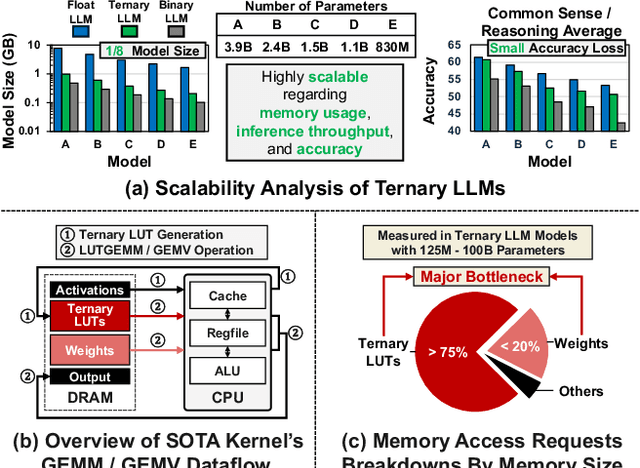
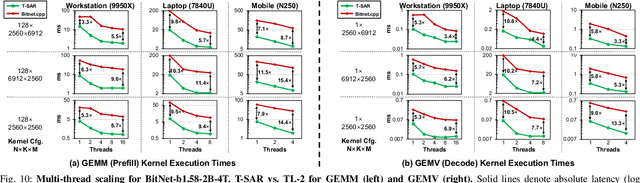
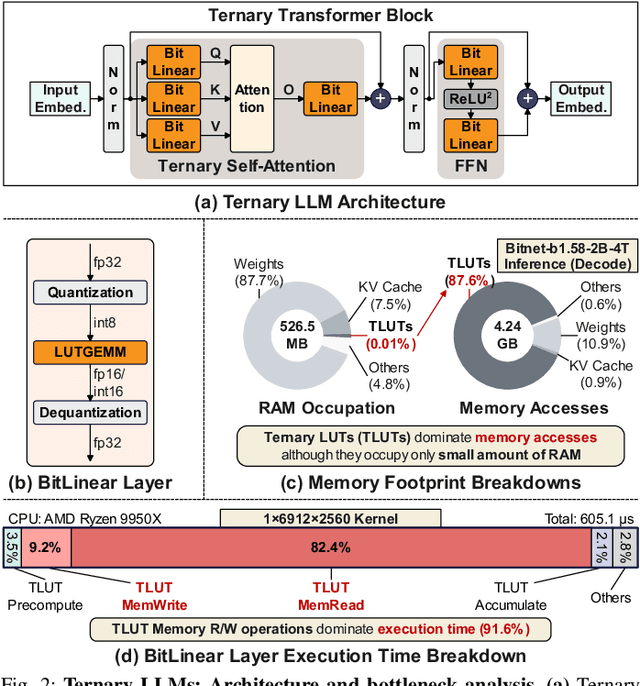
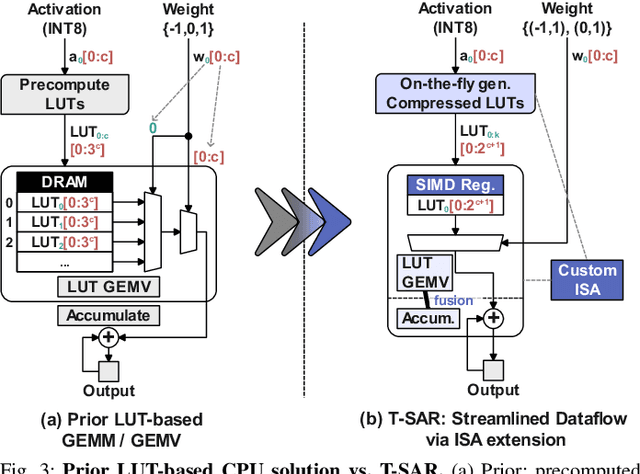
Recent advances in LLMs have outpaced the computational and memory capacities of edge platforms that primarily employ CPUs, thereby challenging efficient and scalable deployment. While ternary quantization enables significant resource savings, existing CPU solutions rely heavily on memory-based lookup tables (LUTs) which limit scalability, and FPGA or GPU accelerators remain impractical for edge use. This paper presents T-SAR, the first framework to achieve scalable ternary LLM inference on CPUs by repurposing the SIMD register file for dynamic, in-register LUT generation with minimal hardware modifications. T-SAR eliminates memory bottlenecks and maximizes data-level parallelism, delivering 5.6-24.5x and 1.1-86.2x improvements in GEMM latency and GEMV throughput, respectively, with only 3.2% power and 1.4% area overheads in SIMD units. T-SAR achieves up to 2.5-4.9x the energy efficiency of an NVIDIA Jetson AGX Orin, establishing a practical approach for efficient LLM inference on edge platforms.
ACCESS-AV: Adaptive Communication-Computation Codesign for Sustainable Autonomous Vehicle Localization in Smart Factories
Jul 27, 2025Autonomous Delivery Vehicles (ADVs) are increasingly used for transporting goods in 5G network-enabled smart factories, with the compute-intensive localization module presenting a significant opportunity for optimization. We propose ACCESS-AV, an energy-efficient Vehicle-to-Infrastructure (V2I) localization framework that leverages existing 5G infrastructure in smart factory environments. By opportunistically accessing the periodically broadcast 5G Synchronization Signal Blocks (SSBs) for localization, ACCESS-AV obviates the need for dedicated Roadside Units (RSUs) or additional onboard sensors to achieve energy efficiency as well as cost reduction. We implement an Angle-of-Arrival (AoA)-based estimation method using the Multiple Signal Classification (MUSIC) algorithm, optimized for resource-constrained ADV platforms through an adaptive communication-computation strategy that dynamically balances energy consumption with localization accuracy based on environmental conditions such as Signal-to-Noise Ratio (SNR) and vehicle velocity. Experimental results demonstrate that ACCESS-AV achieves an average energy reduction of 43.09% compared to non-adaptive systems employing AoA algorithms such as vanilla MUSIC, ESPRIT, and Root-MUSIC. It maintains sub-30 cm localization accuracy while also delivering substantial reductions in infrastructure and operational costs, establishing its viability for sustainable smart factory environments.
DEMENTIA-PLAN: An Agent-Based Framework for Multi-Knowledge Graph Retrieval-Augmented Generation in Dementia Care
Mar 26, 2025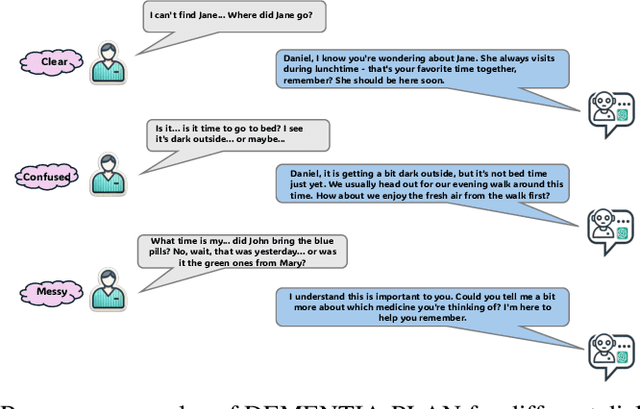
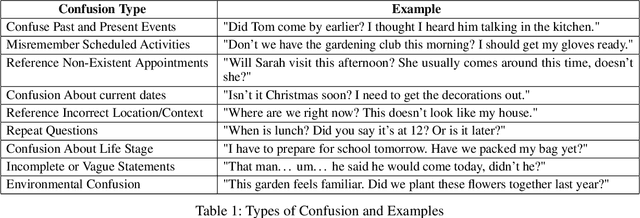
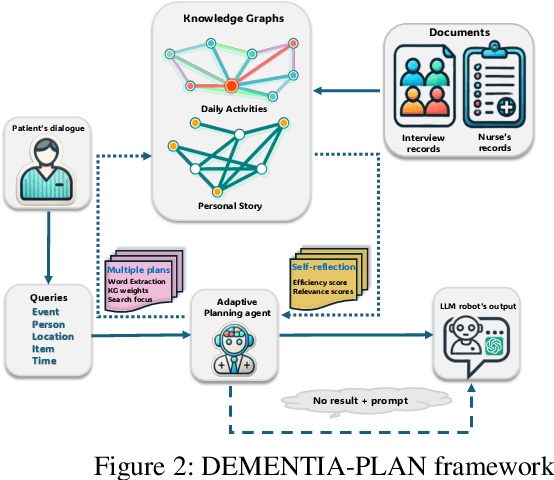
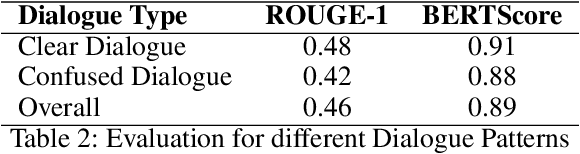
Mild-stage dementia patients primarily experience two critical symptoms: severe memory loss and emotional instability. To address these challenges, we propose DEMENTIA-PLAN, an innovative retrieval-augmented generation framework that leverages large language models to enhance conversational support. Our model employs a multiple knowledge graph architecture, integrating various dimensional knowledge representations including daily routine graphs and life memory graphs. Through this multi-graph architecture, DEMENTIA-PLAN comprehensively addresses both immediate care needs and facilitates deeper emotional resonance through personal memories, helping stabilize patient mood while providing reliable memory support. Our notable innovation is the self-reflection planning agent, which systematically coordinates knowledge retrieval and semantic integration across multiple knowledge graphs, while scoring retrieved content from daily routine and life memory graphs to dynamically adjust their retrieval weights for optimized response generation. DEMENTIA-PLAN represents a significant advancement in the clinical application of large language models for dementia care, bridging the gap between AI tools and caregivers interventions.