 Add to Chrome
 Add to Firefox
 Add to Edge
No Vision, No Wearables: 5G-based 2D Human Pose Recognition with Integrated Sensing and Communications
Dec 31, 2025
With the increasing maturity of contactless human pose recognition (HPR) technology, indoor interactive applications have raised higher demands for natural, controller-free interaction methods. However, current mainstream HPR solutions relying on vision or radio-frequency (RF) (including WiFi, radar) still face various challenges in practical deployment, such as privacy concerns, susceptibility to occlusion, dedicated equipment and functions, and limited sensing resolution and range. 5G-based integrated sensing and communication (ISAC) technology, by merging communication and sensing functions, offers a new approach to address these challenges in contactless HPR. We propose a practical 5G-based ISAC system capable of inferring 2D HPR from uplink sounding reference signals (SRS). Specifically, rich features are extracted from multiple domains and employ an encoder to achieve unified alignment and representation in a latent space. Subsequently, low-dimensional features are fused to output the human pose state. Experimental results demonstrate that in typical indoor environments, our proposed 5G-based ISAC HPR system significantly outperforms current mainstream baseline solutions in HPR performance, providing a solid technical foundation for universal human-computer interaction.

LimiX: Unleashing Structured-Data Modeling Capability for Generalist Intelligence
Sep 03, 2025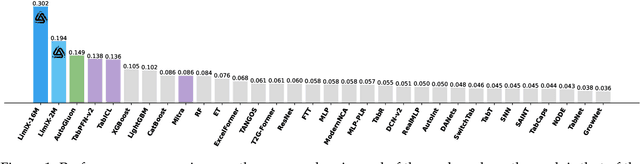
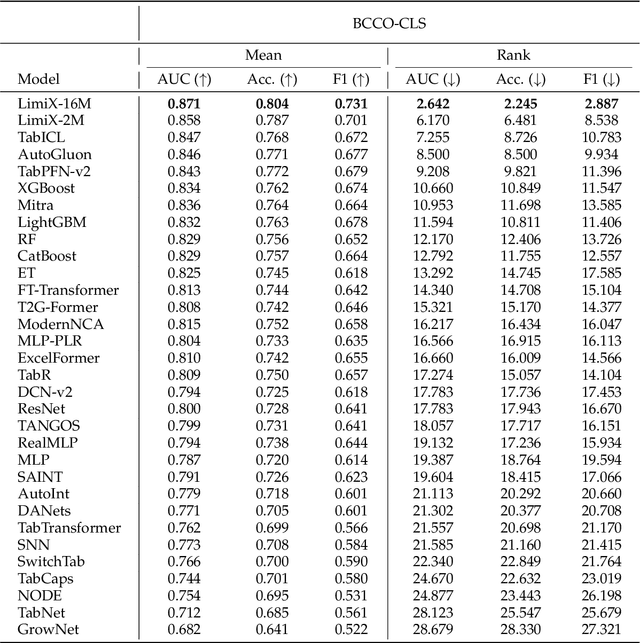
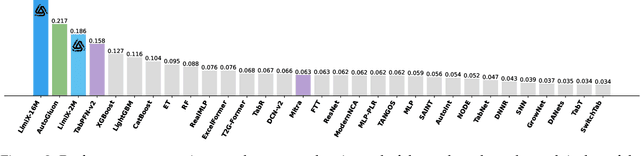
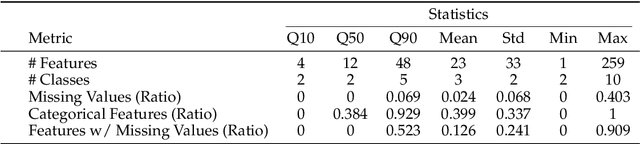
We argue that progress toward general intelligence requires complementary foundation models grounded in language, the physical world, and structured data. This report presents LimiX, the first installment of our large structured-data models (LDMs). LimiX treats structured data as a joint distribution over variables and missingness, thus capable of addressing a wide range of tabular tasks through query-based conditional prediction via a single model. LimiX is pretrained using masked joint-distribution modeling with an episodic, context-conditional objective, where the model predicts for query subsets conditioned on dataset-specific contexts, supporting rapid, training-free adaptation at inference. We evaluate LimiX across 10 large structured-data benchmarks with broad regimes of sample size, feature dimensionality, class number, categorical-to-numerical feature ratio, missingness, and sample-to-feature ratios. With a single model and a unified interface, LimiX consistently surpasses strong baselines including gradient-boosting trees, deep tabular networks, recent tabular foundation models, and automated ensembles, as shown in Figure 1 and Figure 2. The superiority holds across a wide range of tasks, such as classification, regression, missing value imputation, and data generation, often by substantial margins, while avoiding task-specific architectures or bespoke training per task. All LimiX models are publicly accessible under Apache 2.0.