 Add to Chrome
 Add to Firefox
 Add to Edge
CoMind: Understanding Collaborative Human Activity from Multiple Minds and Views
Jul 07, 2026
Human-human collaboration is a fundamental aspect of everyday life, essential to success in a wide range of goal-directed activities from household tasks to professional teamwork. While much research has focused on modeling coordination and task execution, the cognitive processes that support such collaboration, particularly Theory of Mind (the ability to infer the mental states of others), remain difficult to study in natural settings. To address this gap, we introduce a novel egocentric and exocentric video dataset capturing real-world collaboration in cooking scenarios. The dataset integrates multi-perspective video, high-quality audio, gaze tracking, and 3D scene and object scans, with annotations for shared attention to objects, social cues and interactions between agents, as well as agent-object interactions. We establish benchmarks for Joint Attention Estimation, Socially Conditioned Object Interaction Anticipation, and Collaborative Handover Prediction, enabling research on multimodal perception, proactive assistance, and collaborative planning. By providing temporally aligned, richly annotated multimodal data, CoMind facilitates the development and evaluation of AI systems capable of modeling complex social interactions and reasoning about human behaviors in collaborative environments. Our dataset and benchmarks are made available at https://comind.ethz.ch/.

LIFT: Reinforcement Learning in Computer Systems by Learning From Demonstrations
Aug 23, 2018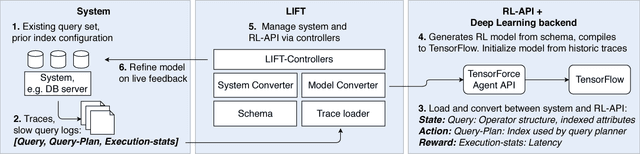
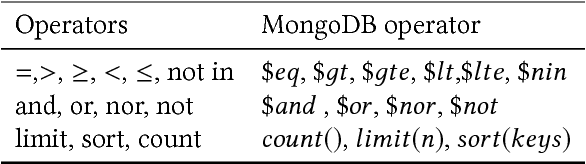
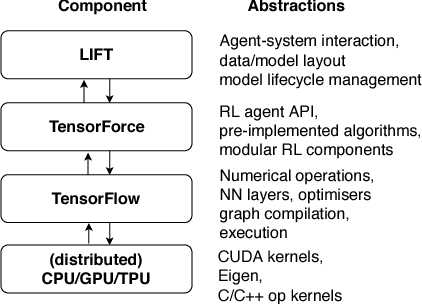
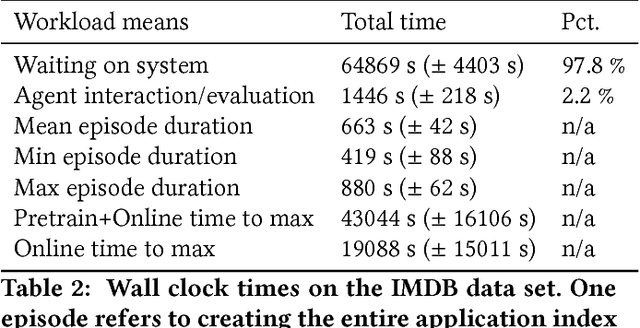
Reinforcement learning approaches have long appealed to the data management community due to their ability to learn to control dynamic behavior from raw system performance. Recent successes in combining deep neural networks with reinforcement learning have sparked significant new interest in this domain. However, practical solutions remain elusive due to large training data requirements, algorithmic instability, and lack of standard tools. In this work, we introduce LIFT, an end-to-end software stack for applying deep reinforcement learning to data management tasks. While prior work has frequently explored applications in simulations, LIFT centers on utilizing human expertise to learn from demonstrations, thus lowering online training times. We further introduce TensorForce, a TensorFlow library for applied deep reinforcement learning exposing a unified declarative interface to common RL algorithms, thus providing a backend to LIFT. We demonstrate the utility of LIFT in two case studies in database compound indexing and resource management in stream processing. Results show LIFT controllers initialized from demonstrations can outperform human baselines and heuristics across latency metrics and space usage by up to 70%.