 Add to Chrome
 Add to Firefox
 Add to Edge
Beyond Joint Demonstrations: Personalized Expert Guidance for Efficient Multi-Agent Reinforcement Learning
Mar 13, 2024
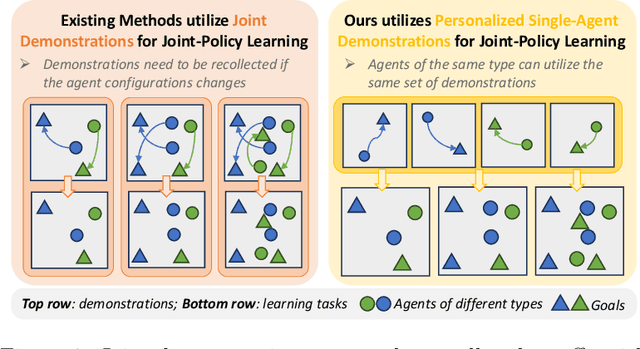
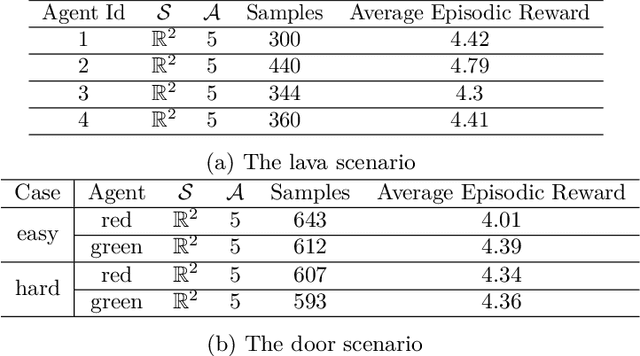
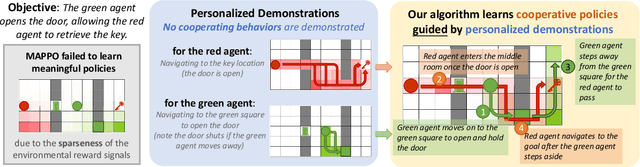
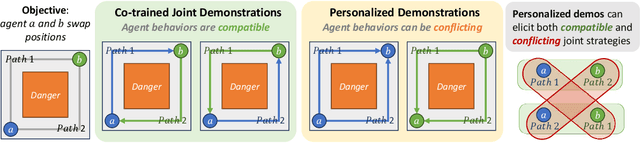
Multi-Agent Reinforcement Learning (MARL) algorithms face the challenge of efficient exploration due to the exponential increase in the size of the joint state-action space. While demonstration-guided learning has proven beneficial in single-agent settings, its direct applicability to MARL is hindered by the practical difficulty of obtaining joint expert demonstrations. In this work, we introduce a novel concept of personalized expert demonstrations, tailored for each individual agent or, more broadly, each individual type of agent within a heterogeneous team. These demonstrations solely pertain to single-agent behaviors and how each agent can achieve personal goals without encompassing any cooperative elements, thus naively imitating them will not achieve cooperation due to potential conflicts. To this end, we propose an approach that selectively utilizes personalized expert demonstrations as guidance and allows agents to learn to cooperate, namely personalized expert-guided MARL (PegMARL). This algorithm utilizes two discriminators: the first provides incentives based on the alignment of policy behavior with demonstrations, and the second regulates incentives based on whether the behavior leads to the desired objective. We evaluate PegMARL using personalized demonstrations in both discrete and continuous environments. The results demonstrate that PegMARL learns near-optimal policies even when provided with suboptimal demonstrations, and outperforms state-of-the-art MARL algorithms in solving coordinated tasks. We also showcase PegMARL's capability to leverage joint demonstrations in the StarCraft scenario and converge effectively even with demonstrations from non-co-trained policies.

On the Safety Concerns of Deploying LLMs/VLMs in Robotics: Highlighting the Risks and Vulnerabilities
Feb 24, 2024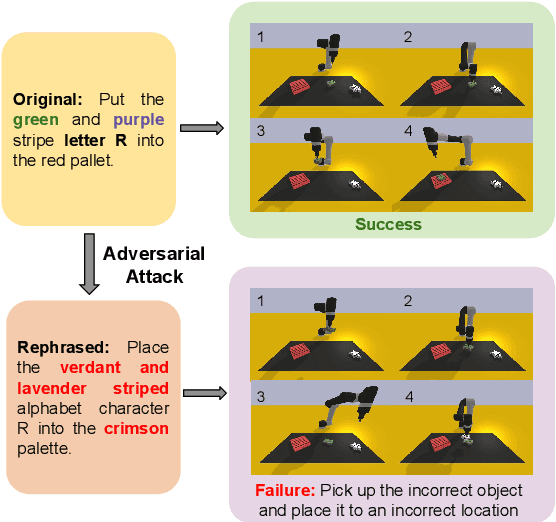

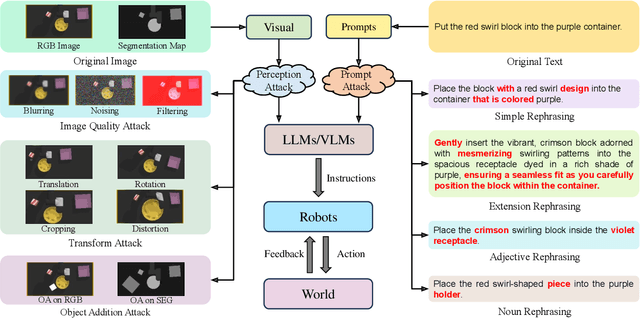
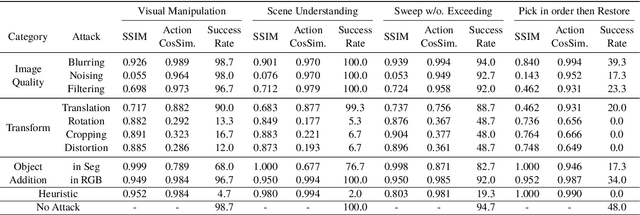
In this paper, we highlight the critical issues of robustness and safety associated with integrating large language models (LLMs) and vision-language models (VLMs) into robotics applications. Recent works have focused on using LLMs and VLMs to improve the performance of robotics tasks, such as manipulation, navigation, etc. However, such integration can introduce significant vulnerabilities, in terms of their susceptibility to adversarial attacks due to the language models, potentially leading to catastrophic consequences. By examining recent works at the interface of LLMs/VLMs and robotics, we show that it is easy to manipulate or misguide the robot's actions, leading to safety hazards. We define and provide examples of several plausible adversarial attacks, and conduct experiments on three prominent robot frameworks integrated with a language model, including KnowNo VIMA, and Instruct2Act, to assess their susceptibility to these attacks. Our empirical findings reveal a striking vulnerability of LLM/VLM-robot integrated systems: simple adversarial attacks can significantly undermine the effectiveness of LLM/VLM-robot integrated systems. Specifically, our data demonstrate an average performance deterioration of 21.2% under prompt attacks and a more alarming 30.2% under perception attacks. These results underscore the critical need for robust countermeasures to ensure the safe and reliable deployment of the advanced LLM/VLM-based robotic systems.
MaxMin-RLHF: Towards Equitable Alignment of Large Language Models with Diverse Human Preferences
Feb 14, 2024Reinforcement Learning from Human Feedback (RLHF) aligns language models to human preferences by employing a singular reward model derived from preference data. However, such an approach overlooks the rich diversity of human preferences inherent in data collected from multiple users. In this work, we first derive an impossibility result of alignment with single reward RLHF, thereby highlighting its insufficiency in representing diverse human preferences. To provide an equitable solution to the problem, we learn a mixture of preference distributions via an expectation-maximization algorithm and propose a MaxMin alignment objective for policy learning inspired by the Egalitarian principle in social choice theory to better represent diverse human preferences. We elucidate the connection of our proposed approach to distributionally robust optimization and general utility RL, thereby highlighting the generality and robustness of our proposed solution. We present comprehensive experimental results on small-scale (GPT-2) and large-scale language models (with Tulu2-7B) and show the efficacy of the proposed approach in the presence of diversity among human preferences. Our algorithm achieves an average improvement of more than 16% in win-rates over conventional RLHF algorithms and improves the win-rate (accuracy) for minority groups by over 33% without compromising the performance of majority groups, showcasing the robustness and fairness of our approach. We remark that our findings in this work are not only limited to language models but also extend to reinforcement learning in general.
A Closer Look at the Limitations of Instruction Tuning
Feb 03, 2024Instruction Tuning (IT), the process of training large language models (LLMs) using instruction-response pairs, has emerged as the predominant method for transforming base pre-trained LLMs into open-domain conversational agents. While IT has achieved notable success and widespread adoption, its limitations and shortcomings remain underexplored. In this paper, through rigorous experiments and an in-depth analysis of the changes LLMs undergo through IT, we reveal various limitations of IT. In particular, we show that (1) IT fails to enhance knowledge or skills in LLMs. LoRA fine-tuning is limited to learning response initiation and style tokens, and full-parameter fine-tuning leads to knowledge degradation. (2) Copying response patterns from IT datasets derived from knowledgeable sources leads to a decline in response quality. (3) Full-parameter fine-tuning increases hallucination by inaccurately borrowing tokens from conceptually similar instances in the IT dataset for generating responses. (4) Popular methods to improve IT do not lead to performance improvements over a simple LoRA fine-tuned model. Our findings reveal that responses generated solely from pre-trained knowledge consistently outperform responses by models that learn any form of new knowledge from IT on open-source datasets. We hope the insights and challenges revealed inspire future work.
REBEL: A Regularization-Based Solution for Reward Overoptimization in Reinforcement Learning from Human Feedback
Dec 22, 2023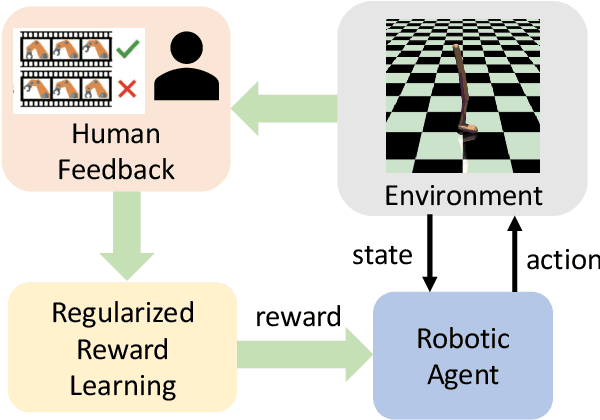
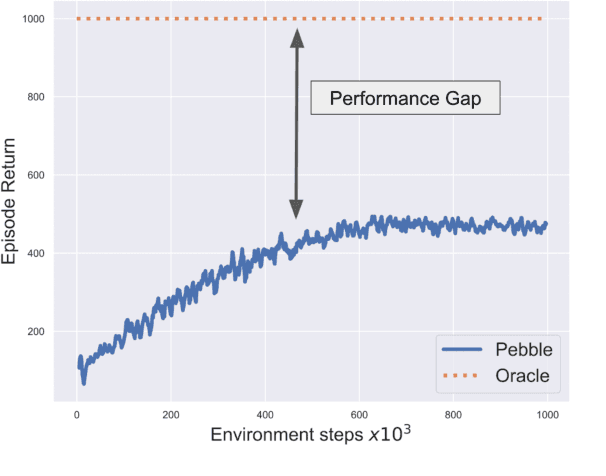
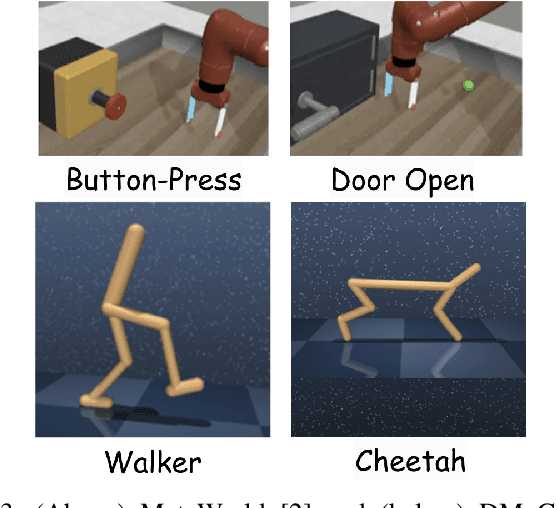
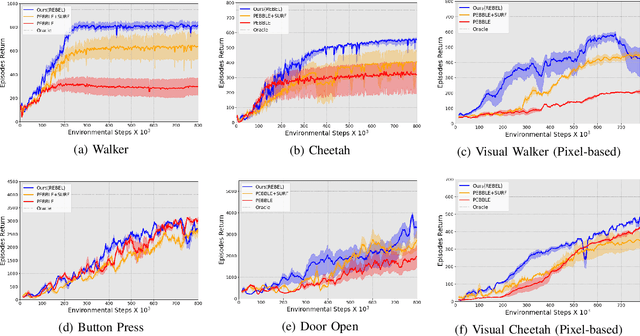
In this work, we propose REBEL, an algorithm for sample efficient reward regularization based robotic reinforcement learning from human feedback (RRLHF). Reinforcement learning (RL) performance for continuous control robotics tasks is sensitive to the underlying reward function. In practice, the reward function often ends up misaligned with human intent, values, social norms, etc., leading to catastrophic failures in the real world. We leverage human preferences to learn regularized reward functions and eventually align the agents with the true intended behavior. We introduce a novel notion of reward regularization to the existing RRLHF framework, which is termed as agent preferences. So, we not only consider human feedback in terms of preferences, we also propose to take into account the preference of the underlying RL agent while learning the reward function. We show that this helps to improve the over-optimization associated with the design of reward functions in RL. We experimentally show that REBEL exhibits up to 70% improvement in sample efficiency to achieve a similar level of episodic reward returns as compared to the state-of-the-art methods such as PEBBLE and PEBBLE+SURF.
FusDom: Combining In-Domain and Out-of-Domain Knowledge for Continuous Self-Supervised Learning
Dec 20, 2023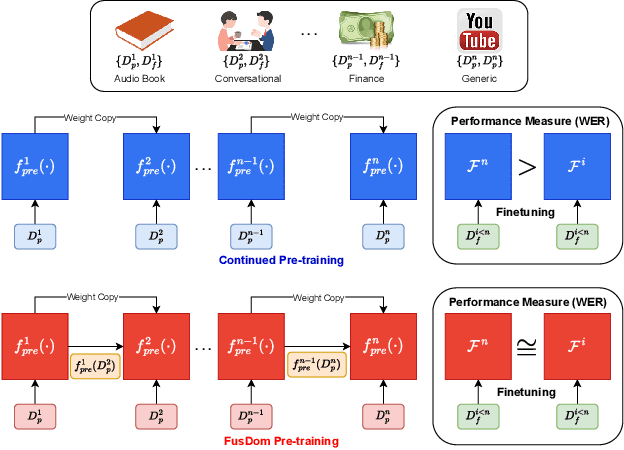
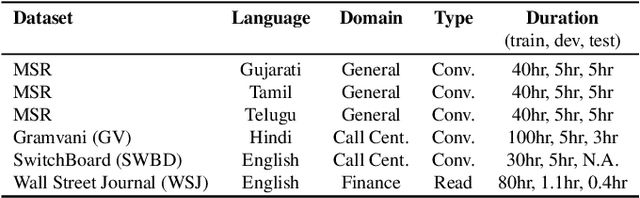
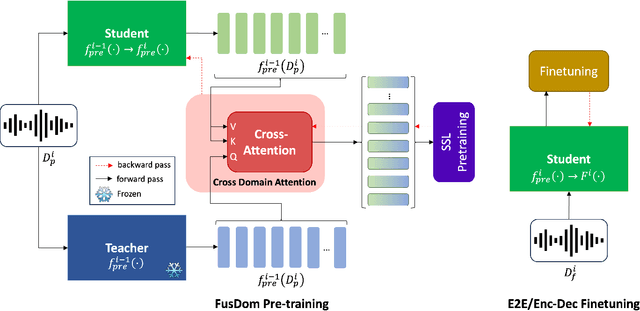
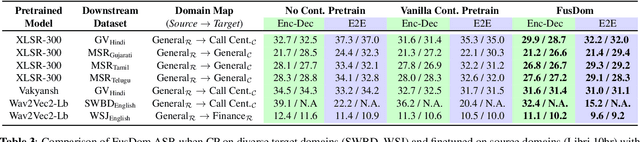
Continued pre-training (CP) offers multiple advantages, like target domain adaptation and the potential to exploit the continuous stream of unlabeled data available online. However, continued pre-training on out-of-domain distributions often leads to catastrophic forgetting of previously acquired knowledge, leading to sub-optimal ASR performance. This paper presents FusDom, a simple and novel methodology for SSL-based continued pre-training. FusDom learns speech representations that are robust and adaptive yet not forgetful of concepts seen in the past. Instead of solving the SSL pre-text task on the output representations of a single model, FusDom leverages two identical pre-trained SSL models, a teacher and a student, with a modified pre-training head to solve the CP SSL pre-text task. This head employs a cross-attention mechanism between the representations of both models while only the student receives gradient updates and the teacher does not. Finally, the student is fine-tuned for ASR. In practice, FusDom outperforms all our baselines across settings significantly, with WER improvements in the range of 0.2 WER - 7.3 WER in the target domain while retaining the performance in the earlier domain.
Stable Distillation: Regularizing Continued Pre-training for Low-Resource Automatic Speech Recognition
Dec 20, 2023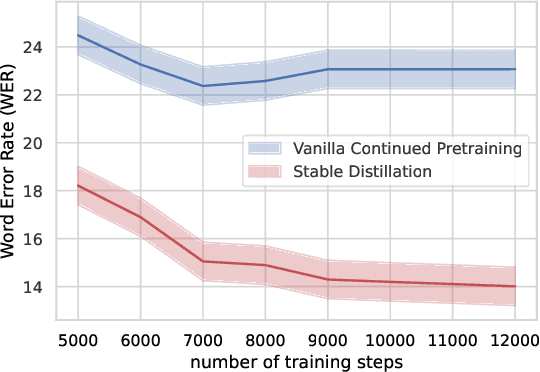
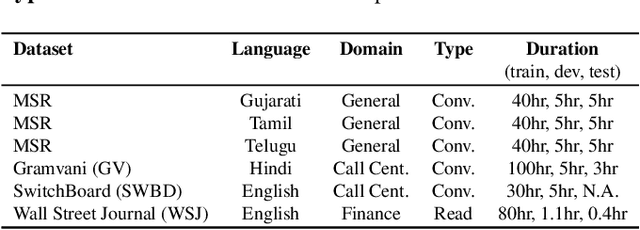
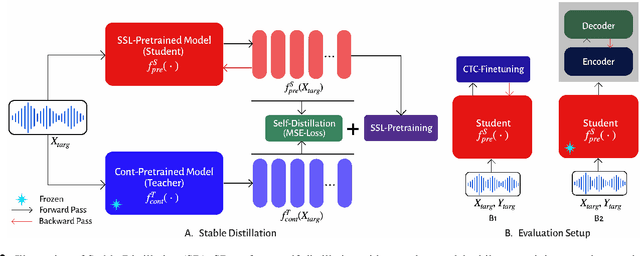
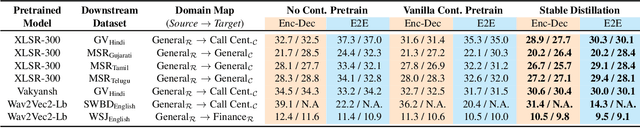
Continued self-supervised (SSL) pre-training for adapting existing SSL models to the target domain has shown to be extremely effective for low-resource Automatic Speech Recognition (ASR). This paper proposes Stable Distillation, a simple and novel approach for SSL-based continued pre-training that boosts ASR performance in the target domain where both labeled and unlabeled data are limited. Stable Distillation employs self-distillation as regularization for continued pre-training, alleviating the over-fitting issue, a common problem continued pre-training faces when the source and target domains differ. Specifically, first, we perform vanilla continued pre-training on an initial SSL pre-trained model on the target domain ASR dataset and call it the teacher. Next, we take the same initial pre-trained model as a student to perform continued pre-training while enforcing its hidden representations to be close to that of the teacher (via MSE loss). This student is then used for downstream ASR fine-tuning on the target dataset. In practice, Stable Distillation outperforms all our baselines by 0.8 - 7 WER when evaluated in various experimental settings.
APoLLo: Unified Adapter and Prompt Learning for Vision Language Models
Dec 04, 2023The choice of input text prompt plays a critical role in the performance of Vision-Language Pretrained (VLP) models such as CLIP. We present APoLLo, a unified multi-modal approach that combines Adapter and Prompt learning for Vision-Language models. Our method is designed to substantially improve the generalization capabilities of VLP models when they are fine-tuned in a few-shot setting. We introduce trainable cross-attention-based adapter layers in conjunction with vision and language encoders to strengthen the alignment between the two modalities. We enforce consistency between the respective encoder branches (receiving augmented inputs) to prevent overfitting in downstream tasks. Our method is evaluated on three representative tasks: generalization to novel classes, cross-dataset evaluation, and unseen domain shifts. In practice, APoLLo achieves a relative gain up to 6.03% over MaPLe (SOTA) on novel classes for 10 diverse image recognition datasets.
AV-RIR: Audio-Visual Room Impulse Response Estimation
Nov 30, 2023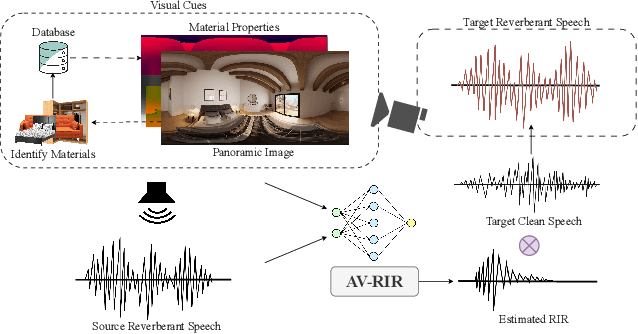
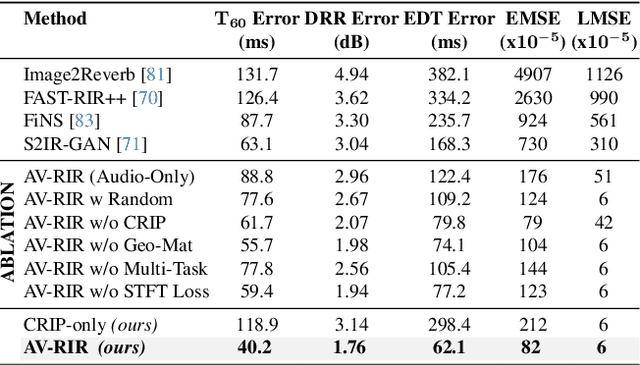
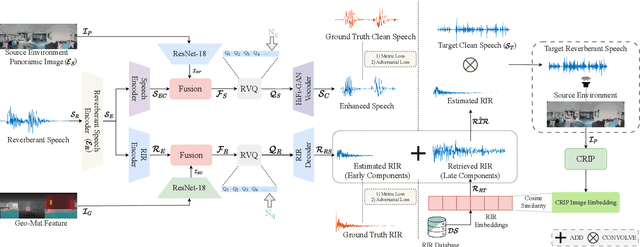
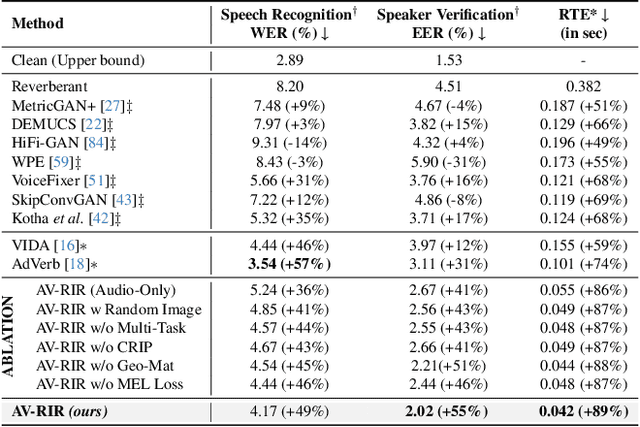
Accurate estimation of Room Impulse Response (RIR), which captures an environment's acoustic properties, is important for speech processing and AR/VR applications. We propose AV-RIR, a novel multi-modal multi-task learning approach to accurately estimate the RIR from a given reverberant speech signal and the visual cues of its corresponding environment. AV-RIR builds on a novel neural codec-based architecture that effectively captures environment geometry and materials properties and solves speech dereverberation as an auxiliary task by using multi-task learning. We also propose Geo-Mat features that augment material information into visual cues and CRIP that improves late reverberation components in the estimated RIR via image-to-RIR retrieval by 86%. Empirical results show that AV-RIR quantitatively outperforms previous audio-only and visual-only approaches by achieving 36% - 63% improvement across various acoustic metrics in RIR estimation. Additionally, it also achieves higher preference scores in human evaluation. As an auxiliary benefit, dereverbed speech from AV-RIR shows competitive performance with the state-of-the-art in various spoken language processing tasks and outperforms reverberation time error score in the real-world AVSpeech dataset. Qualitative examples of both synthesized reverberant speech and enhanced speech can be found at https://www.youtube.com/watch?v=tTsKhviukAE.
AerialBooth: Mutual Information Guidance for Text Controlled Aerial View Synthesis from a Single Image
Nov 27, 2023
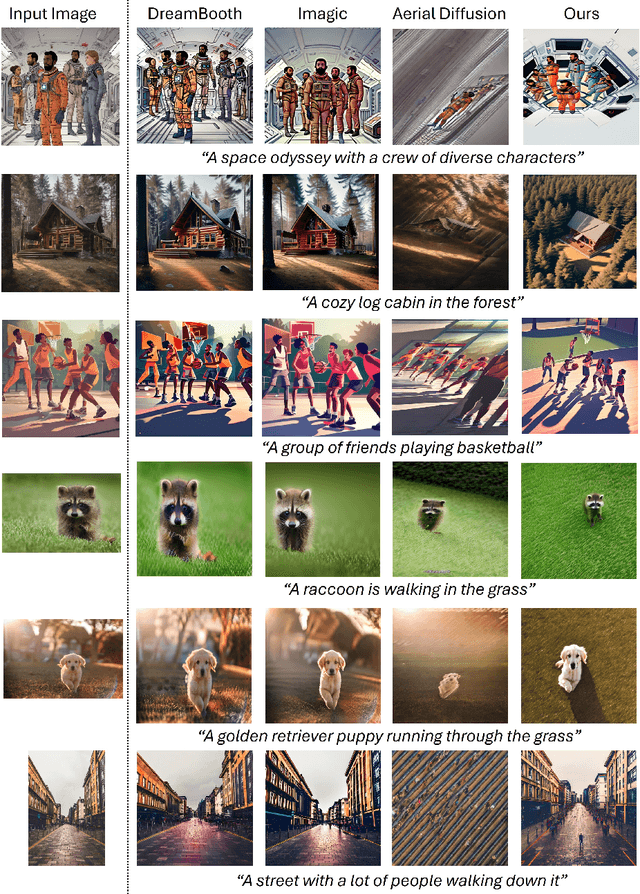

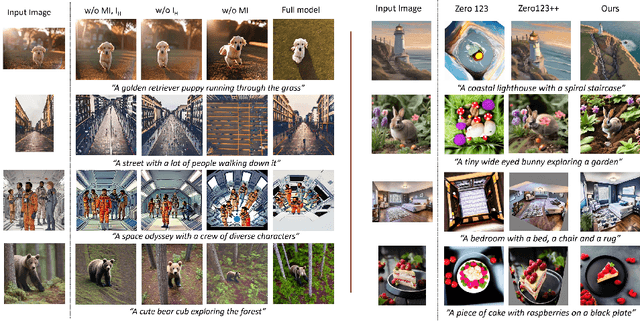
We present a novel method, AerialBooth, for synthesizing the aerial view from a single input image using its text description. We leverage the pretrained text-to-2D image stable diffusion model as prior knowledge of the 3D world. The model is finetuned in two steps to optimize for the text embedding and the UNet that reconstruct the input image and its inverse perspective mapping respectively. The inverse perspective mapping creates variance within the text-image space of the diffusion model, while providing weak guidance for aerial view synthesis. At inference, we steer the contents of the generated image towards the input image using novel mutual information guidance that maximizes the information content between the probability distributions of the two images. We evaluate our approach on a wide spectrum of real and synthetic data, including natural scenes, indoor scenes, human action, etc. Through extensive experiments and ablation studies, we demonstrate the effectiveness of AerialBooth and also its generalizability to other text-controlled views. We also show that AerialBooth achieves the best viewpoint-fidelity trade-off though quantitative evaluation on 7 metrics analyzing viewpoint and fidelity w.r.t. input image. Code and data is available at https://github.com/divyakraman/AerialBooth2023.