 Add to Chrome
 Add to Firefox
 Add to Edge
PDE foundation model-accelerated inverse estimation of system parameters in inertial confinement fusion
Mar 04, 2026
PDE foundation models are typically pretrained on large, diverse corpora of PDE datasets and can be adapted to new settings with limited task-specific data. However, most downstream evaluations focus on forward problems, such as autoregressive rollout prediction. In this work, we study an inverse problem in inertial confinement fusion (ICF): estimating system parameters (inputs) from multi-modal, snapshot-style observations (outputs). Using the open JAG benchmark, which provides hyperspectral X-ray images and scalar observables per simulation, we finetune the PDE foundation model and train a lightweight task-specific head to jointly reconstruct hyperspectral images and regress system parameters. The fine-tuned model achieves accurate hyperspectral reconstruction (test MSE 1.2e-3) and strong parameter-estimation performance (up to R^2=0.995). Data-scaling experiments (5%-100% of the training set) show consistent improvements in both reconstruction and regression losses as the amount of training data increases, with the largest marginal gains in the low-data regime. Finally, finetuning from pretrained MORPH weights outperforms training the same architecture from scratch, demonstrating that foundation-model initialization improves sample efficiency for data-limited inverse problems in ICF.

Out-of-distribution transfer of PDE foundation models to material dynamics under extreme loading
Mar 04, 2026Most PDE foundation models are pretrained and fine-tuned on fluid-centric benchmarks. Their utility under extreme-loading material dynamics remains unclear. We benchmark out-of-distribution transfer on two discontinuity-dominated regimes in which shocks, evolving interfaces, and fracture produce highly non-smooth fields: shock-driven multi-material interface dynamics (perturbed layered interface or PLI) and dynamic fracture/failure evolution (FRAC). We formulate the downstream task as terminal-state prediction, i.e., learning a long-horizon map that predicts the final state directly from the first snapshot without intermediate supervision. Using a unified training and evaluation protocol, we evaluate two open-source pretrained PDE foundation models, POSEIDON and MORPH, and compare fine-tuning from pretrained weights against training from scratch across training-set sizes to quantify sample efficiency under distribution shift.
Accelerating Posterior Inference from Pulsar Light Curves via Learned Latent Representations and Local Simulator-Guided Optimization
Feb 16, 2026Posterior inference from pulsar observations in the form of light curves is commonly performed using Markov chain Monte Carlo methods, which are accurate but computationally expensive. We introduce a framework that accelerates posterior inference while maintaining accuracy by combining learned latent representations with local simulator-guided optimization. A masked U-Net is first pretrained to reconstruct complete light curves from partial observations and to produce informative latent embeddings. Given a query light curve, we identify similar simulated light curves from the simulation bank by measuring similarity in the learned embedding space produced by pretrained U-Net encoder, yielding an initial empirical approximation to the posterior over parameters. This initialization is then refined using a local optimization procedure using hill-climbing updates, guided by a forward simulator, progressively shifting the empirical posterior toward higher-likelihood parameter regions. Experiments on the observed light curve of PSR J0030+0451, captured by NASA's Neutron Star Interior Composition Explorer (NICER), show that our method closely matches posterior estimates obtained using traditional MCMC methods while achieving 120 times reduction in inference time (from 24 hours to 12 minutes), demonstrating the effectiveness of learned representations and simulator-guided optimization for accelerated posterior inference.
SPUS: A Lightweight and Parameter-Efficient Foundation Model for PDEs
Oct 01, 2025We introduce Small PDE U-Net Solver (SPUS), a compact and efficient foundation model (FM) designed as a unified neural operator for solving a wide range of partial differential equations (PDEs). Unlike existing state-of-the-art PDE FMs-primarily based on large complex transformer architectures with high computational and parameter overhead-SPUS leverages a lightweight residual U-Net-based architecture that has been largely underexplored as a foundation model architecture in this domain. To enable effective learning in this minimalist framework, we utilize a simple yet powerful auto-regressive pretraining strategy which closely replicates the behavior of numerical solvers to learn the underlying physics. SPUS is pretrained on a diverse set of fluid dynamics PDEs and evaluated across 6 challenging unseen downstream PDEs spanning various physical systems. Experimental results demonstrate that SPUS using residual U-Net based architecture achieves state-of-the-art generalization on these downstream tasks while requiring significantly fewer parameters and minimal fine-tuning data, highlighting its potential as a highly parameter-efficient FM for solving diverse PDE systems.
Graph Neural Networks for Parameterized Quantum Circuits Expressibility Estimation
May 13, 2024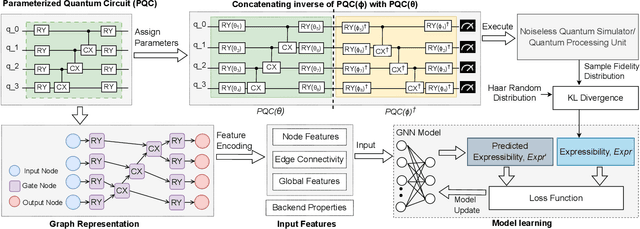


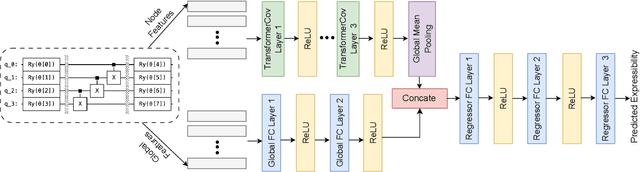
Parameterized quantum circuits (PQCs) are fundamental to quantum machine learning (QML), quantum optimization, and variational quantum algorithms (VQAs). The expressibility of PQCs is a measure that determines their capability to harness the full potential of the quantum state space. It is thus a crucial guidepost to know when selecting a particular PQC ansatz. However, the existing technique for expressibility computation through statistical estimation requires a large number of samples, which poses significant challenges due to time and computational resource constraints. This paper introduces a novel approach for expressibility estimation of PQCs using Graph Neural Networks (GNNs). We demonstrate the predictive power of our GNN model with a dataset consisting of 25,000 samples from the noiseless IBM QASM Simulator and 12,000 samples from three distinct noisy quantum backends. The model accurately estimates expressibility, with root mean square errors (RMSE) of 0.05 and 0.06 for the noiseless and noisy backends, respectively. We compare our model's predictions with reference circuits [Sim and others, QuTe'2019] and IBM Qiskit's hardware-efficient ansatz sets to further evaluate our model's performance. Our experimental evaluation in noiseless and noisy scenarios reveals a close alignment with ground truth expressibility values, highlighting the model's efficacy. Moreover, our model exhibits promising extrapolation capabilities, predicting expressibility values with low RMSE for out-of-range qubit circuits trained solely on only up to 5-qubit circuit sets. This work thus provides a reliable means of efficiently evaluating the expressibility of diverse PQCs on noiseless simulators and hardware.
DeepPatent2: A Large-Scale Benchmarking Corpus for Technical Drawing Understanding
Nov 07, 2023Recent advances in computer vision (CV) and natural language processing have been driven by exploiting big data on practical applications. However, these research fields are still limited by the sheer volume, versatility, and diversity of the available datasets. CV tasks, such as image captioning, which has primarily been carried out on natural images, still struggle to produce accurate and meaningful captions on sketched images often included in scientific and technical documents. The advancement of other tasks such as 3D reconstruction from 2D images requires larger datasets with multiple viewpoints. We introduce DeepPatent2, a large-scale dataset, providing more than 2.7 million technical drawings with 132,890 object names and 22,394 viewpoints extracted from 14 years of US design patent documents. We demonstrate the usefulness of DeepPatent2 with conceptual captioning. We further provide the potential usefulness of our dataset to facilitate other research areas such as 3D image reconstruction and image retrieval.
Discovering Image Usage Online: A Case Study With "Flatten the Curve''
Jul 12, 2023Understanding the spread of images across the web helps us understand the reuse of scientific visualizations and their relationship with the public. The "Flatten the Curve" graphic was heavily used during the COVID-19 pandemic to convey a complex concept in a simple form. It displays two curves comparing the impact on case loads for medical facilities if the populace either adopts or fails to adopt protective measures during a pandemic. We use five variants of the "Flatten the Curve" image as a case study for viewing the spread of an image online. To evaluate its spread, we leverage three information channels: reverse image search engines, social media, and web archives. Reverse image searches give us a current view into image reuse. Social media helps us understand a variant's popularity over time. Web archives help us see when it was preserved, highlighting a view of popularity for future researchers. Our case study leverages document URLs can be used as a proxy for images when studying the spread of images online.
Semi-supervised Learning of Pushforwards For Domain Translation & Adaptation
Apr 18, 2023Given two probability densities on related data spaces, we seek a map pushing one density to the other while satisfying application-dependent constraints. For maps to have utility in a broad application space (including domain translation, domain adaptation, and generative modeling), the map must be available to apply on out-of-sample data points and should correspond to a probabilistic model over the two spaces. Unfortunately, existing approaches, which are primarily based on optimal transport, do not address these needs. In this paper, we introduce a novel pushforward map learning algorithm that utilizes normalizing flows to parameterize the map. We first re-formulate the classical optimal transport problem to be map-focused and propose a learning algorithm to select from all possible maps under the constraint that the map minimizes a probability distance and application-specific regularizers; thus, our method can be seen as solving a modified optimal transport problem. Once the map is learned, it can be used to map samples from a source domain to a target domain. In addition, because the map is parameterized as a composition of normalizing flows, it models the empirical distributions over the two data spaces and allows both sampling and likelihood evaluation for both data sets. We compare our method (parOT) to related optimal transport approaches in the context of domain adaptation and domain translation on benchmark data sets. Finally, to illustrate the impact of our work on applied problems, we apply parOT to a real scientific application: spectral calibration for high-dimensional measurements from two vastly different environments
Generative structured normalizing flow Gaussian processes applied to spectroscopic data
Dec 14, 2022


In this work, we propose a novel generative model for mapping inputs to structured, high-dimensional outputs using structured conditional normalizing flows and Gaussian process regression. The model is motivated by the need to characterize uncertainty in the input/output relationship when making inferences on new data. In particular, in the physical sciences, limited training data may not adequately characterize future observed data; it is critical that models adequately indicate uncertainty, particularly when they may be asked to extrapolate. In our proposed model, structured conditional normalizing flows provide parsimonious latent representations that relate to the inputs through a Gaussian process, providing exact likelihood calculations and uncertainty that naturally increases away from the training data inputs. We demonstrate the methodology on laser-induced breakdown spectroscopy data from the ChemCam instrument onboard the Mars rover Curiosity. ChemCam was designed to recover the chemical composition of rock and soil samples by measuring the spectral properties of plasma atomic emissions induced by a laser pulse. We show that our model can generate realistic spectra conditional on a given chemical composition and that we can use the model to perform uncertainty quantification of chemical compositions for new observed spectra. Based on our results, we anticipate that our proposed modeling approach may be useful in other scientific domains with high-dimensional, complex structure where it is important to quantify predictive uncertainty.
Abstract Images Have Different Levels of Retrievability Per Reverse Image Search Engine
Nov 03, 2022Much computer vision research has focused on natural images, but technical documents typically consist of abstract images, such as charts, drawings, diagrams, and schematics. How well do general web search engines discover abstract images? Recent advancements in computer vision and machine learning have led to the rise of reverse image search engines. Where conventional search engines accept a text query and return a set of document results, including images, a reverse image search accepts an image as a query and returns a set of images as results. This paper evaluates how well common reverse image search engines discover abstract images. We conducted an experiment leveraging images from Wikimedia Commons, a website known to be well indexed by Baidu, Bing, Google, and Yandex. We measure how difficult an image is to find again (retrievability), what percentage of images returned are relevant (precision), and the average number of results a visitor must review before finding the submitted image (mean reciprocal rank). When trying to discover the same image again among similar images, Yandex performs best. When searching for pages containing a specific image, Google and Yandex outperform the others when discovering photographs with precision scores ranging from 0.8191 to 0.8297, respectively. In both of these cases, Google and Yandex perform better with natural images than with abstract ones achieving a difference in retrievability as high as 54\% between images in these categories. These results affect anyone applying common web search engines to search for technical documents that use abstract images.