 Add to Chrome
 Add to Firefox
 Add to Edge
Generalised Bellman recurrence and three dualities in sequential decision-making
Jul 20, 2026
What gives the Bellman equation its form? We show that the recursive properties of optimal value functions follow from three conditions: that the dynamics decomposes through sufficient statistics, that the return decomposes recursively, and that the aggregation of uncertainty is compatible with both. When all three conditions hold on a common state, the Bellman equation arises from their mutual consistency; when one fails, tractability can often be recovered by augmenting the state or by deforming return or dynamics. The same conditions are shown to give rise to three dualities: one between probability and return, one between return and aggregation, and one between aggregation and probability. Our framework reveals these dualities as arising from a single construction, unifying methods developed separately across reinforcement learning, control, and decision theory.

Safety from Honesty in a Disinterested AI Predictor
Jun 28, 2026As AI systems become more capable, training procedures that optimize for downstream outcomes risk introducing implicit agency: goal-directed behavior that designers never specified. We present a formal safety argument for the Scientist AI (SAI) Predictor, trained to approximate the Bayesian posterior conditioned on a dataset of "epistemically contextualized" natural-language statements. We argue that such a Predictor can honestly predict agents, actions, and their consequences without itself being an agent that selects outputs to achieve goals. This rests on data representation and on the training procedure. Epistemic contextualization of text distinguishes latent factual claims from communication acts, so expressions of goals are treated as evidence to be explained rather than drives the model adopts. With a posterior-seeking training objective, this is intended to drive the Predictor toward calibrated, cautious predictions. Training proceeds so downstream effects of deploying a prediction never serve as a reward signal; any agency the system needs is supplied by explicit scaffolding constrained by guardrails. We prove that, under assumptions on the training dynamics and on the argued sparsity of dangerous Predictors, the probability that training produces a Predictor whose guarded deployment carries residual harm above a specified threshold is small: a dangerous Predictor would have to underestimate harm in a coordinated way across many queries while such coordinated patterns are rare under the initialization distribution and receive no direct training signal. Safety and accuracy are jointly supported in this framework, since the constraints that secure accuracy are the same ones that make coordinated deception costly. These guarantees against misalignment and agency arising from within the Predictor itself do not preclude the use of the Predictor as part of an agentic system.
Learning POMDP World Models from Observations with Language-Model Priors
May 13, 2026Whether navigating a building, operating a robot, or playing a game, an agent that acts effectively in an environment must first learn an internal model of how that environment works. Partially-observable Markov decision processes (POMDPs) provide a flexible modeling class for such internal world models, but learning them from observation-action trajectories alone is challenging and typically requires extensive environment interaction. We ask whether language-model priors can reduce costly interaction by leveraging prior knowledge, and introduce \emph{Pinductor} (POMDP-inductor): an LLM proposes candidate POMDP models from a few observation-action trajectories and iteratively refines them to optimize a belief-based likelihood score. Despite using strictly less information, \emph{Pinductor} matches the performance and sample efficiency of LLM-based POMDP learning methods that assume privileged access to the hidden state, while significantly surpassing the sample efficiency of tabular POMDP baselines. Further results show that performance scales with LLM capability and degrades gracefully as semantic information about the environment is withheld. Together, these results position language-model priors as a practical tool for sample-efficient world-model learning under partial observability, and a step toward generalist agents in real-world environments. Code is available at https://github.com/atomresearch/pinductor.
Learning Task Automata for Reinforcement Learning using Hidden Markov Models
Aug 25, 2022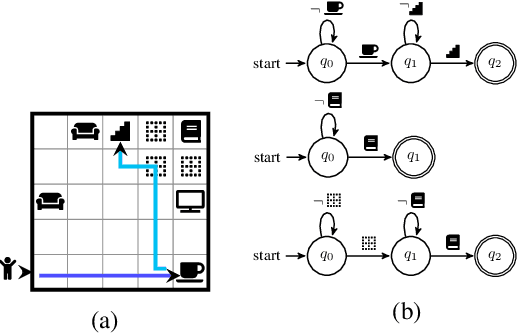
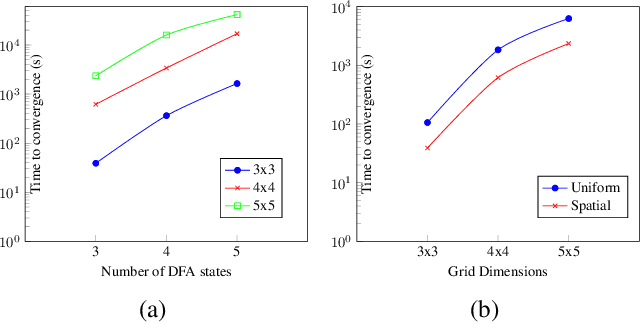
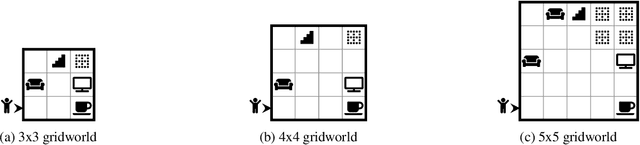

Training reinforcement learning (RL) agents using scalar reward signals is often infeasible when an environment has sparse and non-Markovian rewards. Moreover, handcrafting these reward functions before training is prone to misspecification, especially when the environment's dynamics are only partially known. This paper proposes a novel pipeline for learning non-Markovian task specifications as succinct finite-state `task automata' from episodes of agent experience within unknown environments. We leverage two key algorithmic insights. First, we learn a product MDP, a model composed of the specification's automaton and the environment's MDP (both initially unknown), by treating it as a partially observable MDP and using off-the-shelf algorithms for hidden Markov models. Second, we propose a novel method for distilling the task automaton (assumed to be a deterministic finite automaton) from the learnt product MDP. Our learnt task automaton enables the decomposition of a task into its constituent sub-tasks, which improves the rate at which an RL agent can later synthesise an optimal policy. It also provides an interpretable encoding of high-level environmental and task features, so a human can readily verify that the agent has learnt coherent tasks with no misspecifications. In addition, we take steps towards ensuring that the learnt automaton is environment-agnostic, making it well-suited for use in transfer learning. Finally, we provide experimental results to illustrate our algorithm's performance in different environments and tasks and its ability to incorporate prior domain knowledge to facilitate more efficient learning.