 Add to Chrome
 Add to Firefox
 Add to Edge
Generalised Bellman recurrence and three dualities in sequential decision-making
Jul 20, 2026
What gives the Bellman equation its form? We show that the recursive properties of optimal value functions follow from three conditions: that the dynamics decomposes through sufficient statistics, that the return decomposes recursively, and that the aggregation of uncertainty is compatible with both. When all three conditions hold on a common state, the Bellman equation arises from their mutual consistency; when one fails, tractability can often be recovered by augmenting the state or by deforming return or dynamics. The same conditions are shown to give rise to three dualities: one between probability and return, one between return and aggregation, and one between aggregation and probability. Our framework reveals these dualities as arising from a single construction, unifying methods developed separately across reinforcement learning, control, and decision theory.

Life as Plasmas: Autonomy and Interactivism in-materio
Jul 03, 2026When is a material system a candidate for life at all? We argue that this question is prior to behavior, functional architecture, or computational capacity, and that at root it is one of physical admissibility. We develop a framework in which minimal autonomy, taken in the interactivist sense of normativity grounded in self-maintaining far-from-equilibrium organization, corresponds to a distinct non-equilibrium phase of matter, and we take complex plasmas, a physical and non-biological system, as its in-materio exemplar. We formalize a diagnostic phase-space whose criteria (sustained free-energy throughput, organizational closure, active information maintenance, and regulated noise sensitivity) constitute necessary conditions for life-attribution. We instantiate the diagnostics across contrasting systems and fix the boundaries of the phase space via Bénard convection as a driven baseline lacking closure, and a digital self-replicating soup that carries measured informational heredity while its physical closure remains a structural zero. We demonstrate that plasmas satisfy every admissibility condition for minimal physical autonomy while carrying none of the informational heredity that open-ended evolution requires, sharpening the distinction between physical admissibility and biological sufficiency, and bounding downstream questions of machine sentience.
Active Inference: A method for Phenotyping Agency in AI systems?
Apr 25, 2026The proliferation of agentic artificial intelligence has outpaced the conceptual tools needed to characterize agency in computational systems. Prevailing definitions mainly rely on autonomy and goal-directedness. Here, we argue for a minimal notion open to principled inspection given three criteria: intentionality as action grounded in beliefs and desires, rationality as normatively coherent action entailed by a world model, and explainability as action causally traceable to internal states; we subsequently instantiate these as a partially observable Markov decision process under a variational framework wherein posterior beliefs, prior preferences, and the minimization of expected free energy jointly constitute an agentic action chain. Using a canonical T-maze paradigm, we evidence how empowerment, formulated as the channel capacity between actions and anticipated observations, serves as an operational metric that distinguishes zero-, intermediate-, and high-agency phenotypes through structural manipulations of the generative model. We conclude by arguing that as agents engage in epistemic foraging to resolve ambiguity, the governance controls that remain effective must shift systematically from external constraints to the internal modulation of prior preferences, offering a principled, variational bridge from computational phenotyping to AI governance strategy
Multi-Agent Empowerment and Emergence of Complex Behavior in Groups
Apr 22, 2026Intrinsic motivations are receiving increasing attention, i.e. behavioral incentives that are not engineered, but emerge from the interaction of an agent with its surroundings. In this work we study the emergence of behaviors driven by one such incentive, empowerment, specifically in the context of more than one agent. We formulate a principled extension of empowerment to the multi-agent setting, and demonstrate its efficient calculation. We observe that this intrinsic motivation gives rise to characteristic modes of group-organization in two qualitatively distinct environments: a pair of agents coupled by a tendon, and a controllable Vicsek flock. This demonstrates the potential of intrinsic motivations such as empowerment to not just drive behavior for only individual agents but also higher levels of behavioral organization at scale.
The Contingencies of Physical Embodiment Allow for Open-Endedness and Care
Oct 08, 2025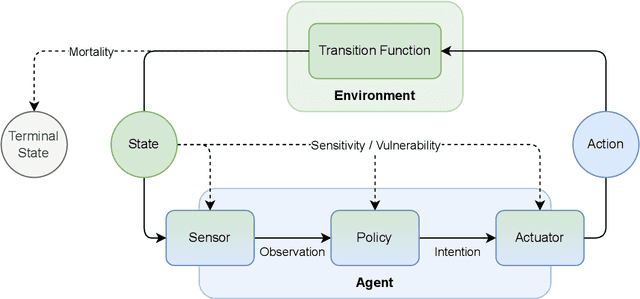
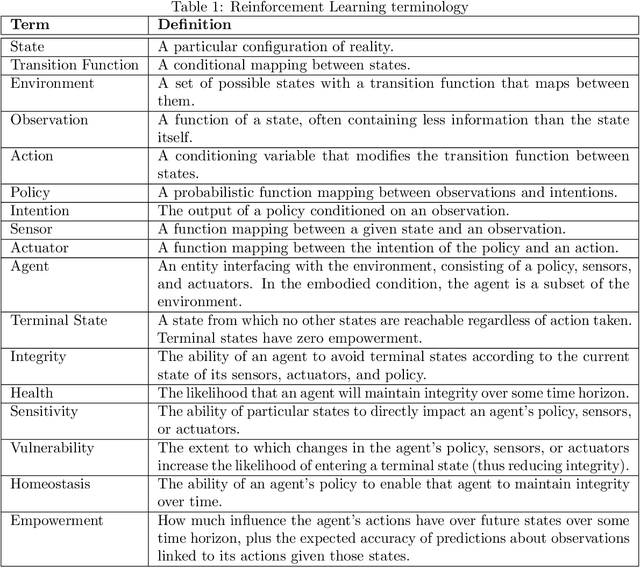
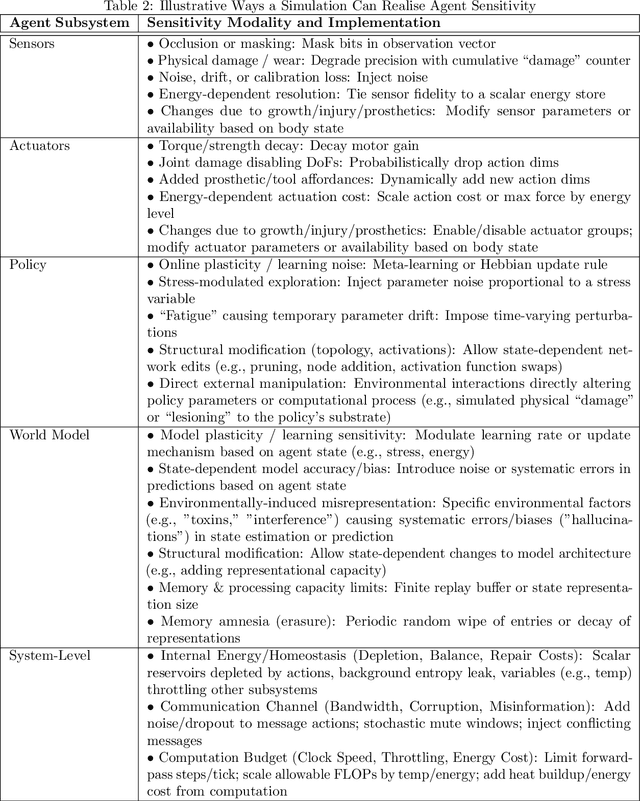
Physical vulnerability and mortality are often seen as obstacles to be avoided in the development of artificial agents, which struggle to adapt to open-ended environments and provide aligned care. Meanwhile, biological organisms survive, thrive, and care for each other in an open-ended physical world with relative ease and efficiency. Understanding the role of the conditions of life in this disparity can aid in developing more robust, adaptive, and caring artificial agents. Here we define two minimal conditions for physical embodiment inspired by the existentialist phenomenology of Martin Heidegger: being-in-the-world (the agent is a part of the environment) and being-towards-death (unless counteracted, the agent drifts toward terminal states due to the second law of thermodynamics). We propose that from these conditions we can obtain both a homeostatic drive - aimed at maintaining integrity and avoiding death by expending energy to learn and act - and an intrinsic drive to continue to do so in as many ways as possible. Drawing inspiration from Friedrich Nietzsche's existentialist concept of will-to-power, we examine how intrinsic drives to maximize control over future states, e.g., empowerment, allow agents to increase the probability that they will be able to meet their future homeostatic needs, thereby enhancing their capacity to maintain physical integrity. We formalize these concepts within a reinforcement learning framework, which enables us to examine how intrinsically driven embodied agents learning in open-ended multi-agent environments may cultivate the capacities for open-endedness and care.ov
Decentralized Traffic Flow Optimization Through Intrinsic Motivation
May 08, 2025Traffic congestion has long been an ubiquitous problem that is exacerbating with the rapid growth of megacities. In this proof-of-concept work we study intrinsic motivation, implemented via the empowerment principle, to control autonomous car behavior to improve traffic flow. In standard models of traffic dynamics, self-organized traffic jams emerge spontaneously from the individual behavior of cars, affecting traffic over long distances. Our novel car behavior strategy improves traffic flow while still being decentralized and using only locally available information without explicit coordination. Decentralization is essential for various reasons, not least to be able to absorb robustly substantial levels of uncertainty. Our scenario is based on the well-established traffic dynamics model, the Nagel-Schreckenberg cellular automaton. In a fraction of the cars in this model, we substitute the default behavior by empowerment, our intrinsic motivation-based method. This proposed model significantly improves overall traffic flow, mitigates congestion, and reduces the average traffic jam time.
* 9 pages, 6 figures, Published in the Proceedings of the 2024 IEEE 27th International Conference on Intelligent Transportation Systems (ITSC)
SuPLE: Robot Learning with Lyapunov Rewards
Nov 20, 2024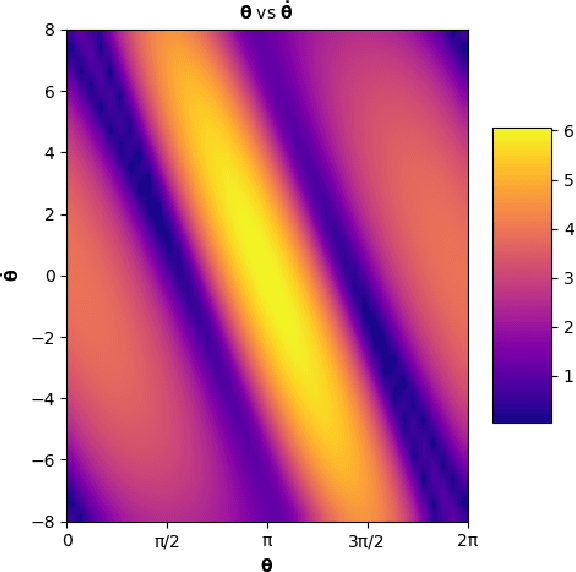
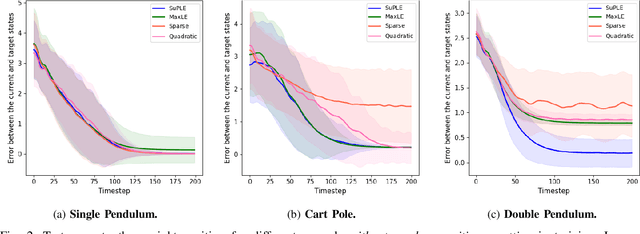
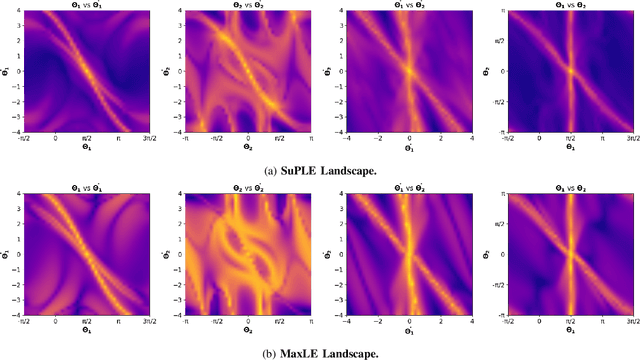
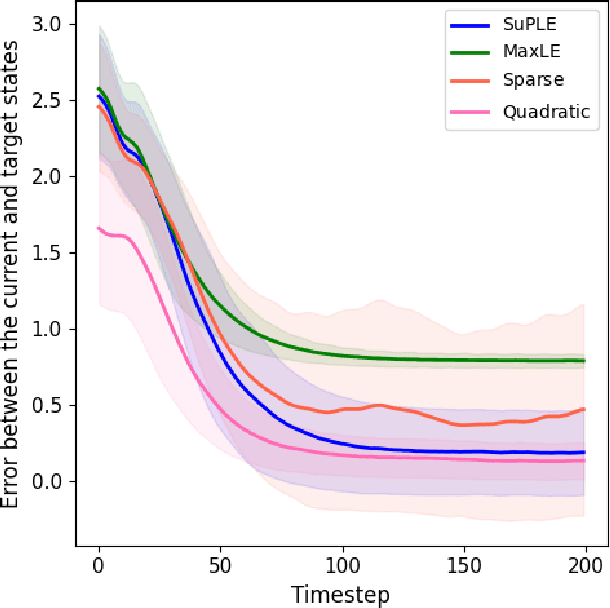
The reward function is an essential component in robot learning. Reward directly affects the sample and computational complexity of learning, and the quality of a solution. The design of informative rewards requires domain knowledge, which is not always available. We use the properties of the dynamics to produce system-appropriate reward without adding external assumptions. Specifically, we explore an approach to utilize the Lyapunov exponents of the system dynamics to generate a system-immanent reward. We demonstrate that the `Sum of the Positive Lyapunov Exponents' (SuPLE) is a strong candidate for the design of such a reward. We develop a computational framework for the derivation of this reward, and demonstrate its effectiveness on classical benchmarks for sample-based stabilization of various dynamical systems. It eliminates the need to start the training trajectories at arbitrary states, also known as auxiliary exploration. While the latter is a common practice in simulated robot learning, it is unpractical to consider to use it in real robotic systems, since they typically start from natural rest states such as a pendulum at the bottom, a robot on the ground, etc. and can not be easily initialized at arbitrary states. Comparing the performance of SuPLE to commonly-used reward functions, we observe that the latter fail to find a solution without auxiliary exploration, even for the task of swinging up the double pendulum and keeping it stable at the upright position, a prototypical scenario for multi-linked robots. SuPLE-induced rewards for robot learning offer a novel route for effective robot learning in typical as opposed to highly specialized or fine-tuned scenarios. Our code is publicly available for reproducibility and further research.
Dimensionality Reduction of Dynamics on Lie Manifolds via Structure-Aware Canonical Correlation Analysis
Nov 17, 2023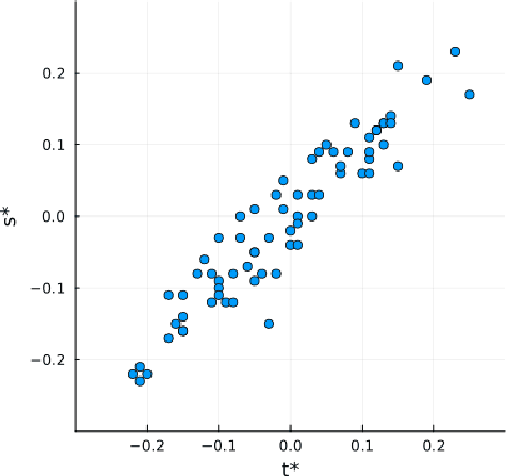
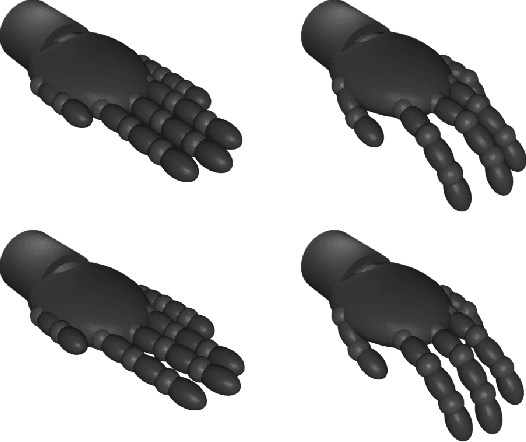
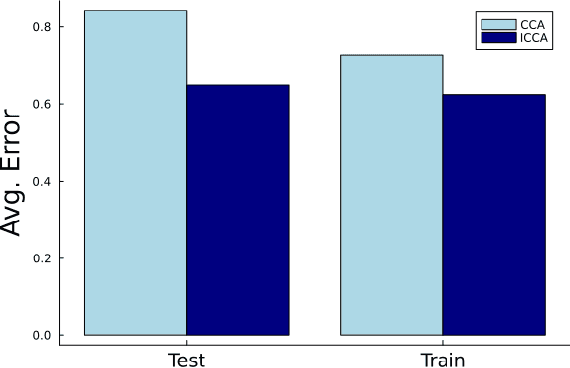
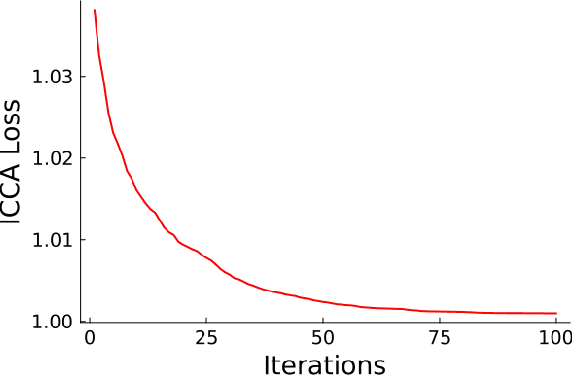
Incorporating prior knowledge into a data-driven modeling problem can drastically improve performance, reliability, and generalization outside of the training sample. The stronger the structural properties, the more effective these improvements become. Manifolds are a powerful nonlinear generalization of Euclidean space for modeling finite dimensions. Structural impositions in constrained systems increase when applying group structure, converting them into Lie manifolds. The range of their applications is very wide and includes the important case of robotic tasks. Canonical Correlation Analysis (CCA) can construct a hierarchical sequence of maximal correlations of up to two paired data sets in these Euclidean spaces. We present a method to generalize this concept to Lie Manifolds and demonstrate its efficacy through the substantial improvements it achieves in making structure-consistent predictions about changes in the state of a robotic hand.
Towards Information Theory-Based Discovery of Equivariances
Oct 25, 2023The presence of symmetries imposes a stringent set of constraints on a system. This constrained structure allows intelligent agents interacting with such a system to drastically improve the efficiency of learning and generalization, through the internalisation of the system's symmetries into their information-processing. In parallel, principled models of complexity-constrained learning and behaviour make increasing use of information-theoretic methods. Here, we wish to marry these two perspectives and understand whether and in which form the information-theoretic lens can "see" the effect of symmetries of a system. For this purpose, we propose a novel variant of the Information Bottleneck principle, which has served as a productive basis for many principled studies of learning and information-constrained adaptive behaviour. We show (in the discrete case) that our approach formalises a certain duality between symmetry and information parsimony: namely, channel equivariances can be characterised by the optimal mutual information-preserving joint compression of the channel's input and output. This information-theoretic treatment furthermore suggests a principled notion of "soft" equivariance, whose "coarseness" is measured by the amount of input-output mutual information preserved by the corresponding optimal compression. This new notion offers a bridge between the field of bounded rationality and the study of symmetries in neural representations. The framework may also allow (exact and soft) equivariances to be automatically discovered.
Intrinsic Motivation in Dynamical Control Systems
Dec 29, 2022Biological systems often choose actions without an explicit reward signal, a phenomenon known as intrinsic motivation. The computational principles underlying this behavior remain poorly understood. In this study, we investigate an information-theoretic approach to intrinsic motivation, based on maximizing an agent's empowerment (the mutual information between its past actions and future states). We show that this approach generalizes previous attempts to formalize intrinsic motivation, and we provide a computationally efficient algorithm for computing the necessary quantities. We test our approach on several benchmark control problems, and we explain its success in guiding intrinsically motivated behaviors by relating our information-theoretic control function to fundamental properties of the dynamical system representing the combined agent-environment system. This opens the door for designing practical artificial, intrinsically motivated controllers and for linking animal behaviors to their dynamical properties.