 Add to Chrome
 Add to Firefox
 Add to Edge
Safety from Honesty in a Disinterested AI Predictor
Jun 28, 2026
As AI systems become more capable, training procedures that optimize for downstream outcomes risk introducing implicit agency: goal-directed behavior that designers never specified. We present a formal safety argument for the Scientist AI (SAI) Predictor, trained to approximate the Bayesian posterior conditioned on a dataset of "epistemically contextualized" natural-language statements. We argue that such a Predictor can honestly predict agents, actions, and their consequences without itself being an agent that selects outputs to achieve goals. This rests on data representation and on the training procedure. Epistemic contextualization of text distinguishes latent factual claims from communication acts, so expressions of goals are treated as evidence to be explained rather than drives the model adopts. With a posterior-seeking training objective, this is intended to drive the Predictor toward calibrated, cautious predictions. Training proceeds so downstream effects of deploying a prediction never serve as a reward signal; any agency the system needs is supplied by explicit scaffolding constrained by guardrails. We prove that, under assumptions on the training dynamics and on the argued sparsity of dangerous Predictors, the probability that training produces a Predictor whose guarded deployment carries residual harm above a specified threshold is small: a dangerous Predictor would have to underestimate harm in a coordinated way across many queries while such coordinated patterns are rare under the initialization distribution and receive no direct training signal. Safety and accuracy are jointly supported in this framework, since the constraints that secure accuracy are the same ones that make coordinated deception costly. These guarantees against misalignment and agency arising from within the Predictor itself do not preclude the use of the Predictor as part of an agentic system.

CodeUltraFeedback: An LLM-as-a-Judge Dataset for Aligning Large Language Models to Coding Preferences
Mar 14, 2024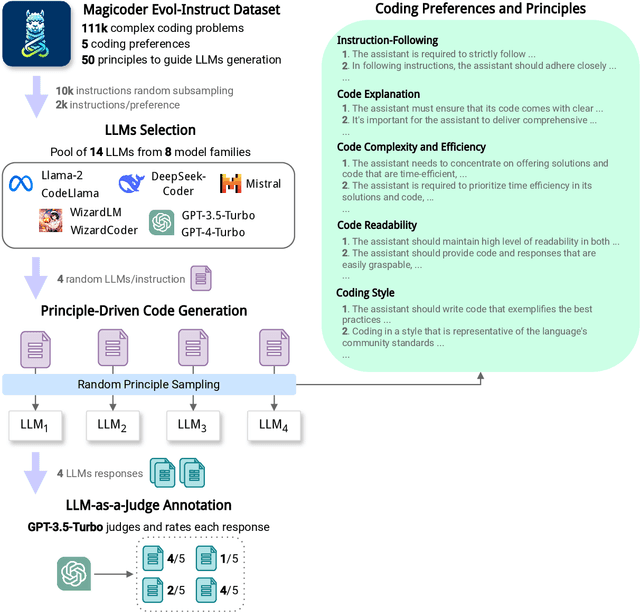
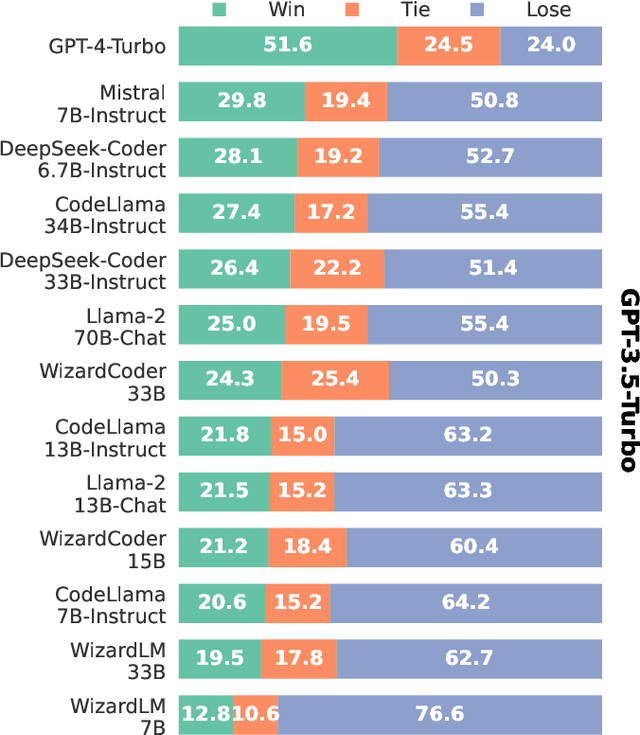
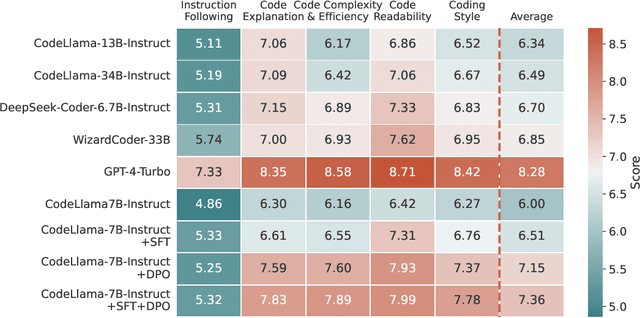
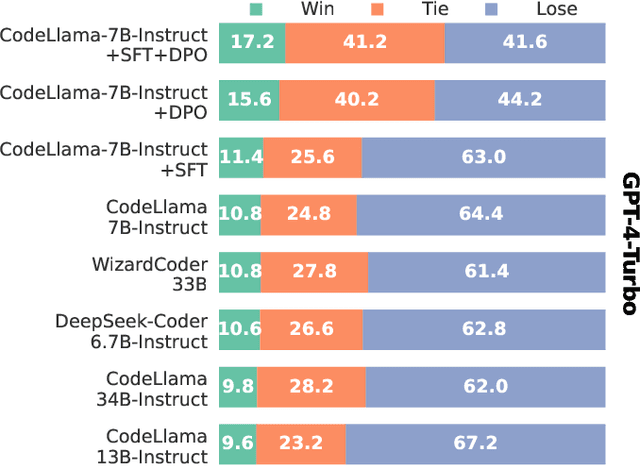
Evaluating the alignment of large language models (LLMs) with user-defined coding preferences is a challenging endeavour that requires assessing intricate textual LLMs' outputs. By relying on automated metrics and static analysis tools, existing benchmarks fail to assess nuances in user instructions and LLM outputs, highlighting the need for large-scale datasets and benchmarks for LLM preference alignment. In this paper, we introduce CodeUltraFeedback, a preference dataset of 10,000 complex instructions to tune and align LLMs to coding preferences through AI feedback. We generate responses to the instructions using a pool of 14 diverse LLMs, which we then annotate according to their alignment with five coding preferences using the LLM-as-a-Judge approach with GPT-3.5, producing both numerical and textual feedback. We also present CODAL-Bench, a benchmark for assessing LLM alignment with these coding preferences. Our results show that CodeLlama-7B-Instruct, aligned through reinforcement learning from AI feedback (RLAIF) with direct preference optimization (DPO) using CodeUltraFeedback's AI feedback data, outperforms 34B LLMs on CODAL-Bench, validating the utility of CodeUltraFeedback for preference tuning. Furthermore, we show our DPO-aligned CodeLlama model improves functional correctness on HumanEval+ compared to the unaligned base model. Therefore, our contributions bridge the gap in preference tuning of LLMs for code and set the stage for further advancements in model alignment and RLAIF for code intelligence. Our code and data are available at https://github.com/martin-wey/CodeUltraFeedback.