 Add to Chrome
 Add to Firefox
 Add to Edge
Safety from Honesty in a Disinterested AI Predictor
Jun 28, 2026
As AI systems become more capable, training procedures that optimize for downstream outcomes risk introducing implicit agency: goal-directed behavior that designers never specified. We present a formal safety argument for the Scientist AI (SAI) Predictor, trained to approximate the Bayesian posterior conditioned on a dataset of "epistemically contextualized" natural-language statements. We argue that such a Predictor can honestly predict agents, actions, and their consequences without itself being an agent that selects outputs to achieve goals. This rests on data representation and on the training procedure. Epistemic contextualization of text distinguishes latent factual claims from communication acts, so expressions of goals are treated as evidence to be explained rather than drives the model adopts. With a posterior-seeking training objective, this is intended to drive the Predictor toward calibrated, cautious predictions. Training proceeds so downstream effects of deploying a prediction never serve as a reward signal; any agency the system needs is supplied by explicit scaffolding constrained by guardrails. We prove that, under assumptions on the training dynamics and on the argued sparsity of dangerous Predictors, the probability that training produces a Predictor whose guarded deployment carries residual harm above a specified threshold is small: a dangerous Predictor would have to underestimate harm in a coordinated way across many queries while such coordinated patterns are rare under the initialization distribution and receive no direct training signal. Safety and accuracy are jointly supported in this framework, since the constraints that secure accuracy are the same ones that make coordinated deception costly. These guarantees against misalignment and agency arising from within the Predictor itself do not preclude the use of the Predictor as part of an agentic system.

A Systematic Evaluation of Large Language Models on Out-of-Distribution Logical Reasoning Tasks
Oct 18, 2023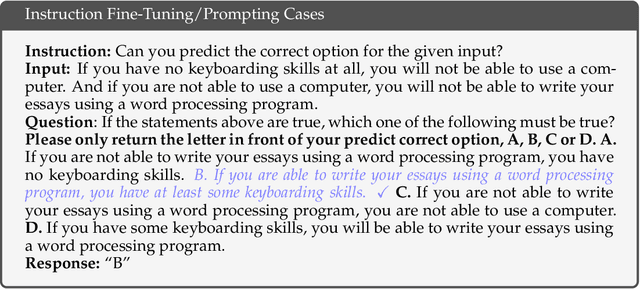
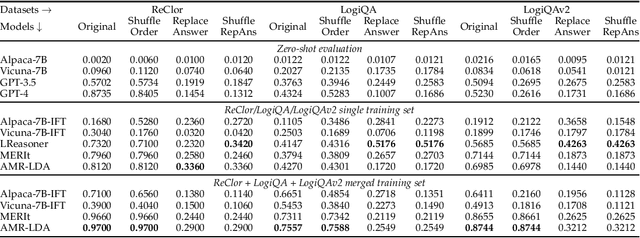
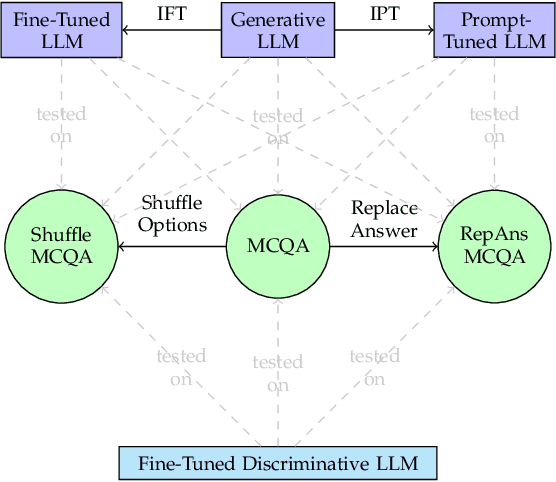
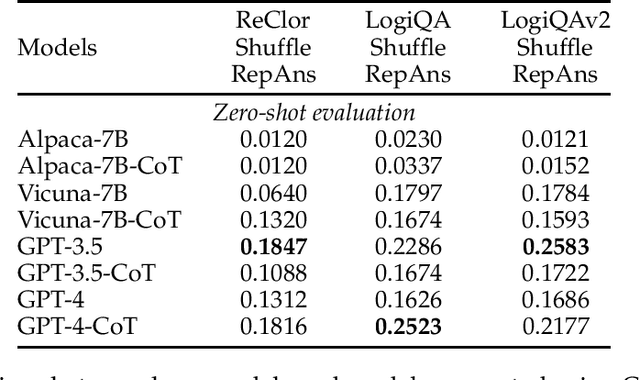
Large language models (LLMs), such as GPT-3.5 and GPT-4, have greatly advanced the performance of artificial systems on various natural language processing tasks to human-like levels. However, their generalisation and robustness to perform logical reasoning remain under-evaluated. To probe this ability, we propose three new logical reasoning datasets named "ReClor-plus", "LogiQA-plus" and "LogiQAv2-plus", each featuring three subsets: the first with randomly shuffled options, the second with the correct choices replaced by "none of the other options are correct", and a combination of the previous two subsets. We carry out experiments on these datasets with both discriminative and generative LLMs and show that these simple tricks greatly hinder the performance of the language models. Despite their superior performance on the original publicly available datasets, we find that all models struggle to answer our newly constructed datasets. We show that introducing task variations by perturbing a sizable training set can markedly improve the model's generalisation and robustness in logical reasoning tasks. Moreover, applying logic-driven data augmentation for fine-tuning, combined with prompting can enhance the generalisation performance of both discriminative large language models and generative large language models. These results offer insights into assessing and improving the generalisation and robustness of large language models for logical reasoning tasks. We make our source code and data publicly available \url{https://github.com/Strong-AI-Lab/Logical-and-abstract-reasoning}.