 Add to Chrome
 Add to Firefox
 Add to Edge
Curator: Efficient Indexing for Multi-Tenant Vector Databases
Jan 13, 2024
Vector databases have emerged as key enablers for bridging intelligent applications with unstructured data, providing generic search and management support for embedding vectors extracted from the raw unstructured data. As multiple data users can share the same database infrastructure, multi-tenancy support for vector databases is increasingly desirable. This hinges on an efficient filtered search operation, i.e., only querying the vectors accessible to a particular tenant. Multi-tenancy in vector databases is currently achieved by building either a single, shared index among all tenants, or a per-tenant index. The former optimizes for memory efficiency at the expense of search performance, while the latter does the opposite. Instead, this paper presents Curator, an in-memory vector index design tailored for multi-tenant queries that simultaneously achieves the two conflicting goals, low memory overhead and high performance for queries, vector insertion, and deletion. Curator indexes each tenant's vectors with a tenant-specific clustering tree and encodes these trees compactly as sub-trees of a shared clustering tree. Each tenant's clustering tree adapts dynamically to its unique vector distribution, while maintaining a low per-tenant memory footprint. Our evaluation, based on two widely used data sets, confirms that Curator delivers search performance on par with per-tenant indexing, while maintaining memory consumption at the same level as metadata filtering on a single, shared index.

Fairness in Serving Large Language Models
Dec 31, 2023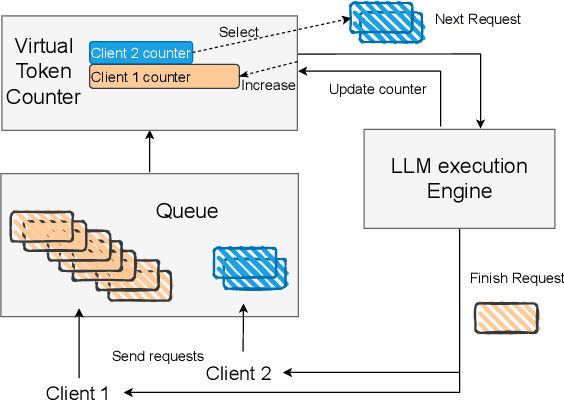
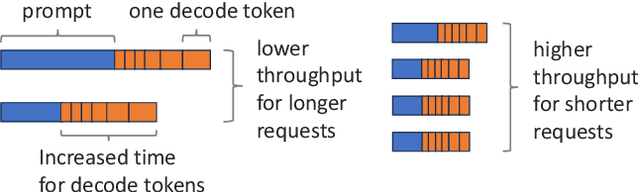
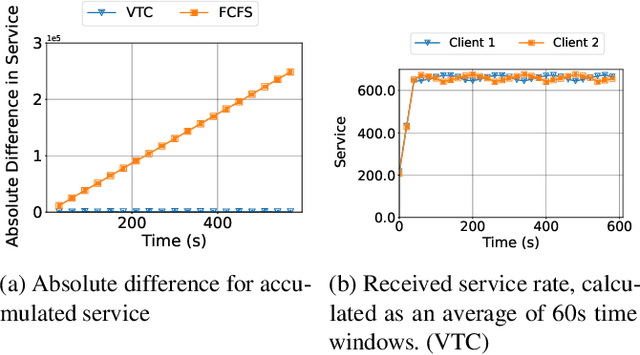

High-demand LLM inference services (e.g., ChatGPT and BARD) support a wide range of requests from short chat conversations to long document reading. To ensure that all client requests are processed fairly, most major LLM inference services have request rate limits, to ensure that no client can dominate the request queue. However, this rudimentary notion of fairness also results in under-utilization of the resources and poor client experience when there is spare capacity. While there is a rich literature on fair scheduling, serving LLMs presents new challenges due to their unpredictable request lengths and their unique batching characteristics on parallel accelerators. This paper introduces the definition of LLM serving fairness based on a cost function that accounts for the number of input and output tokens processed. To achieve fairness in serving, we propose a novel scheduling algorithm, the Virtual Token Counter (VTC), a fair scheduler based on the continuous batching mechanism. We prove a 2x tight upper bound on the service difference between two backlogged clients, adhering to the requirement of work-conserving. Through extensive experiments, we demonstrate the superior performance of VTC in ensuring fairness, especially in contrast to other baseline methods, which exhibit shortcomings under various conditions.
Punica: Multi-Tenant LoRA Serving
Oct 28, 2023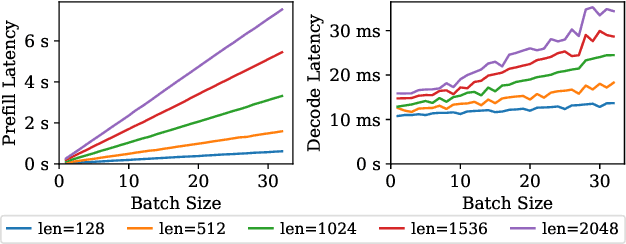
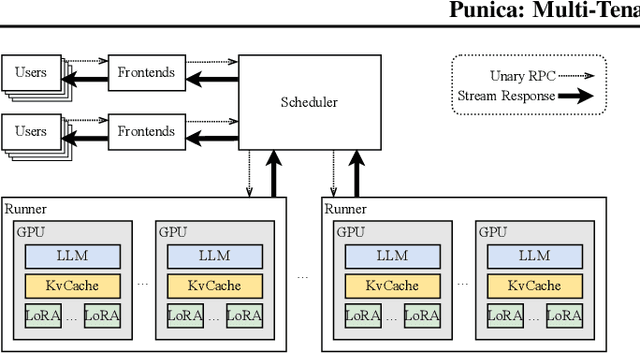
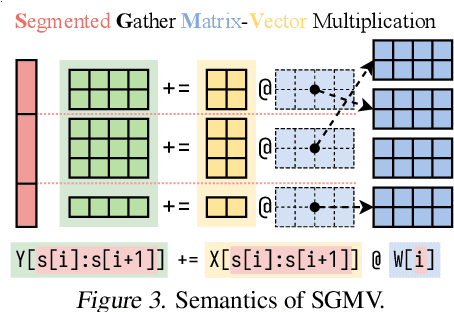
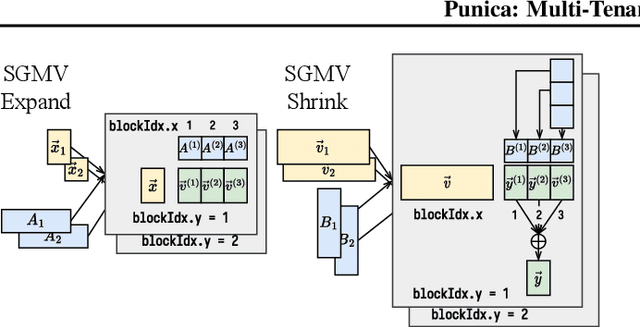
Low-rank adaptation (LoRA) has become an important and popular method to adapt pre-trained models to specific domains. We present Punica, a system to serve multiple LoRA models in a shared GPU cluster. Punica contains a new CUDA kernel design that allows batching of GPU operations for different LoRA models. This allows a GPU to hold only a single copy of the underlying pre-trained model when serving multiple, different LoRA models, significantly enhancing GPU efficiency in terms of both memory and computation. Our scheduler consolidates multi-tenant LoRA serving workloads in a shared GPU cluster. With a fixed-sized GPU cluster, our evaluations show that Punica achieves 12x higher throughput in serving multiple LoRA models compared to state-of-the-art LLM serving systems while only adding 2ms latency per token. Punica is open source at https://github.com/punica-ai/punica .
Query Complexity of Active Learning for Function Family With Nearly Orthogonal Basis
Jun 06, 2023Many machine learning algorithms require large numbers of labeled data to deliver state-of-the-art results. In applications such as medical diagnosis and fraud detection, though there is an abundance of unlabeled data, it is costly to label the data by experts, experiments, or simulations. Active learning algorithms aim to reduce the number of required labeled data points while preserving performance. For many convex optimization problems such as linear regression and $p$-norm regression, there are theoretical bounds on the number of required labels to achieve a certain accuracy. We call this the query complexity of active learning. However, today's active learning algorithms require the underlying learned function to have an orthogonal basis. For example, when applying active learning to linear regression, the requirement is the target function is a linear composition of a set of orthogonal linear functions, and active learning can find the coefficients of these linear functions. We present a theoretical result to show that active learning does not need an orthogonal basis but rather only requires a nearly orthogonal basis. We provide the corresponding theoretical proofs for the function family of nearly orthogonal basis, and its applications associated with the algorithmically efficient active learning framework.
Adaptive and Dynamic Multi-Resolution Hashing for Pairwise Summations
Dec 21, 2022In this paper, we propose Adam-Hash: an adaptive and dynamic multi-resolution hashing data-structure for fast pairwise summation estimation. Given a data-set $X \subset \mathbb{R}^d$, a binary function $f:\mathbb{R}^d\times \mathbb{R}^d\to \mathbb{R}$, and a point $y \in \mathbb{R}^d$, the Pairwise Summation Estimate $\mathrm{PSE}_X(y) := \frac{1}{|X|} \sum_{x \in X} f(x,y)$. For any given data-set $X$, we need to design a data-structure such that given any query point $y \in \mathbb{R}^d$, the data-structure approximately estimates $\mathrm{PSE}_X(y)$ in time that is sub-linear in $|X|$. Prior works on this problem have focused exclusively on the case where the data-set is static, and the queries are independent. In this paper, we design a hashing-based PSE data-structure which works for the more practical \textit{dynamic} setting in which insertions, deletions, and replacements of points are allowed. Moreover, our proposed Adam-Hash is also robust to adaptive PSE queries, where an adversary can choose query $q_j \in \mathbb{R}^d$ depending on the output from previous queries $q_1, q_2, \dots, q_{j-1}$.
A Faster $k$-means++ Algorithm
Nov 28, 2022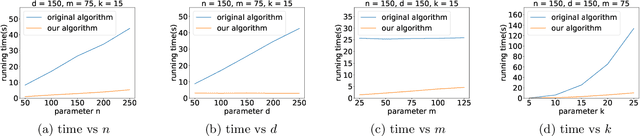
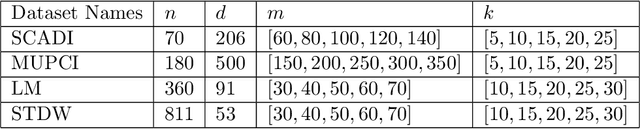
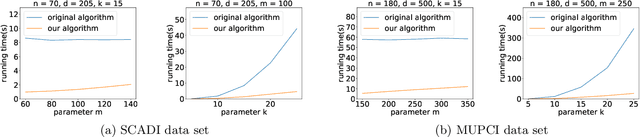
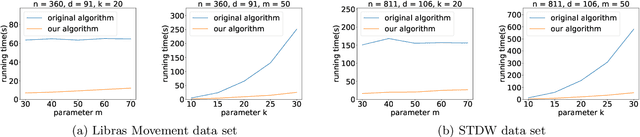
K-means++ is an important algorithm to choose initial cluster centers for the k-means clustering algorithm. In this work, we present a new algorithm that can solve the $k$-means++ problem with near optimal running time. Given $n$ data points in $\mathbb{R}^d$, the current state-of-the-art algorithm runs in $\widetilde{O}(k )$ iterations, and each iteration takes $\widetilde{O}(nd k)$ time. The overall running time is thus $\widetilde{O}(n d k^2)$. We propose a new algorithm \textsc{FastKmeans++} that only takes in $\widetilde{O}(nd + nk^2)$ time, in total.
Bypass Exponential Time Preprocessing: Fast Neural Network Training via Weight-Data Correlation Preprocessing
Nov 25, 2022Over the last decade, deep neural networks have transformed our society, and they are already widely applied in various machine learning applications. State-of-art deep neural networks are becoming larger in size every year to deliver increasing model accuracy, and as a result, model training consumes substantial computing resources and will only consume more in the future. Using current training methods, in each iteration, to process a data point $x \in \mathbb{R}^d$ in a layer, we need to spend $\Theta(md)$ time to evaluate all the $m$ neurons in the layer. This means processing the entire layer takes $\Theta(nmd)$ time for $n$ data points. Recent work [Song, Yang and Zhang, NeurIPS 2021] reduces this time per iteration to $o(nmd)$, but requires exponential time to preprocess either the data or the neural network weights, making it unlikely to have practical usage. In this work, we present a new preprocessing method that simply stores the weight-data correlation in a tree data structure in order to quickly, dynamically detect which neurons fire at each iteration. Our method requires only $O(nmd)$ time in preprocessing and still achieves $o(nmd)$ time per iteration. We complement our new algorithm with a lower bound, proving that assuming a popular conjecture from complexity theory, one could not substantially speed up our algorithm for dynamic detection of firing neurons.
Training Overparametrized Neural Networks in Sublinear Time
Aug 09, 2022The success of deep learning comes at a tremendous computational and energy cost, and the scalability of training massively overparametrized neural networks is becoming a real barrier to the progress of AI. Despite the popularity and low cost-per-iteration of traditional Backpropagation via gradient decent, SGD has prohibitive convergence rate in non-convex settings, both in theory and practice. To mitigate this cost, recent works have proposed to employ alternative (Newton-type) training methods with much faster convergence rate, albeit with higher cost-per-iteration. For a typical neural network with $m=\mathrm{poly}(n)$ parameters and input batch of $n$ datapoints in $\mathbb{R}^d$, the previous work of [Brand, Peng, Song, and Weinstein, ITCS'2021] requires $\sim mnd + n^3$ time per iteration. In this paper, we present a novel training method that requires only $m^{1-\alpha} n d + n^3$ amortized time in the same overparametrized regime, where $\alpha \in (0.01,1)$ is some fixed constant. This method relies on a new and alternative view of neural networks, as a set of binary search trees, where each iteration corresponds to modifying a small subset of the nodes in the tree. We believe this view would have further applications in the design and analysis of DNNs.
Dynamic Maintenance of Kernel Density Estimation Data Structure: From Practice to Theory
Aug 08, 2022Kernel density estimation (KDE) stands out as a challenging task in machine learning. The problem is defined in the following way: given a kernel function $f(x,y)$ and a set of points $\{x_1, x_2, \cdots, x_n \} \subset \mathbb{R}^d$, we would like to compute $\frac{1}{n}\sum_{i=1}^{n} f(x_i,y)$ for any query point $y \in \mathbb{R}^d$. Recently, there has been a growing trend of using data structures for efficient KDE. However, the proposed KDE data structures focus on static settings. The robustness of KDE data structures over dynamic changing data distributions is not addressed. In this work, we focus on the dynamic maintenance of KDE data structures with robustness to adversarial queries. Especially, we provide a theoretical framework of KDE data structures. In our framework, the KDE data structures only require subquadratic spaces. Moreover, our data structure supports the dynamic update of the dataset in sublinear time. Furthermore, we can perform adaptive queries with the potential adversary in sublinear time.
Sublinear Time Algorithm for Online Weighted Bipartite Matching
Aug 05, 2022Online bipartite matching is a fundamental problem in online algorithms. The goal is to match two sets of vertices to maximize the sum of the edge weights, where for one set of vertices, each vertex and its corresponding edge weights appear in a sequence. Currently, in the practical recommendation system or search engine, the weights are decided by the inner product between the deep representation of a user and the deep representation of an item. The standard online matching needs to pay $nd$ time to linear scan all the $n$ items, computing weight (assuming each representation vector has length $d$), and then decide the matching based on the weights. However, in reality, the $n$ could be very large, e.g. in online e-commerce platforms. Thus, improving the time of computing weights is a problem of practical significance. In this work, we provide the theoretical foundation for computing the weights approximately. We show that, with our proposed randomized data structures, the weights can be computed in sublinear time while still preserving the competitive ratio of the matching algorithm.