 Add to Chrome
 Add to Firefox
 Add to Edge
EgoLive: A Large-Scale Egocentric Dataset from Real-World Human Tasks
Apr 26, 2026
The advancement of robot learning is currently hindered by the scarcity of large-scale, high-quality datasets. While established data collection methods such as teleoperation and universal manipulation interfaces dominate current datasets, they suffer from inherent limitations in scalability and real-world deployability. Human egocentric video collection, by contrast, has emerged as a promising approach to enable scalable, natural and in-the-wild data collection. As such, we present EgoLive, a large-scale, high-quality egocentric dataset designed explicitly for robot manipulation learning. EgoLive establishes three distinctive technical advantages over existing egocentric datasets: first, it represents the largest open-source annotated egocentric dataset focused on real-world task-oriented human routines to date; second, it delivers leading data quality via a customized head-mounted capture device and comprehensive high-precision multi-modal annotations; third, all data is collected exclusively in unconstrained real-world scenarios and encompasses vertical field human working data, including home service, retail, and other practical work scenarios, providing superior diversity and ecological validity. With the introduction of EgoLive, we aim to provide the research community with a scalable, high-quality dataset that accelerates breakthroughs in generalizable robotic models and facilitates the real-world deployment of robot systems.

JoyAI-RA 0.1: A Foundation Model for Robotic Autonomy
Apr 22, 2026Robotic autonomy in open-world environments is fundamentally limited by insufficient data diversity and poor cross-embodiment generalization. Existing robotic datasets are often limited in scale and task coverage, while relatively large differences across robot embodiments impede effective behavior knowledge transfer. To address these challenges, we propose JoyAI-RA, a vision-language-action (VLA) embodied foundation model tailored for generalizable robotic manipulation. JoyAI-RA presents a multi-source multi-level pretraining framework that integrates web data, large-scale egocentric human manipulation videos, simulation-generated trajectories, and real-robot data. Through training on heterogeneous multi-source data with explicit action-space unification, JoyAI-RA effectively bridges embodiment gaps, particularly between human manipulation and robotic control, thereby enhancing cross-embodiment behavior learning. JoyAI-RA outperforms state-of-the-art methods in both simulation and real-world benchmarks, especially on diverse tasks with generalization demands.
HMVLM: Multistage Reasoning-Enhanced Vision-Language Model for Long-Tailed Driving Scenarios
Jun 06, 2025We present HaoMo Vision-Language Model (HMVLM), an end-to-end driving framework that implements the slow branch of a cognitively inspired fast-slow architecture. A fast controller outputs low-level steering, throttle, and brake commands, while a slow planner-a large vision-language model-generates high-level intents such as "yield to pedestrian" or "merge after the truck" without compromising latency. HMVLM introduces three upgrades: (1) selective five-view prompting with an embedded 4s history of ego kinematics, (2) multi-stage chain-of-thought (CoT) prompting that enforces a Scene Understanding -> Driving Decision -> Trajectory Inference reasoning flow, and (3) spline-based trajectory post-processing that removes late-stage jitter and sharp turns. Trained on the Waymo Open Dataset, these upgrades enable HMVLM to achieve a Rater Feedback Score (RFS) of 7.7367, securing 2nd place in the 2025 Waymo Vision-based End-to-End (E2E) Driving Challenge and surpassing the public baseline by 2.77%.
Quality over Quantity: Boosting Data Efficiency Through Ensembled Multimodal Data Curation
Feb 12, 2025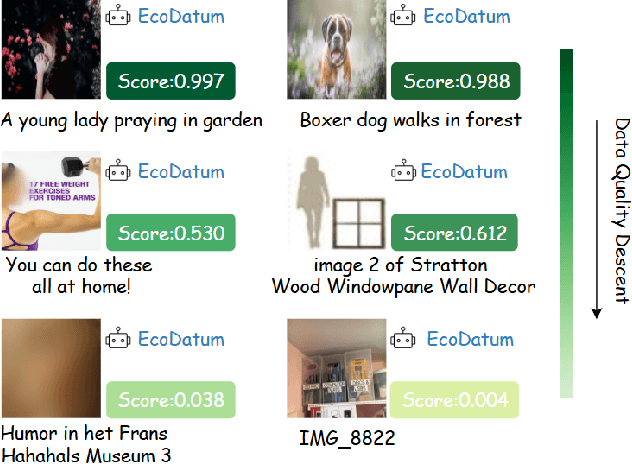

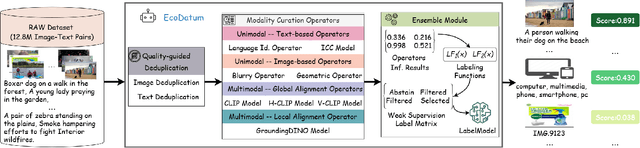
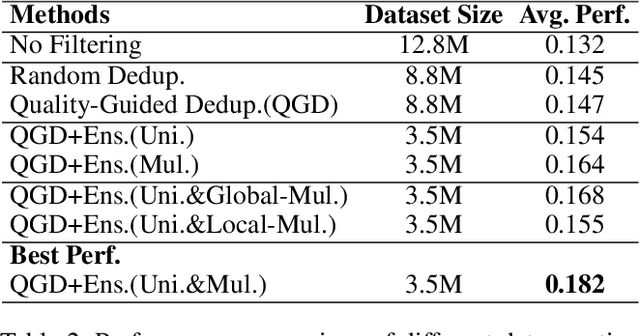
In an era overwhelmed by vast amounts of data, the effective curation of web-crawl datasets is essential for optimizing model performance. This paper tackles the challenges associated with the unstructured and heterogeneous nature of such datasets. Traditional heuristic curation methods often inadequately capture complex features, resulting in biases and the exclusion of relevant data. We introduce an advanced, learning-driven approach, Ensemble Curation Of DAta ThroUgh Multimodal Operators (EcoDatum), incorporating a novel quality-guided deduplication method to ensure balanced feature distributions. EcoDatum strategically integrates various unimodal and multimodal data curation operators within a weak supervision ensemble framework, utilizing automated optimization to score each data point effectively. EcoDatum, which significantly improves the data curation quality and efficiency, outperforms existing state-of-the-art (SOTA) techniques, ranked 1st on the DataComp leaderboard, with an average performance score of 0.182 across 38 diverse evaluation datasets. This represents a 28% improvement over the DataComp baseline method, demonstrating its effectiveness in improving dataset curation and model training efficiency.