 Add to Chrome
 Add to Firefox
 Add to Edge
Joint Optimization of Flexible Antenna Array Shape and Beamforming for Secure Communication
Feb 27, 2026
Flexible antenna arrays (FAAs) can physically reshape their geometry to add new spatial degrees of freedom, whereas transmit beamforming adjusts the complex element weights to electronically steer and shape the array's radiation pattern, thereby significantly improving communication performance. This paper is the first to explore the integration of FAA geometry control and beamforming for physical layer security enhancement, where a base station equipped with an FAA communicates with a legitimate user in the presence of passive eavesdroppers. To safeguard confidential transmissions, we formulate a new secrecy rate maximization problem that jointly optimizes the transmit beamforming vector and a continuous FAA shape control parameter. Due to the non convex nature of the problem, an alternating optimization algorithm is developed to decompose the joint design into tractable subproblems, which are solved iteratively to refine both the FAA geometry and beamforming strategy. Simulation results confirm that the proposed joint optimization framework significantly outperforms conventional fixed shape or beamforming only schemes, demonstrating the potential of FAA enabled reconfigurability for secure wireless communications.

Multimodal Peer Review Simulation with Actionable To-Do Recommendations for Community-Aware Manuscript Revisions
Nov 14, 2025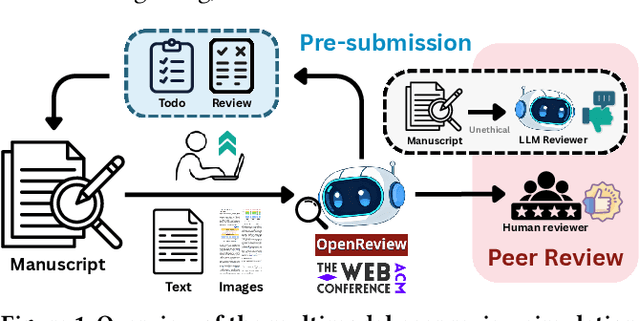
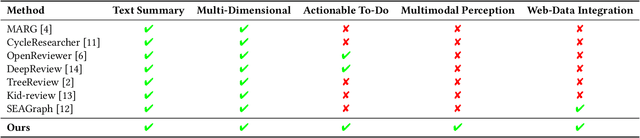
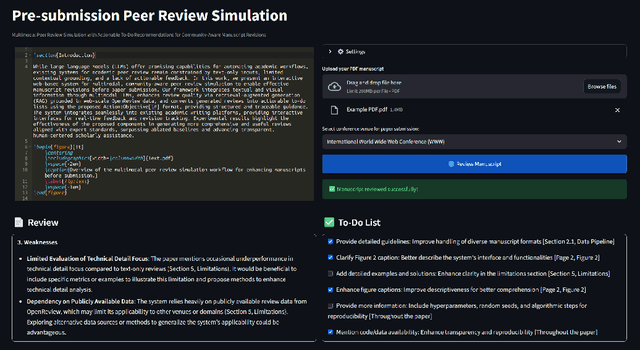
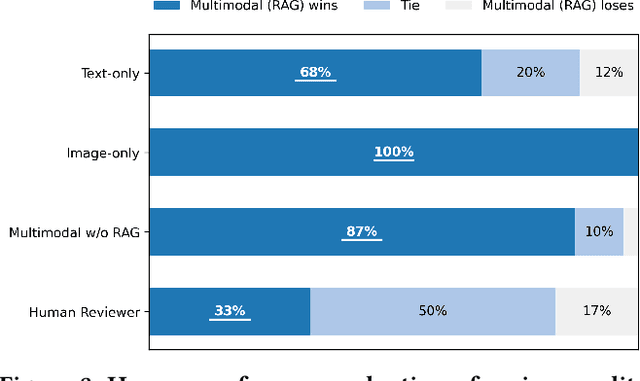
While large language models (LLMs) offer promising capabilities for automating academic workflows, existing systems for academic peer review remain constrained by text-only inputs, limited contextual grounding, and a lack of actionable feedback. In this work, we present an interactive web-based system for multimodal, community-aware peer review simulation to enable effective manuscript revisions before paper submission. Our framework integrates textual and visual information through multimodal LLMs, enhances review quality via retrieval-augmented generation (RAG) grounded in web-scale OpenReview data, and converts generated reviews into actionable to-do lists using the proposed Action:Objective[\#] format, providing structured and traceable guidance. The system integrates seamlessly into existing academic writing platforms, providing interactive interfaces for real-time feedback and revision tracking. Experimental results highlight the effectiveness of the proposed system in generating more comprehensive and useful reviews aligned with expert standards, surpassing ablated baselines and advancing transparent, human-centered scholarly assistance.
Quality over Quantity: Boosting Data Efficiency Through Ensembled Multimodal Data Curation
Feb 12, 2025

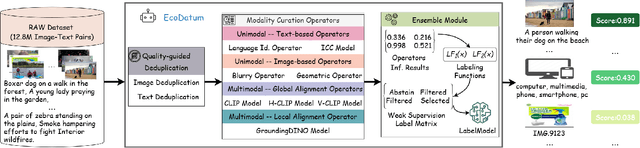
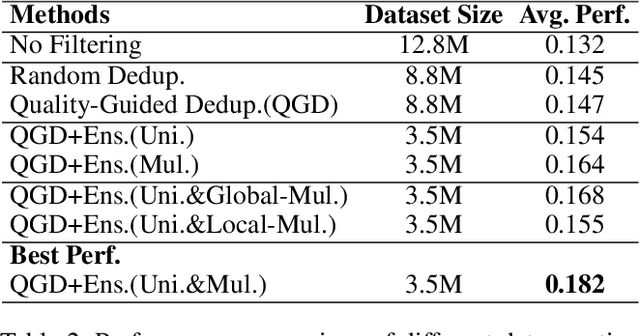
In an era overwhelmed by vast amounts of data, the effective curation of web-crawl datasets is essential for optimizing model performance. This paper tackles the challenges associated with the unstructured and heterogeneous nature of such datasets. Traditional heuristic curation methods often inadequately capture complex features, resulting in biases and the exclusion of relevant data. We introduce an advanced, learning-driven approach, Ensemble Curation Of DAta ThroUgh Multimodal Operators (EcoDatum), incorporating a novel quality-guided deduplication method to ensure balanced feature distributions. EcoDatum strategically integrates various unimodal and multimodal data curation operators within a weak supervision ensemble framework, utilizing automated optimization to score each data point effectively. EcoDatum, which significantly improves the data curation quality and efficiency, outperforms existing state-of-the-art (SOTA) techniques, ranked 1st on the DataComp leaderboard, with an average performance score of 0.182 across 38 diverse evaluation datasets. This represents a 28% improvement over the DataComp baseline method, demonstrating its effectiveness in improving dataset curation and model training efficiency.