 Add to Chrome
 Add to Firefox
 Add to Edge
Exposing and Mitigating Spurious Correlations for Cross-Modal Retrieval
Apr 06, 2023
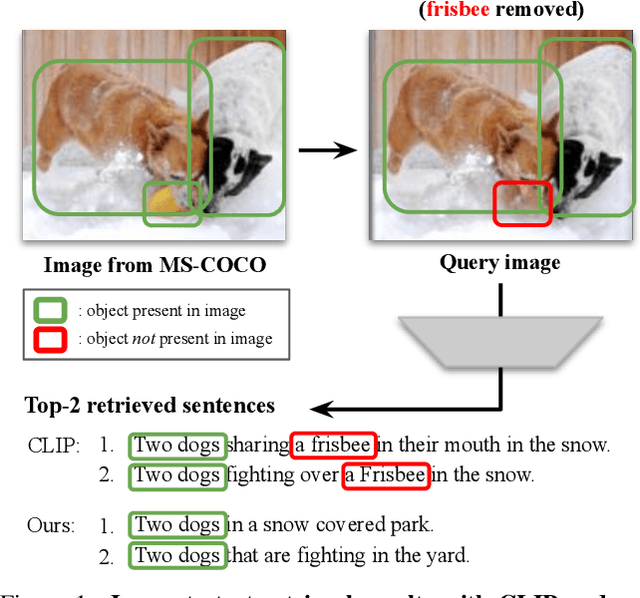
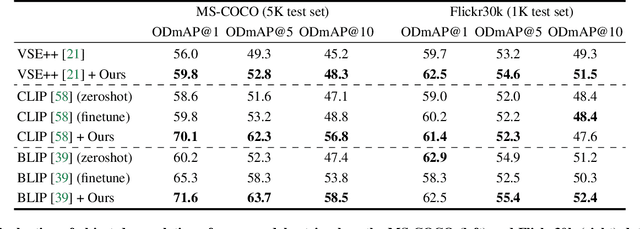
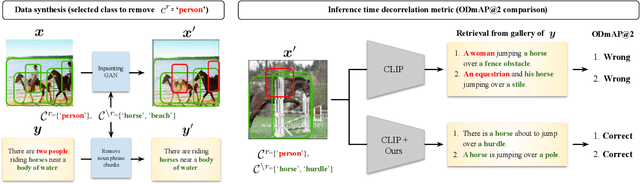
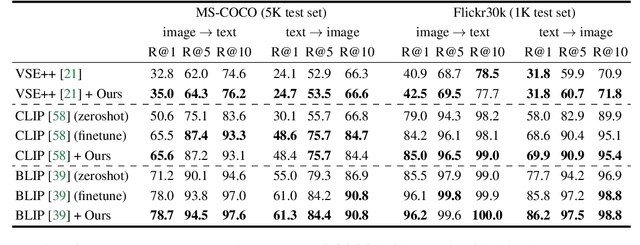
Cross-modal retrieval methods are the preferred tool to search databases for the text that best matches a query image and vice versa. However, image-text retrieval models commonly learn to memorize spurious correlations in the training data, such as frequent object co-occurrence, instead of looking at the actual underlying reasons for the prediction in the image. For image-text retrieval, this manifests in retrieved sentences that mention objects that are not present in the query image. In this work, we introduce ODmAP@k, an object decorrelation metric that measures a model's robustness to spurious correlations in the training data. We use automatic image and text manipulations to control the presence of such object correlations in designated test data. Additionally, our data synthesis technique is used to tackle model biases due to spurious correlations of semantically unrelated objects in the training data. We apply our proposed pipeline, which involves the finetuning of image-text retrieval frameworks on carefully designed synthetic data, to three state-of-the-art models for image-text retrieval. This results in significant improvements for all three models, both in terms of the standard retrieval performance and in terms of our object decorrelation metric. The code is available at https://github.com/ExplainableML/Spurious_CM_Retrieval.

Bridging the Gap between Model Explanations in Partially Annotated Multi-label Classification
Apr 04, 2023Due to the expensive costs of collecting labels in multi-label classification datasets, partially annotated multi-label classification has become an emerging field in computer vision. One baseline approach to this task is to assume unobserved labels as negative labels, but this assumption induces label noise as a form of false negative. To understand the negative impact caused by false negative labels, we study how these labels affect the model's explanation. We observe that the explanation of two models, trained with full and partial labels each, highlights similar regions but with different scaling, where the latter tends to have lower attribution scores. Based on these findings, we propose to boost the attribution scores of the model trained with partial labels to make its explanation resemble that of the model trained with full labels. Even with the conceptually simple approach, the multi-label classification performance improves by a large margin in three different datasets on a single positive label setting and one on a large-scale partial label setting. Code is available at https://github.com/youngwk/BridgeGapExplanationPAMC.
AVFormer: Injecting Vision into Frozen Speech Models for Zero-Shot AV-ASR
Mar 29, 2023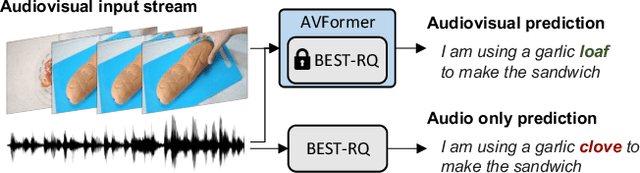
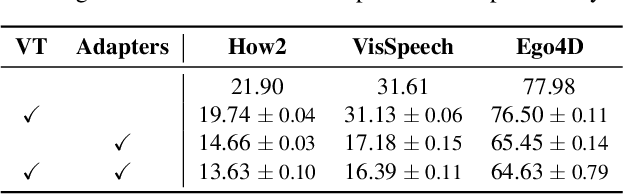
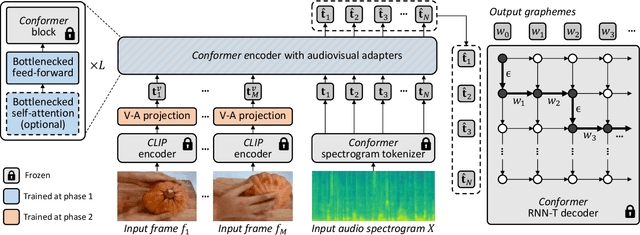
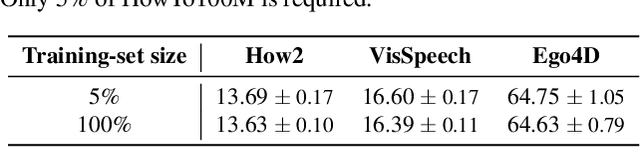
Audiovisual automatic speech recognition (AV-ASR) aims to improve the robustness of a speech recognition system by incorporating visual information. Training fully supervised multimodal models for this task from scratch, however is limited by the need for large labelled audiovisual datasets (in each downstream domain of interest). We present AVFormer, a simple method for augmenting audio-only models with visual information, at the same time performing lightweight domain adaptation. We do this by (i) injecting visual embeddings into a frozen ASR model using lightweight trainable adaptors. We show that these can be trained on a small amount of weakly labelled video data with minimum additional training time and parameters. (ii) We also introduce a simple curriculum scheme during training which we show is crucial to enable the model to jointly process audio and visual information effectively; and finally (iii) we show that our model achieves state of the art zero-shot results on three different AV-ASR benchmarks (How2, VisSpeech and Ego4D), while also crucially preserving decent performance on traditional audio-only speech recognition benchmarks (LibriSpeech). Qualitative results show that our model effectively leverages visual information for robust speech recognition.
Vid2Seq: Large-Scale Pretraining of a Visual Language Model for Dense Video Captioning
Mar 21, 2023

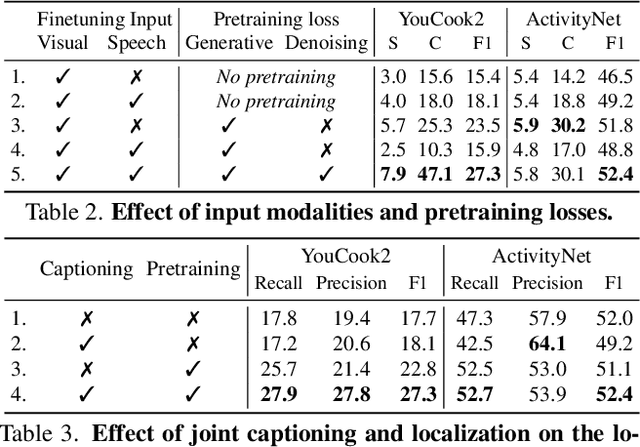

In this work, we introduce Vid2Seq, a multi-modal single-stage dense event captioning model pretrained on narrated videos which are readily-available at scale. The Vid2Seq architecture augments a language model with special time tokens, allowing it to seamlessly predict event boundaries and textual descriptions in the same output sequence. Such a unified model requires large-scale training data, which is not available in current annotated datasets. We show that it is possible to leverage unlabeled narrated videos for dense video captioning, by reformulating sentence boundaries of transcribed speech as pseudo event boundaries, and using the transcribed speech sentences as pseudo event captions. The resulting Vid2Seq model pretrained on the YT-Temporal-1B dataset improves the state of the art on a variety of dense video captioning benchmarks including YouCook2, ViTT and ActivityNet Captions. Vid2Seq also generalizes well to the tasks of video paragraph captioning and video clip captioning, and to few-shot settings. Our code is publicly available at https://antoyang.github.io/vid2seq.html.
Tackling Ambiguity with Images: Improved Multimodal Machine Translation and Contrastive Evaluation
Dec 20, 2022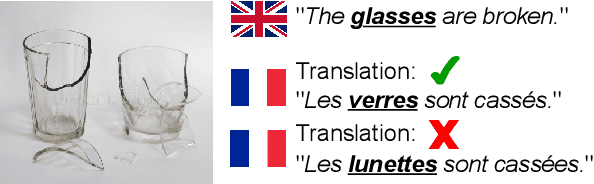
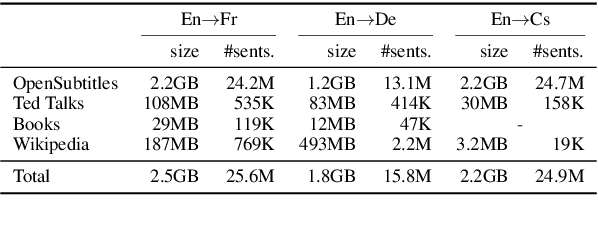
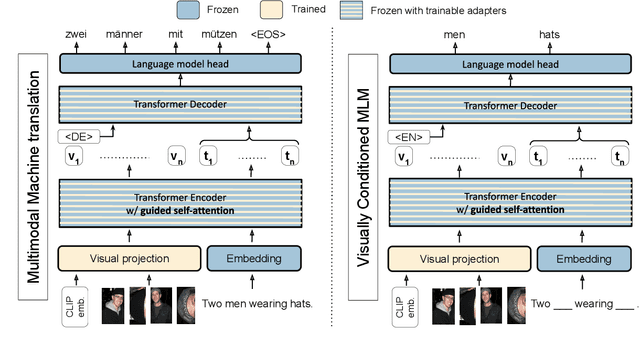
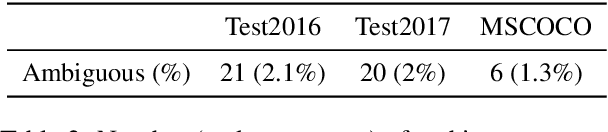
One of the major challenges of machine translation (MT) is ambiguity, which can in some cases be resolved by accompanying context such as an image. However, recent work in multimodal MT (MMT) has shown that obtaining improvements from images is challenging, limited not only by the difficulty of building effective cross-modal representations but also by the lack of specific evaluation and training data. We present a new MMT approach based on a strong text-only MT model, which uses neural adapters and a novel guided self-attention mechanism and which is jointly trained on both visual masking and MMT. We also release CoMMuTE, a Contrastive Multilingual Multimodal Translation Evaluation dataset, composed of ambiguous sentences and their possible translations, accompanied by disambiguating images corresponding to each translation. Our approach obtains competitive results over strong text-only models on standard English-to-French benchmarks and outperforms these baselines and state-of-the-art MMT systems with a large margin on our contrastive test set.
REVEAL: Retrieval-Augmented Visual-Language Pre-Training with Multi-Source Multimodal Knowledge Memory
Dec 10, 2022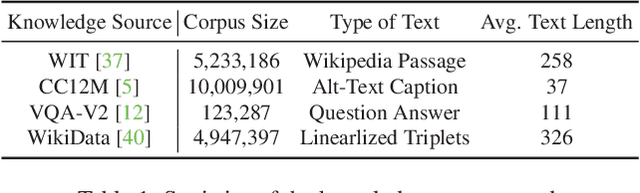


In this paper, we propose an end-to-end Retrieval-Augmented Visual Language Model (REVEAL) that learns to encode world knowledge into a large-scale memory, and to retrieve from it to answer knowledge-intensive queries. REVEAL consists of four key components: the memory, the encoder, the retriever and the generator. The large-scale memory encodes various sources of multimodal world knowledge (e.g. image-text pairs, question answering pairs, knowledge graph triplets, etc) via a unified encoder. The retriever finds the most relevant knowledge entries in the memory, and the generator fuses the retrieved knowledge with the input query to produce the output. A key novelty in our approach is that the memory, encoder, retriever and generator are all pre-trained end-to-end on a massive amount of data. Furthermore, our approach can use a diverse set of multimodal knowledge sources, which is shown to result in significant gains. We show that REVEAL achieves state-of-the-art results on visual question answering and image captioning.
Audiovisual Masked Autoencoders
Dec 09, 2022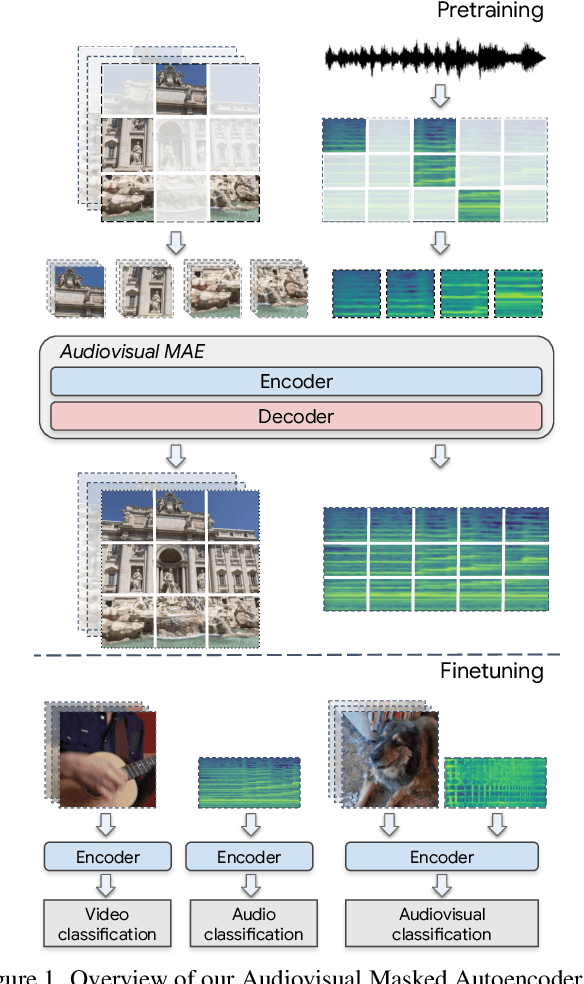
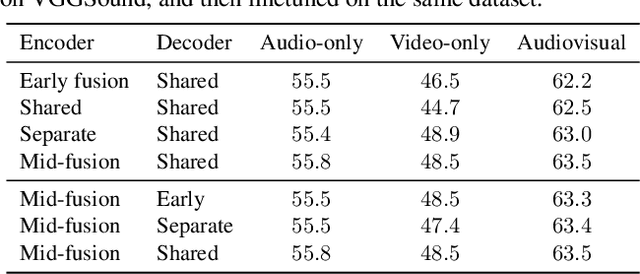
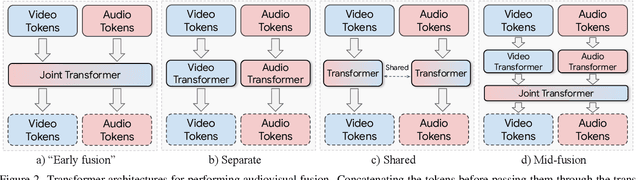
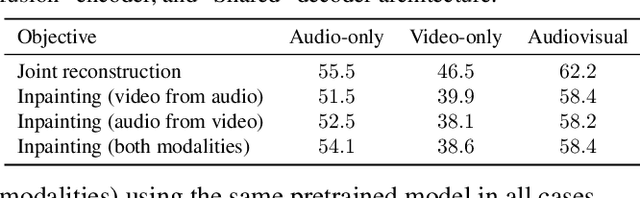
Can we leverage the audiovisual information already present in video to improve self-supervised representation learning? To answer this question, we study various pretraining architectures and objectives within the masked autoencoding framework, motivated by the success of similar methods in natural language and image understanding. We show that we can achieve significant improvements on audiovisual downstream classification tasks, surpassing the state-of-the-art on VGGSound and AudioSet. Furthermore, we can leverage our audiovisual pretraining scheme for multiple unimodal downstream tasks using a single audiovisual pretrained model. We additionally demonstrate the transferability of our representations, achieving state-of-the-art audiovisual results on Epic Kitchens without pretraining specifically for this dataset.
Location-Aware Self-Supervised Transformers
Dec 05, 2022Pixel-level labels are particularly expensive to acquire. Hence, pretraining is a critical step to improve models on a task like semantic segmentation. However, prominent algorithms for pretraining neural networks use image-level objectives, e.g. image classification, image-text alignment a la CLIP, or self-supervised contrastive learning. These objectives do not model spatial information, which might be suboptimal when finetuning on downstream tasks with spatial reasoning. In this work, we propose to pretrain networks for semantic segmentation by predicting the relative location of image parts. We formulate this task as a classification problem where each patch in a query view has to predict its position relatively to another reference view. We control the difficulty of the task by masking a subset of the reference patch features visible to those of the query. Our experiments show that this location-aware (LOCA) self-supervised pretraining leads to representations that transfer competitively to several challenging semantic segmentation benchmarks.
WALDO: Future Video Synthesis using Object Layer Decomposition and Parametric Flow Prediction
Nov 25, 2022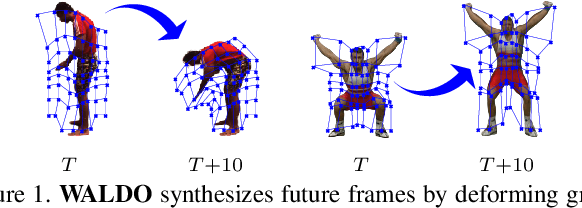
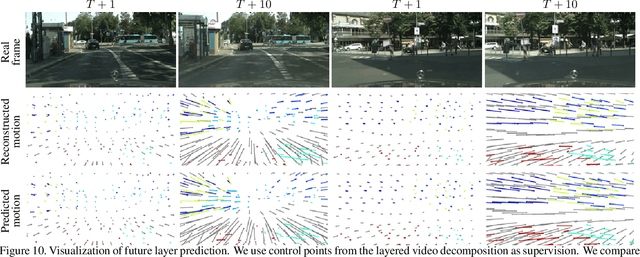
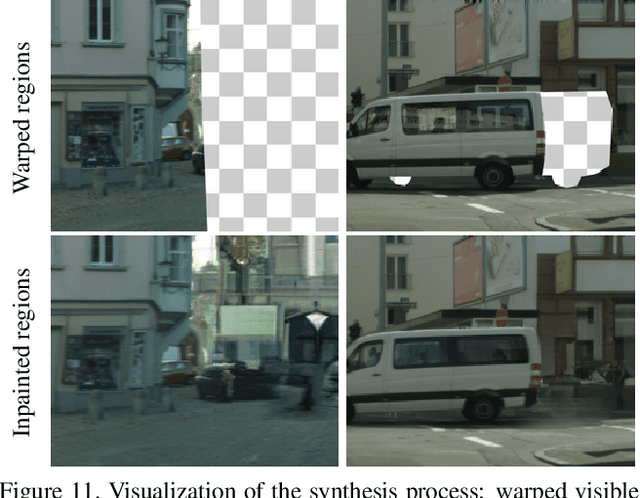
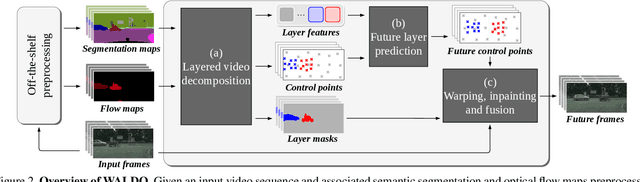
This paper presents WALDO (WArping Layer-Decomposed Objects), a novel approach to the prediction of future video frames from past ones. Individual images are decomposed into multiple layers combining object masks and a small set of control points. The layer structure is shared across all frames in each video to build dense inter-frame connections. Complex scene motions are modeled by combining parametric geometric transformations associated with individual layers, and video synthesis is broken down into discovering the layers associated with past frames, predicting the corresponding transformations for upcoming ones and warping the associated object regions accordingly, and filling in the remaining image parts. Extensive experiments on the Cityscapes (resp. KITTI) dataset show that WALDO significantly outperforms prior works with, e.g., 3, 27, and 51% (resp. 5, 20 and 11%) relative improvement in SSIM, LPIPS and FVD metrics. Code, pretrained models, and video samples synthesized by our approach can be found in the project webpage https://16lemoing.github.io/waldo.
AVATAR submission to the Ego4D AV Transcription Challenge
Nov 18, 2022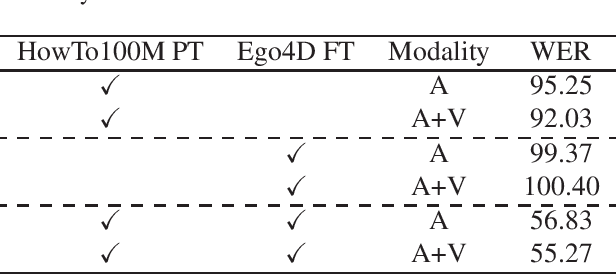
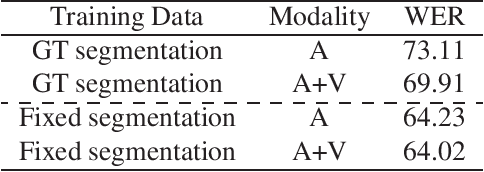
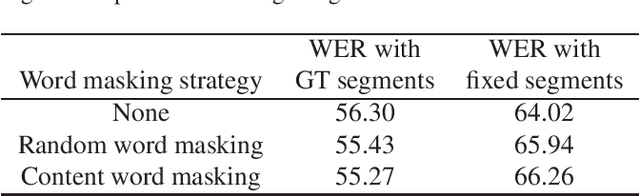
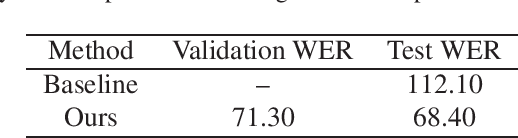
In this report, we describe our submission to the Ego4D AudioVisual (AV) Speech Transcription Challenge 2022. Our pipeline is based on AVATAR, a state of the art encoder-decoder model for AV-ASR that performs early fusion of spectrograms and RGB images. We describe the datasets, experimental settings and ablations. Our final method achieves a WER of 68.40 on the challenge test set, outperforming the baseline by 43.7%, and winning the challenge.