 Add to Chrome
 Add to Firefox
 Add to Edge
Integrating Weather Foundation Model and Satellite to Enable Fine-Grained Solar Irradiance Forecasting
Mar 17, 2026
Accurate day-ahead solar irradiance forecasting is essential for integrating solar energy into the power grid. However, it remains challenging due to the pronounced diurnal cycle and inherently complex cloud dynamics. Current methods either lack fine-scale resolution (e.g., numerical weather prediction, weather foundation models) or degrade at longer lead times (e.g., satellite extrapolation). We propose Baguan-solar, a two-stage multimodal framework that fuses forecasts from Baguan, a global weather foundation model, with high-resolution geostationary satellite imagery to produce 24- hour irradiance forecasts at kilometer scale. Its decoupled two-stage design first forecasts day-night continuous intermediates (e.g., cloud cover) and then infers irradiance, while its modality fusion jointly preserves fine-scale cloud structures from satellite and large-scale constraints from Baguan forecasts. Evaluated over East Asia using CLDAS as ground truth, Baguan-solar outperforms strong baselines (including ECMWF IFS, vanilla Baguan, and SolarSeer), reducing RMSE by 16.08% and better resolving cloud-induced transients. An operational deployment of Baguan-solar has supported solar power forecasting in an eastern province in China, since July 2025. Our code is accessible at https://github.com/DAMO-DI-ML/Baguansolar. git.

AutoInst: Automatic Instance-Based Segmentation of LiDAR 3D Scans
Mar 24, 2024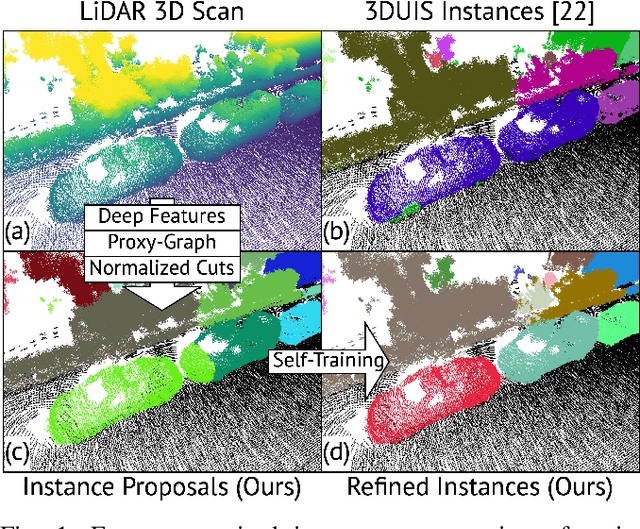
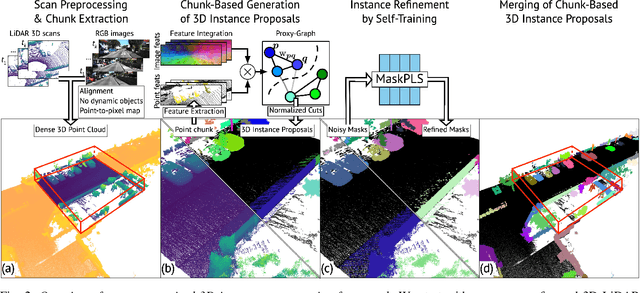
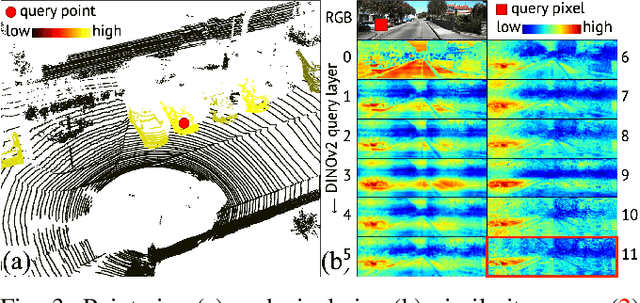
Recently, progress in acquisition equipment such as LiDAR sensors has enabled sensing increasingly spacious outdoor 3D environments. Making sense of such 3D acquisitions requires fine-grained scene understanding, such as constructing instance-based 3D scene segmentations. Commonly, a neural network is trained for this task; however, this requires access to a large, densely annotated dataset, which is widely known to be challenging to obtain. To address this issue, in this work we propose to predict instance segmentations for 3D scenes in an unsupervised way, without relying on ground-truth annotations. To this end, we construct a learning framework consisting of two components: (1) a pseudo-annotation scheme for generating initial unsupervised pseudo-labels; and (2) a self-training algorithm for instance segmentation to fit robust, accurate instances from initial noisy proposals. To enable generating 3D instance mask proposals, we construct a weighted proxy-graph by connecting 3D points with edges integrating multi-modal image- and point-based self-supervised features, and perform graph-cuts to isolate individual pseudo-instances. We then build on a state-of-the-art point-based architecture and train a 3D instance segmentation model, resulting in significant refinement of initial proposals. To scale to arbitrary complexity 3D scenes, we design our algorithm to operate on local 3D point chunks and construct a merging step to generate scene-level instance segmentations. Experiments on the challenging SemanticKITTI benchmark demonstrate the potential of our approach, where it attains 13.3% higher Average Precision and 9.1% higher F1 score compared to the best-performing baseline. The code will be made publicly available at https://github.com/artonson/autoinst.