 Add to Chrome
 Add to Firefox
 Add to Edge
Tianmu-TC: Physics-constraints Generative Artificial Intelligence for Global Tropical Cyclone Forecasting
Aug 19, 2026
Tropical cyclones (TCs) pose severe risks from strong winds and heavy rainfall. However, forecasting their track and intensity remains challenging due to chaotic atmosphere and the rapid amplification of initial condition errors, leading to growing forecast uncertainty. While numerical weather prediction (NWP) and deep learning models have made progress, they remain computationally demanding and often fail under complex meteorological scenarios. Here, we present Tianmu-TC, a physics-constraints generative framework for global TC forecasting. Trained on Western North Pacific data, Tianmu-TC leverages physics-constraints to generate controllable outputs with reduced uncertainty thus improving forecast reliability. Experiments show Tianmu-TC outperforms deterministic and ensemble meteorological artificial intelligence models and authoritative NWP systems such as ECMWF in global ocean basins, with significantly lower computational cost. We further show Tianmu-TC performs well in challenging scenarios such as data sparsity, anomaly tracks, rapid intensification and weakening. These findings suggest physics-constraints generative AI offers a promising approach for reliable, efficient global TC forecasting.

IDOL: Meeting Diverse Distribution Shifts with Prior Physics for Tropical Cyclone Multi-Task Estimation
Nov 13, 2025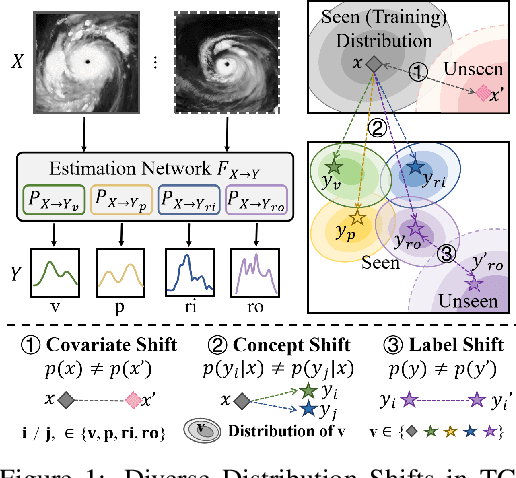
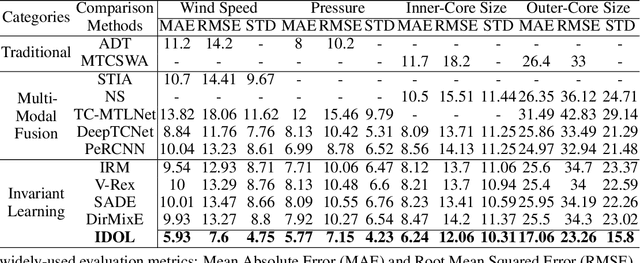
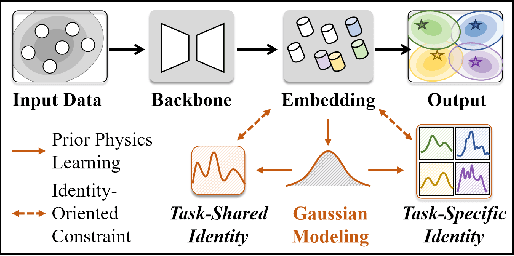

Tropical Cyclone (TC) estimation aims to accurately estimate various TC attributes in real time. However, distribution shifts arising from the complex and dynamic nature of TC environmental fields, such as varying geographical conditions and seasonal changes, present significant challenges to reliable estimation. Most existing methods rely on multi-modal fusion for feature extraction but overlook the intrinsic distribution of feature representations, leading to poor generalization under out-of-distribution (OOD) scenarios. To address this, we propose an effective Identity Distribution-Oriented Physical Invariant Learning framework (IDOL), which imposes identity-oriented constraints to regulate the feature space under the guidance of prior physical knowledge, thereby dealing distribution variability with physical invariance. Specifically, the proposed IDOL employs the wind field model and dark correlation knowledge of TC to model task-shared and task-specific identity tokens. These tokens capture task dependencies and intrinsic physical invariances of TC, enabling robust estimation of TC wind speed, pressure, inner-core, and outer-core size under distribution shifts. Extensive experiments conducted on multiple datasets and tasks demonstrate the outperformance of the proposed IDOL, verifying that imposing identity-oriented constraints based on prior physical knowledge can effectively mitigates diverse distribution shifts in TC estimation.Code is available at https://github.com/Zjut-MultimediaPlus/IDOL.