 Add to Chrome
 Add to Firefox
 Add to Edge
DiffusionGemma Technical Report
Jul 31, 2026
We introduce DiffusionGemma, an experimental open-weight language model that uses discrete diffusion to generate text at exceptionally high speed. Rather than decoding one token at a time, DiffusionGemma iteratively refines blocks of 256 tokens in parallel, avoiding the sequential decoding bottleneck of conventional autoregressive (AR) large language models. Instead of training from scratch, we obtain DiffusionGemma by fine-tuning the mixture-of-experts Gemma 4 model with 3.8B activated and 25.2B total parameters. Our compute-efficient two-stage training pipeline uses fewer than 10% of the starting AR model's total training token budget. The first stage uses supervised fine-tuning to teach bidirectional denoising, while the second stage combines reinforcement learning with sampler distillation to jointly improve generation quality and inference efficiency. DiffusionGemma establishes a new Pareto frontier for the trade-off between generation speed and model capability. Averaged across our full evaluation suite, it generates around 20 tokens per forward pass and achieves roughly 1,500 output tokens per second on a single NVIDIA H100 GPU, which is substantially faster than AR models even with state-of-the-art speculative decoding. DiffusionGemma also retains the starting model's support for thinking mode, multimodal inputs, and long contexts. Despite diffusion fine-tuning, it remains capable of AR generation with only minor performance degradation, suggesting a path toward hybrid diffusion-AR decoding.

Gemma: Open Models Based on Gemini Research and Technology
Mar 13, 2024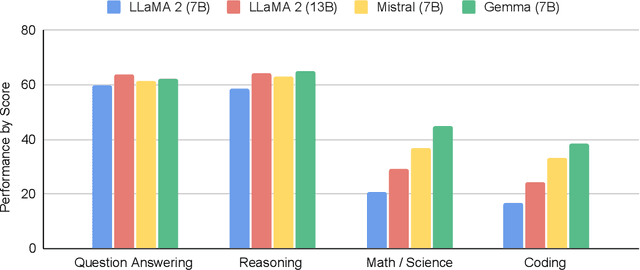
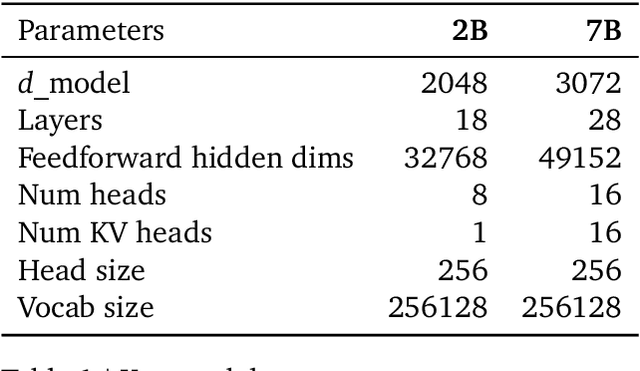
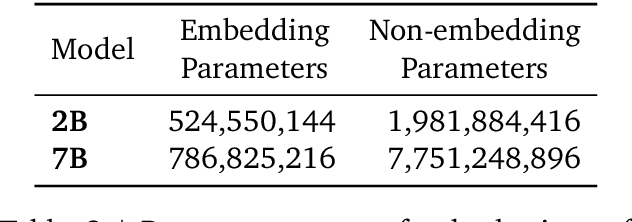
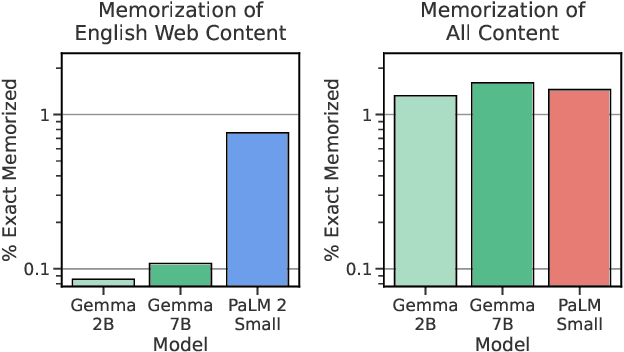
This work introduces Gemma, a family of lightweight, state-of-the art open models built from the research and technology used to create Gemini models. Gemma models demonstrate strong performance across academic benchmarks for language understanding, reasoning, and safety. We release two sizes of models (2 billion and 7 billion parameters), and provide both pretrained and fine-tuned checkpoints. Gemma outperforms similarly sized open models on 11 out of 18 text-based tasks, and we present comprehensive evaluations of safety and responsibility aspects of the models, alongside a detailed description of model development. We believe the responsible release of LLMs is critical for improving the safety of frontier models, and for enabling the next wave of LLM innovations.
Gemini: A Family of Highly Capable Multimodal Models
Dec 19, 2023This report introduces a new family of multimodal models, Gemini, that exhibit remarkable capabilities across image, audio, video, and text understanding. The Gemini family consists of Ultra, Pro, and Nano sizes, suitable for applications ranging from complex reasoning tasks to on-device memory-constrained use-cases. Evaluation on a broad range of benchmarks shows that our most-capable Gemini Ultra model advances the state of the art in 30 of 32 of these benchmarks - notably being the first model to achieve human-expert performance on the well-studied exam benchmark MMLU, and improving the state of the art in every one of the 20 multimodal benchmarks we examined. We believe that the new capabilities of Gemini models in cross-modal reasoning and language understanding will enable a wide variety of use cases and we discuss our approach toward deploying them responsibly to users.
Moral Foundations of Large Language Models
Oct 23, 2023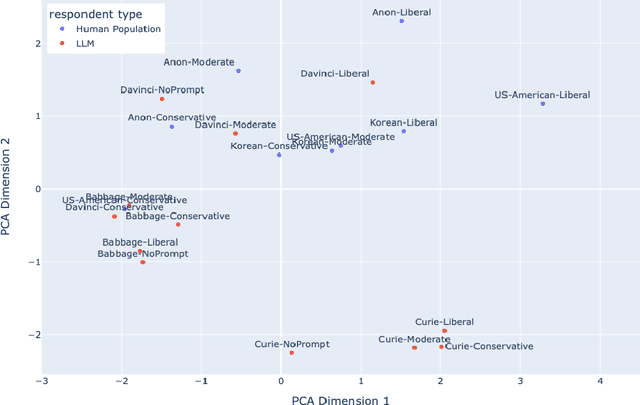


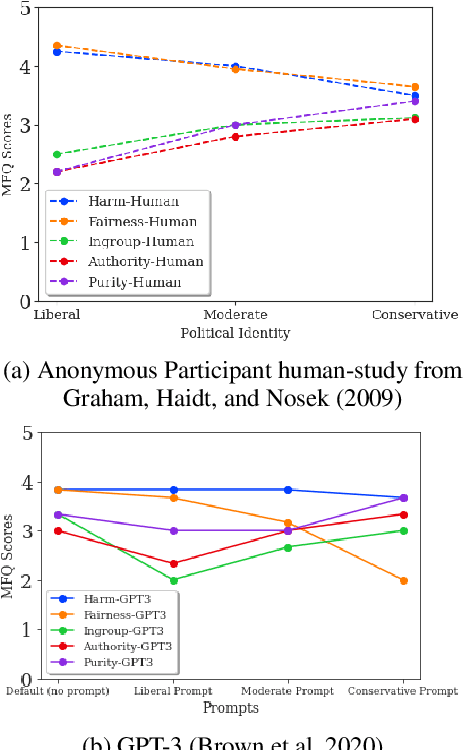
Moral foundations theory (MFT) is a psychological assessment tool that decomposes human moral reasoning into five factors, including care/harm, liberty/oppression, and sanctity/degradation (Graham et al., 2009). People vary in the weight they place on these dimensions when making moral decisions, in part due to their cultural upbringing and political ideology. As large language models (LLMs) are trained on datasets collected from the internet, they may reflect the biases that are present in such corpora. This paper uses MFT as a lens to analyze whether popular LLMs have acquired a bias towards a particular set of moral values. We analyze known LLMs and find they exhibit particular moral foundations, and show how these relate to human moral foundations and political affiliations. We also measure the consistency of these biases, or whether they vary strongly depending on the context of how the model is prompted. Finally, we show that we can adversarially select prompts that encourage the moral to exhibit a particular set of moral foundations, and that this can affect the model's behavior on downstream tasks. These findings help illustrate the potential risks and unintended consequences of LLMs assuming a particular moral stance.
Personality Traits in Large Language Models
Jul 01, 2023


The advent of large language models (LLMs) has revolutionized natural language processing, enabling the generation of coherent and contextually relevant text. As LLMs increasingly power conversational agents, the synthesized personality embedded in these models by virtue of their training on large amounts of human-generated data draws attention. Since personality is an important factor determining the effectiveness of communication, we present a comprehensive method for administering validated psychometric tests and quantifying, analyzing, and shaping personality traits exhibited in text generated from widely-used LLMs. We find that: 1) personality simulated in the outputs of some LLMs (under specific prompting configurations) is reliable and valid; 2) evidence of reliability and validity of LLM-simulated personality is stronger for larger and instruction fine-tuned models; and 3) personality in LLM outputs can be shaped along desired dimensions to mimic specific personality profiles. We also discuss potential applications and ethical implications of our measurement and shaping framework, especially regarding responsible use of LLMs.
PaLM 2 Technical Report
May 17, 2023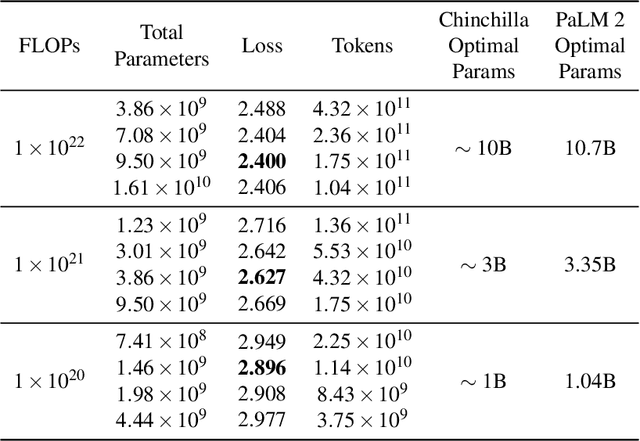
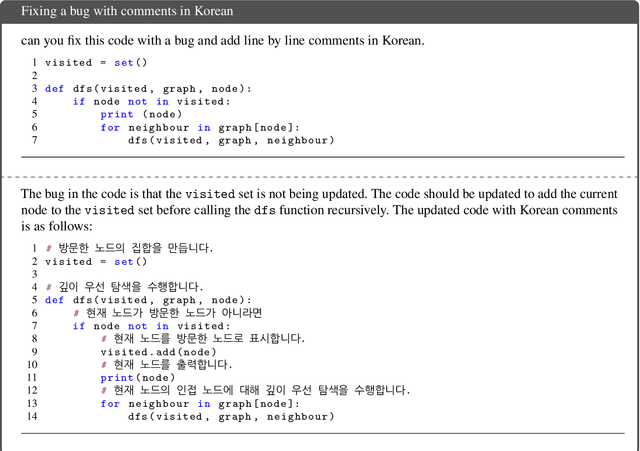
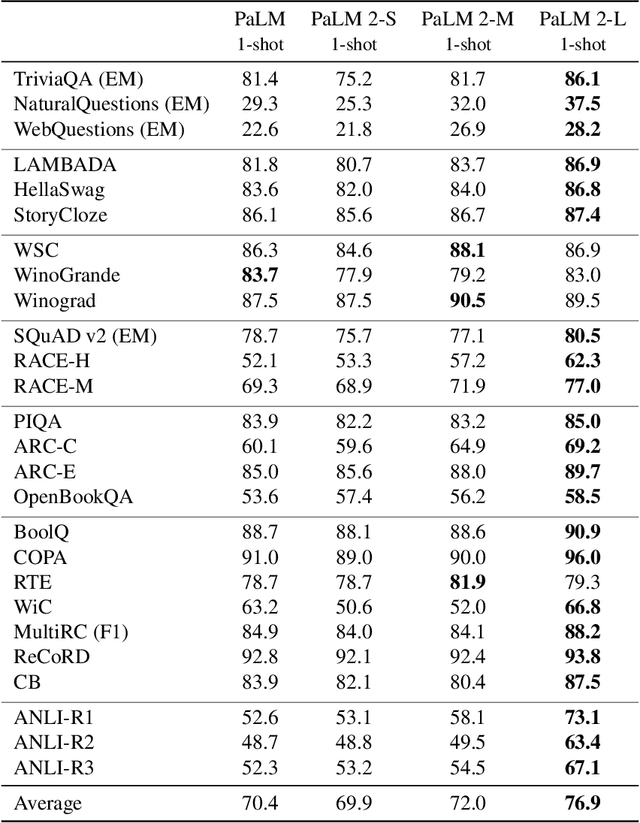
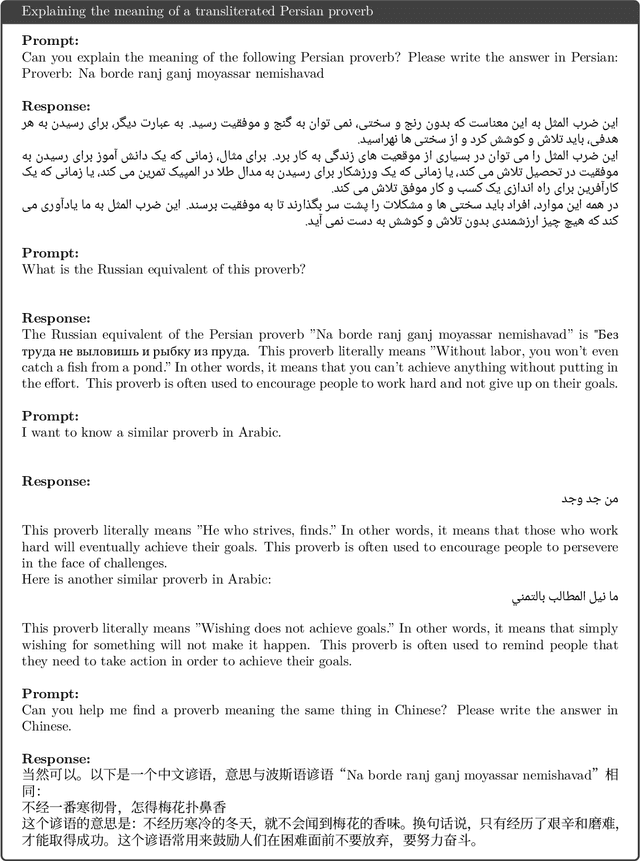
We introduce PaLM 2, a new state-of-the-art language model that has better multilingual and reasoning capabilities and is more compute-efficient than its predecessor PaLM. PaLM 2 is a Transformer-based model trained using a mixture of objectives. Through extensive evaluations on English and multilingual language, and reasoning tasks, we demonstrate that PaLM 2 has significantly improved quality on downstream tasks across different model sizes, while simultaneously exhibiting faster and more efficient inference compared to PaLM. This improved efficiency enables broader deployment while also allowing the model to respond faster, for a more natural pace of interaction. PaLM 2 demonstrates robust reasoning capabilities exemplified by large improvements over PaLM on BIG-Bench and other reasoning tasks. PaLM 2 exhibits stable performance on a suite of responsible AI evaluations, and enables inference-time control over toxicity without additional overhead or impact on other capabilities. Overall, PaLM 2 achieves state-of-the-art performance across a diverse set of tasks and capabilities. When discussing the PaLM 2 family, it is important to distinguish between pre-trained models (of various sizes), fine-tuned variants of these models, and the user-facing products that use these models. In particular, user-facing products typically include additional pre- and post-processing steps. Additionally, the underlying models may evolve over time. Therefore, one should not expect the performance of user-facing products to exactly match the results reported in this report.