 Add to Chrome
 Add to Firefox
 Add to Edge
MTFM: A Scalable and Alignment-free Foundation Model for Industrial Recommendation in Meituan
Feb 13, 2026
Industrial recommendation systems typically involve multiple scenarios, yet existing cross-domain (CDR) and multi-scenario (MSR) methods often require prohibitive resources and strict input alignment, limiting their extensibility. We propose MTFM (Meituan Foundation Model for Recommendation), a transformer-based framework that addresses these challenges. Instead of pre-aligning inputs, MTFM transforms cross-domain data into heterogeneous tokens, capturing multi-scenario knowledge in an alignment-free manner. To enhance efficiency, we first introduce a multi-scenario user-level sample aggregation that significantly enhances training throughput by reducing the total number of instances. We further integrate Grouped-Query Attention and a customized Hybrid Target Attention to minimize memory usage and computational complexity. Furthermore, we implement various system-level optimizations, such as kernel fusion and the elimination of CPU-GPU blocking, to further enhance both training and inference throughput. Offline and online experiments validate the effectiveness of MTFM, demonstrating that significant performance gains are achieved by scaling both model capacity and multi-scenario training data.

MTGR: Industrial-Scale Generative Recommendation Framework in Meituan
May 24, 2025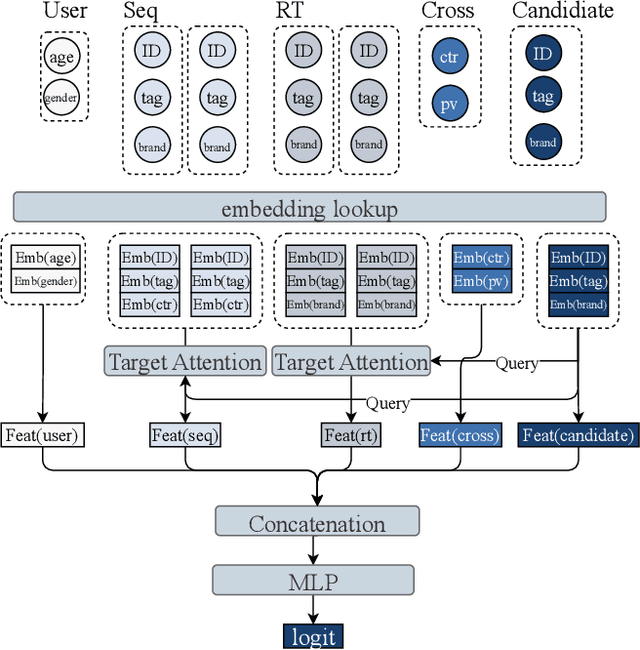
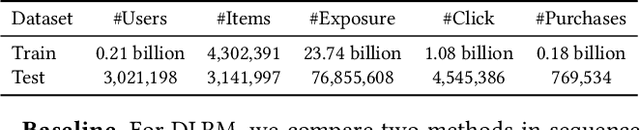
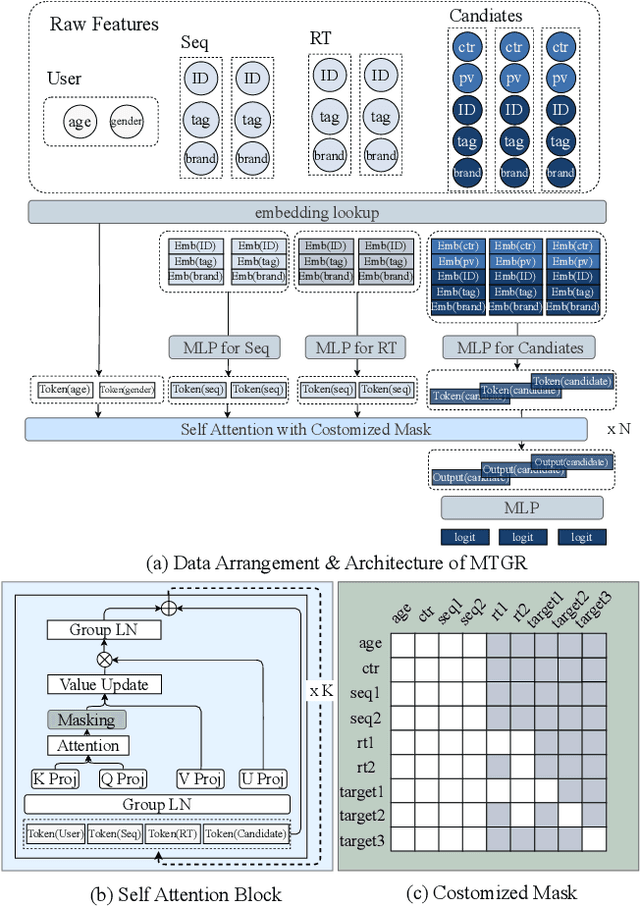
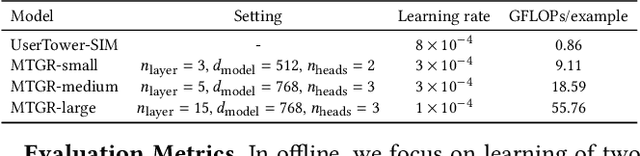
Scaling law has been extensively validated in many domains such as natural language processing and computer vision. In the recommendation system, recent work has adopted generative recommendations to achieve scalability, but their generative approaches require abandoning the carefully constructed cross features of traditional recommendation models. We found that this approach significantly degrades model performance, and scaling up cannot compensate for it at all. In this paper, we propose MTGR (Meituan Generative Recommendation) to address this issue. MTGR is modeling based on the HSTU architecture and can retain the original deep learning recommendation model (DLRM) features, including cross features. Additionally, MTGR achieves training and inference acceleration through user-level compression to ensure efficient scaling. We also propose Group-Layer Normalization (GLN) to enhance the performance of encoding within different semantic spaces and the dynamic masking strategy to avoid information leakage. We further optimize the training frameworks, enabling support for our models with 10 to 100 times computational complexity compared to the DLRM, without significant cost increases. MTGR achieved 65x FLOPs for single-sample forward inference compared to the DLRM model, resulting in the largest gain in nearly two years both offline and online. This breakthrough was successfully deployed on Meituan, the world's largest food delivery platform, where it has been handling the main traffic.