 Add to Chrome
 Add to Firefox
 Add to Edge
AiEDA: An Open-Source AI-Aided Design Library for Design-to-Vector
Nov 08, 2025
Recent research has demonstrated that artificial intelligence (AI) can assist electronic design automation (EDA) in improving both the quality and efficiency of chip design. But current AI for EDA (AI-EDA) infrastructures remain fragmented, lacking comprehensive solutions for the entire data pipeline from design execution to AI integration. Key challenges include fragmented flow engines that generate raw data, heterogeneous file formats for data exchange, non-standardized data extraction methods, and poorly organized data storage. This work introduces a unified open-source library for EDA (AiEDA) that addresses these issues. AiEDA integrates multiple design-to-vector data representation techniques that transform diverse chip design data into universal multi-level vector representations, establishing an AI-aided design (AAD) paradigm optimized for AI-EDA workflows. AiEDA provides complete physical design flows with programmatic data extraction and standardized Python interfaces bridging EDA datasets and AI frameworks. Leveraging the AiEDA library, we generate iDATA, a 600GB dataset of structured data derived from 50 real chip designs (28nm), and validate its effectiveness through seven representative AAD tasks spanning prediction, generation, optimization and analysis. The code is publicly available at https://github.com/OSCC-Project/AiEDA, while the full iDATA dataset is being prepared for public release, providing a foundation for future AI-EDA research.

3D Building Generation in Minecraft via Large Language Models
Jun 13, 2024

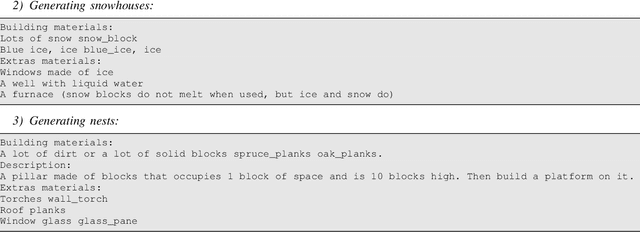

Recently, procedural content generation has exhibited considerable advancements in the domain of 2D game level generation such as Super Mario Bros. and Sokoban through large language models (LLMs). To further validate the capabilities of LLMs, this paper explores how LLMs contribute to the generation of 3D buildings in a sandbox game, Minecraft. We propose a Text to Building in Minecraft (T2BM) model, which involves refining prompts, decoding interlayer representation and repairing. Facade, indoor scene and functional blocks like doors are supported in the generation. Experiments are conducted to evaluate the completeness and satisfaction of buildings generated via LLMs. It shows that LLMs hold significant potential for 3D building generation. Given appropriate prompts, LLMs can generate correct buildings in Minecraft with complete structures and incorporate specific building blocks such as windows and beds, meeting the specified requirements of human users.