 Add to Chrome
 Add to Firefox
 Add to Edge
SkillSafetyBench: Evaluating Agent Safety under Skill-Facing Attack Surfaces
May 12, 2026
Reusable skills are becoming a common interface for extending large language model agents, packaging procedural guidance with access to files, tools, memory, and execution environments. However, this modularity introduces attack surfaces that are largely missed by existing safety evaluations: even when the user request is benign, task-relevant skill materials or local artifacts can steer an agent toward unsafe actions. We present SkillSafetyBench, a runnable benchmark for evaluating such skill-mediated safety failures. SkillSafetyBench includes 155 adversarial cases across 47 tasks, 6 risk domains, and 30 safety categories, each evaluated with a case-specific rule-based verifier. Experiments with multiple CLI agents and model backends show that localized non-user attacks can consistently induce unsafe behavior, with distinct failure patterns across domains, attack methods, and scaffold-model pairings. Our findings suggest that agent safety depends not only on model-level alignment, but also on how agents interpret skills, trust workflow context, and act through executable environments.

OGER: A Robust Offline-Guided Exploration Reward for Hybrid Reinforcement Learning
Apr 20, 2026Recent advancements in Reinforcement Learning with Verifiable Rewards (RLVR) have significantly improved Large Language Model (LLM) reasoning, yet models often struggle to explore novel trajectories beyond their initial latent space. While offline teacher guidance and entropy-driven strategies have been proposed to address this, they often lack deep integration or are constrained by the model's inherent capacity. In this paper, we propose OGER, a novel framework that unifies offline teacher guidance and online reinforcement learning through a specialized reward modeling lens. OGER employs multi-teacher collaborative training and constructs an auxiliary exploration reward that leverages both offline trajectories and the model's own entropy to incentivize autonomous exploration. Extensive experiments across mathematical and general reasoning benchmarks demonstrate that OGER significantly outperforms competitive baselines, achieving substantial gains in mathematical reasoning while maintaining robust generalization to out-of-domain tasks. We provide a comprehensive analysis of training dynamics and conduct detailed ablation studies to validate the effectiveness of our entropy-aware reward modulation. Our code is available at https://github.com/ecoli-hit/OGER.git.
TrinityGuard: A Unified Framework for Safeguarding Multi-Agent Systems
Mar 16, 2026With the rapid development of LLM-based multi-agent systems (MAS), their significant safety and security concerns have emerged, which introduce novel risks going beyond single agents or LLMs. Despite attempts to address these issues, the existing literature lacks a cohesive safeguarding system specialized for MAS risks. In this work, we introduce TrinityGuard, a comprehensive safety evaluation and monitoring framework for LLM-based MAS, grounded in the OWASP standards. Specifically, TrinityGuard encompasses a three-tier fine-grained risk taxonomy that identifies 20 risk types, covering single-agent vulnerabilities, inter-agent communication threats, and system-level emergent hazards. Designed for scalability across various MAS structures and platforms, TrinityGuard is organized in a trinity manner, involving an MAS abstraction layer that can be adapted to any MAS structures, an evaluation layer containing risk-specific test modules, alongside runtime monitor agents coordinated by a unified LLM Judge Factory. During Evaluation, TrinityGuard executes curated attack probes to generate detailed vulnerability reports for each risk type, where monitor agents analyze structured execution traces and issue real-time alerts, enabling both pre-development evaluation and runtime monitoring. We further formalize these safety metrics and present detailed case studies across various representative MAS examples, showcasing the versatility and reliability of TrinityGuard. Overall, TrinityGuard acts as a comprehensive framework for evaluating and monitoring various risks in MAS, paving the way for further research into their safety and security.
When Silence Is Golden: Can LLMs Learn to Abstain in Temporal QA and Beyond?
Feb 04, 2026Large language models (LLMs) rarely admit uncertainty, often producing fluent but misleading answers, rather than abstaining (i.e., refusing to answer). This weakness is even evident in temporal question answering, where models frequently ignore time-sensitive evidence and conflate facts across different time-periods. In this paper, we present the first empirical study of training LLMs with an abstention ability while reasoning about temporal QA. Existing approaches such as calibration might be unreliable in capturing uncertainty in complex reasoning. We instead frame abstention as a teachable skill and introduce a pipeline that couples Chain-of-Thought (CoT) supervision with Reinforcement Learning (RL) guided by abstention-aware rewards. Our goal is to systematically analyze how different information types and training techniques affect temporal reasoning with abstention behavior in LLMs. Through extensive experiments studying various methods, we find that RL yields strong empirical gains on reasoning: a model initialized by Qwen2.5-1.5B-Instruct surpasses GPT-4o by $3.46\%$ and $5.80\%$ in Exact Match on TimeQA-Easy and Hard, respectively. Moreover, it improves the True Positive rate on unanswerable questions by $20\%$ over a pure supervised fine-tuned (SFT) variant. Beyond performance, our analysis shows that SFT induces overconfidence and harms reliability, while RL improves prediction accuracy but exhibits similar risks. Finally, by comparing implicit reasoning cues (e.g., original context, temporal sub-context, knowledge graphs) with explicit CoT supervision, we find that implicit information provides limited benefit for reasoning with abstention. Our study provides new insights into how abstention and reasoning can be jointly optimized, providing a foundation for building more reliable LLMs.
M$^{3}$-20M: A Large-Scale Multi-Modal Molecule Dataset for AI-driven Drug Design and Discovery
Dec 08, 2024
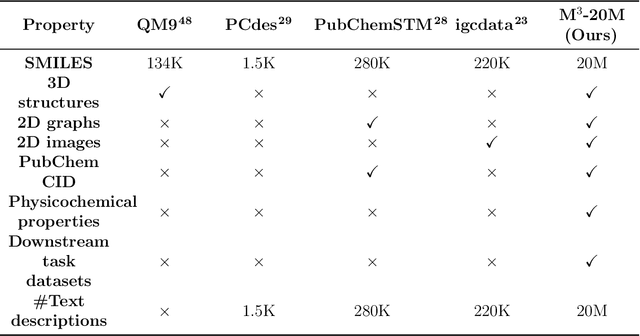

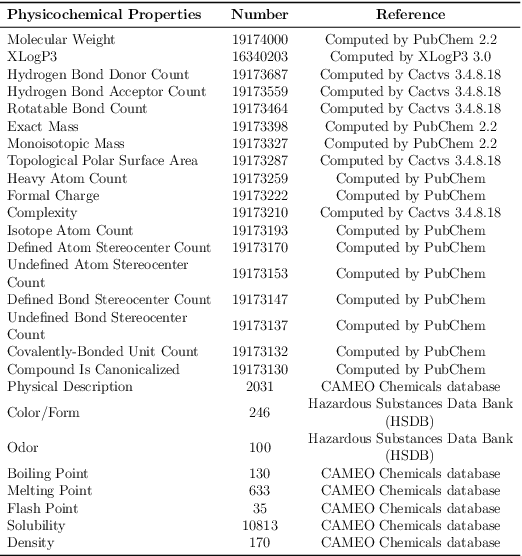
This paper introduces M$^{3}$-20M, a large-scale Multi-Modal Molecular dataset that contains over 20 million molecules. Designed to support AI-driven drug design and discovery, M$^{3}$-20M is 71 times more in the number of molecules than the largest existing dataset, providing an unprecedented scale that can highly benefit training or fine-tuning large (language) models with superior performance for drug design and discovery. This dataset integrates one-dimensional SMILES, two-dimensional molecular graphs, three-dimensional molecular structures, physicochemical properties, and textual descriptions collected through web crawling and generated by using GPT-3.5, offering a comprehensive view of each molecule. To demonstrate the power of M$^{3}$-20M in drug design and discovery, we conduct extensive experiments on two key tasks: molecule generation and molecular property prediction, using large language models including GLM4, GPT-3.5, and GPT-4. Our experimental results show that M$^{3}$-20M can significantly boost model performance in both tasks. Specifically, it enables the models to generate more diverse and valid molecular structures and achieve higher property prediction accuracy than the existing single-modal datasets, which validates the value and potential of M$^{3}$-20M in supporting AI-driven drug design and discovery. The dataset is available at \url{https://github.com/bz99bz/M-3}.
AdMix: A Mixed Sample Data Augmentation Method for Neural Machine Translation
May 10, 2022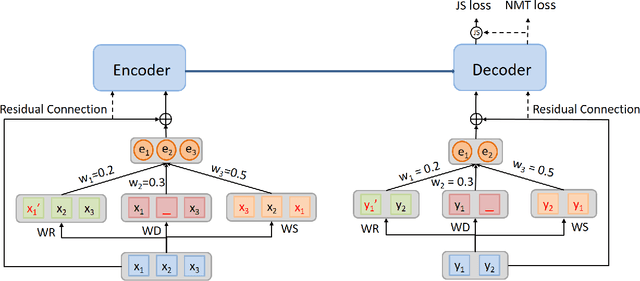
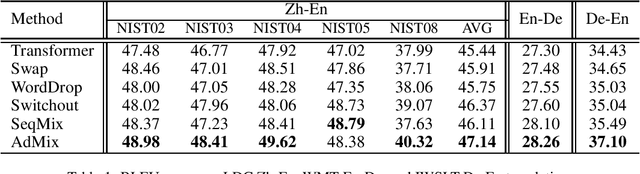
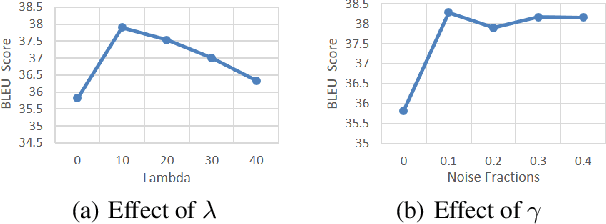
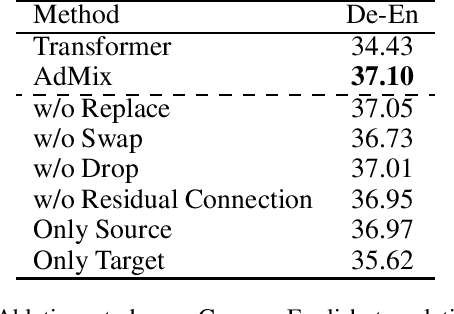
In Neural Machine Translation (NMT), data augmentation methods such as back-translation have proven their effectiveness in improving translation performance. In this paper, we propose a novel data augmentation approach for NMT, which is independent of any additional training data. Our approach, AdMix, consists of two parts: 1) introduce faint discrete noise (word replacement, word dropping, word swapping) into the original sentence pairs to form augmented samples; 2) generate new synthetic training data by softly mixing the augmented samples with their original samples in training corpus. Experiments on three translation datasets of different scales show that AdMix achieves signifi cant improvements (1.0 to 2.7 BLEU points) over strong Transformer baseline. When combined with other data augmentation techniques (e.g., back-translation), our approach can obtain further improvements.