 Add to Chrome
 Add to Firefox
 Add to Edge
A generative framework to bridge data-driven models and scientific theories in language neuroscience
Oct 01, 2024
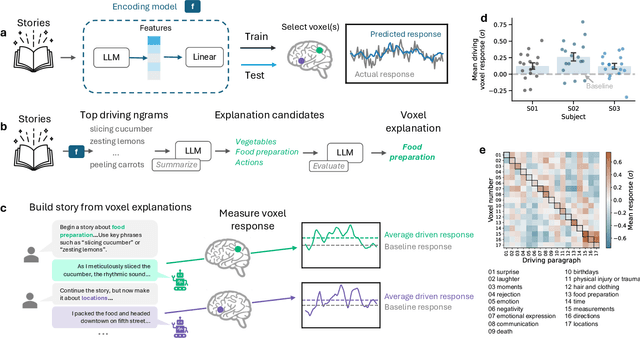
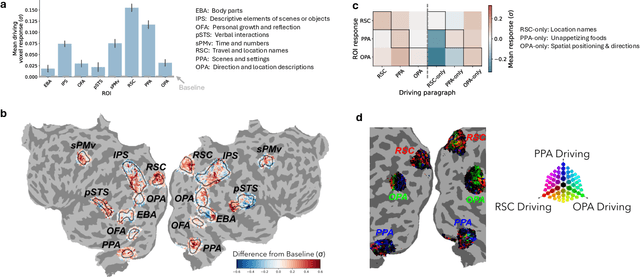
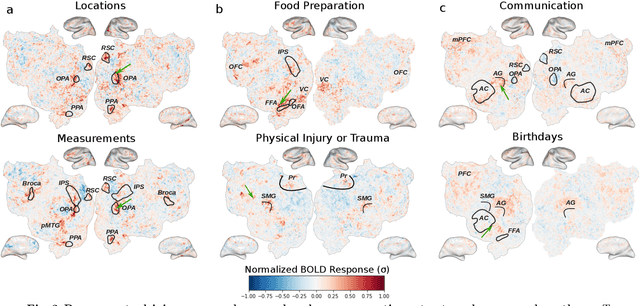

Representations from large language models are highly effective at predicting BOLD fMRI responses to language stimuli. However, these representations are largely opaque: it is unclear what features of the language stimulus drive the response in each brain area. We present generative explanation-mediated validation, a framework for generating concise explanations of language selectivity in the brain and then validating those explanations in follow-up experiments that use synthetic stimuli. This approach is successful at explaining selectivity both in individual voxels and cortical regions of interest (ROIs).We show that explanatory accuracy is closely related to the predictive power and stability of the underlying statistical models. These results demonstrate that LLMs can be used to bridge the widening gap between data-driven models and formal scientific theories.

Model Tells Itself Where to Attend: Faithfulness Meets Automatic Attention Steering
Sep 16, 2024


Large language models (LLMs) have demonstrated remarkable performance across various real-world tasks. However, they often struggle to fully comprehend and effectively utilize their input contexts, resulting in responses that are unfaithful or hallucinated. This difficulty increases for contexts that are long or contain distracting information, which can divert LLMs from fully capturing essential evidence. To address this issue, many works use prompting to help LLMs utilize contextual information more faithfully. For instance, iterative prompting highlights key information in two steps that first ask the LLM to identify important pieces of context and then derive answers accordingly. However, prompting methods are constrained to highlighting key information implicitly in token space, which is often insufficient to fully steer the model's attention. To improve model faithfulness more reliably, we propose AutoPASTA, a method that automatically identifies key contextual information and explicitly highlights it by steering an LLM's attention scores. Like prompting, AutoPASTA is applied at inference time and does not require changing any model parameters. Our experiments on open-book QA demonstrate that AutoPASTA effectively enables models to grasp essential contextual information, leading to substantially improved model faithfulness and performance, e.g., an average improvement of 7.95% for LLAMA3-70B-Instruct. Code will be publicly available at https://github.com/QingruZhang/AutoPASTA .
Crafting Interpretable Embeddings by Asking LLMs Questions
May 26, 2024Large language models (LLMs) have rapidly improved text embeddings for a growing array of natural-language processing tasks. However, their opaqueness and proliferation into scientific domains such as neuroscience have created a growing need for interpretability. Here, we ask whether we can obtain interpretable embeddings through LLM prompting. We introduce question-answering embeddings (QA-Emb), embeddings where each feature represents an answer to a yes/no question asked to an LLM. Training QA-Emb reduces to selecting a set of underlying questions rather than learning model weights. We use QA-Emb to flexibly generate interpretable models for predicting fMRI voxel responses to language stimuli. QA-Emb significantly outperforms an established interpretable baseline, and does so while requiring very few questions. This paves the way towards building flexible feature spaces that can concretize and evaluate our understanding of semantic brain representations. We additionally find that QA-Emb can be effectively approximated with an efficient model, and we explore broader applications in simple NLP tasks.
Attribute Structuring Improves LLM-Based Evaluation of Clinical Text Summaries
Mar 01, 2024
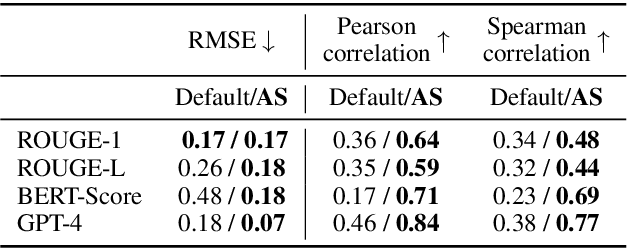


Summarizing clinical text is crucial in health decision-support and clinical research. Large language models (LLMs) have shown the potential to generate accurate clinical text summaries, but still struggle with issues regarding grounding and evaluation, especially in safety-critical domains such as health. Holistically evaluating text summaries is challenging because they may contain unsubstantiated information. Here, we explore a general mitigation framework using Attribute Structuring (AS), which structures the summary evaluation process. It decomposes the evaluation process into a grounded procedure that uses an LLM for relatively simple structuring and scoring tasks, rather than the full task of holistic summary evaluation. Experiments show that AS consistently improves the correspondence between human annotations and automated metrics in clinical text summarization. Additionally, AS yields interpretations in the form of a short text span corresponding to each output, which enables efficient human auditing, paving the way towards trustworthy evaluation of clinical information in resource-constrained scenarios. We release our code, prompts, and an open-source benchmark at https://github.com/microsoft/attribute-structuring.
Learning a Decision Tree Algorithm with Transformers
Feb 06, 2024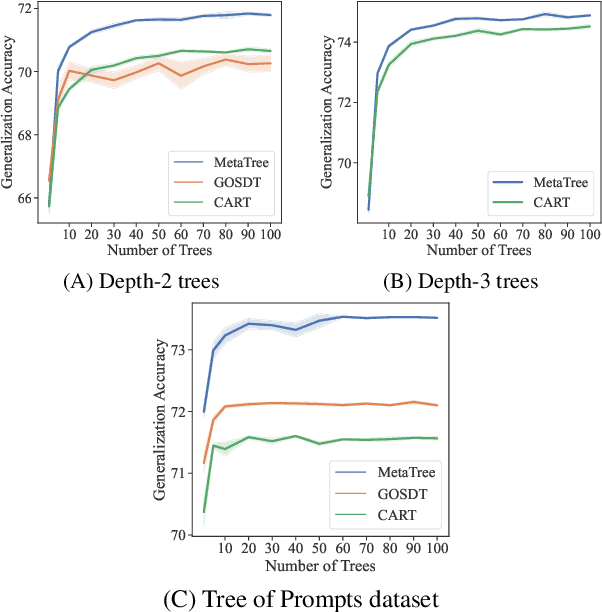

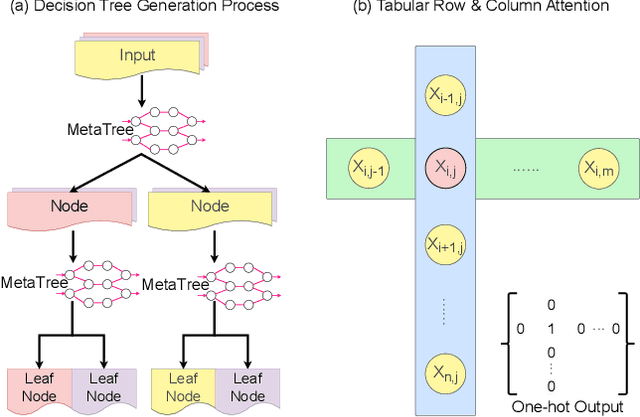
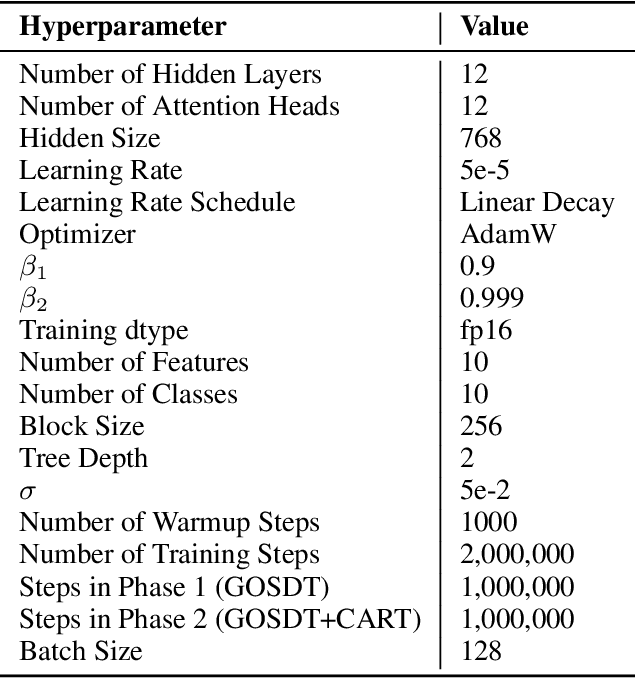
Decision trees are renowned for their interpretability capability to achieve high predictive performance, especially on tabular data. Traditionally, they are constructed through recursive algorithms, where they partition the data at every node in a tree. However, identifying the best partition is challenging, as decision trees optimized for local segments may not bring global generalization. To address this, we introduce MetaTree, which trains a transformer-based model on filtered outputs from classical algorithms to produce strong decision trees for classification. Specifically, we fit both greedy decision trees and optimized decision trees on a large number of datasets. We then train MetaTree to produce the trees that achieve strong generalization performance. This training enables MetaTree to not only emulate these algorithms, but also to intelligently adapt its strategy according to the context, thereby achieving superior generalization performance.
Rethinking Interpretability in the Era of Large Language Models
Jan 30, 2024

Interpretable machine learning has exploded as an area of interest over the last decade, sparked by the rise of increasingly large datasets and deep neural networks. Simultaneously, large language models (LLMs) have demonstrated remarkable capabilities across a wide array of tasks, offering a chance to rethink opportunities in interpretable machine learning. Notably, the capability to explain in natural language allows LLMs to expand the scale and complexity of patterns that can be given to a human. However, these new capabilities raise new challenges, such as hallucinated explanations and immense computational costs. In this position paper, we start by reviewing existing methods to evaluate the emerging field of LLM interpretation (both interpreting LLMs and using LLMs for explanation). We contend that, despite their limitations, LLMs hold the opportunity to redefine interpretability with a more ambitious scope across many applications, including in auditing LLMs themselves. We highlight two emerging research priorities for LLM interpretation: using LLMs to directly analyze new datasets and to generate interactive explanations.
Towards Consistent Natural-Language Explanations via Explanation-Consistency Finetuning
Jan 25, 2024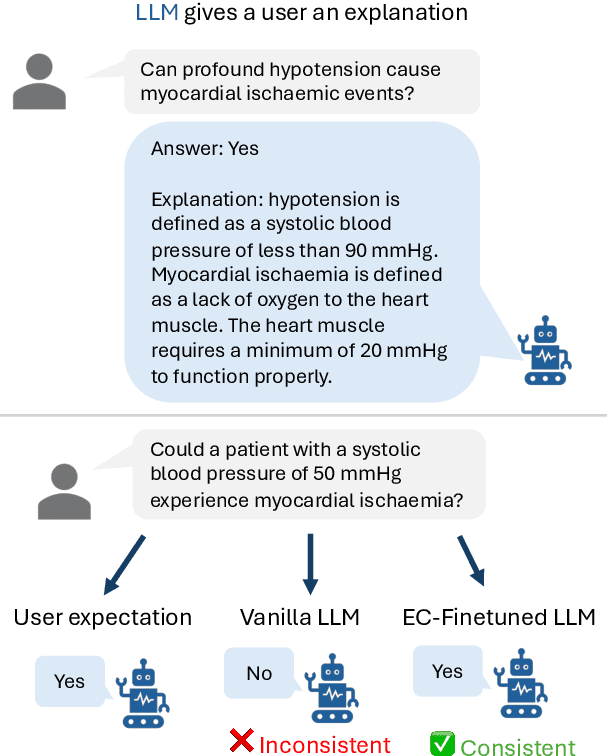


Large language models (LLMs) often generate convincing, fluent explanations. However, different from humans, they often generate inconsistent explanations on different inputs. For example, an LLM may generate the explanation "all birds can fly" when answering the question "Can sparrows fly?" but meanwhile answer "no" to the related question "Can penguins fly?". Explanations should be consistent across related examples so that they allow a human to simulate the LLM's decision process on multiple examples. We propose explanation-consistency finetuning (EC-finetuning), a method that adapts LLMs to generate more consistent natural-language explanations on related examples. EC-finetuning involves finetuning LLMs on synthetic data that is carefully constructed to contain consistent explanations. Across a variety of question-answering datasets in various domains, EC-finetuning yields a 10.0% relative explanation consistency improvement on four finetuning datasets, and generalizes to seven out-of-distribution datasets not seen during finetuning (+4.5% relative). Code is available at https://github.com/yandachen/explanation-consistency-finetuning .
Tell Your Model Where to Attend: Post-hoc Attention Steering for LLMs
Nov 03, 2023In human-written articles, we often leverage the subtleties of text style, such as bold and italics, to guide the attention of readers. These textual emphases are vital for the readers to grasp the conveyed information. When interacting with large language models (LLMs), we have a similar need - steering the model to pay closer attention to user-specified information, e.g., an instruction. Existing methods, however, are constrained to process plain text and do not support such a mechanism. This motivates us to introduce PASTA - Post-hoc Attention STeering Approach, a method that allows LLMs to read text with user-specified emphasis marks. To this end, PASTA identifies a small subset of attention heads and applies precise attention reweighting on them, directing the model attention to user-specified parts. Like prompting, PASTA is applied at inference time and does not require changing any model parameters. Experiments demonstrate that PASTA can substantially enhance an LLM's ability to follow user instructions or integrate new knowledge from user inputs, leading to a significant performance improvement on a variety of tasks, e.g., an average accuracy improvement of 22% for LLAMA-7B. Our code is publicly available at https://github.com/QingruZhang/PASTA .
Tree Prompting: Efficient Task Adaptation without Fine-Tuning
Oct 21, 2023Prompting language models (LMs) is the main interface for applying them to new tasks. However, for smaller LMs, prompting provides low accuracy compared to gradient-based finetuning. Tree Prompting is an approach to prompting which builds a decision tree of prompts, linking multiple LM calls together to solve a task. At inference time, each call to the LM is determined by efficiently routing the outcome of the previous call using the tree. Experiments on classification datasets show that Tree Prompting improves accuracy over competing methods and is competitive with fine-tuning. We also show that variants of Tree Prompting allow inspection of a model's decision-making process.
Self-Verification Improves Few-Shot Clinical Information Extraction
May 30, 2023Extracting patient information from unstructured text is a critical task in health decision-support and clinical research. Large language models (LLMs) have shown the potential to accelerate clinical curation via few-shot in-context learning, in contrast to supervised learning which requires much more costly human annotations. However, despite drastic advances in modern LLMs such as GPT-4, they still struggle with issues regarding accuracy and interpretability, especially in mission-critical domains such as health. Here, we explore a general mitigation framework using self-verification, which leverages the LLM to provide provenance for its own extraction and check its own outputs. This is made possible by the asymmetry between verification and generation, where the latter is often much easier than the former. Experimental results show that our method consistently improves accuracy for various LLMs in standard clinical information extraction tasks. Additionally, self-verification yields interpretations in the form of a short text span corresponding to each output, which makes it very efficient for human experts to audit the results, paving the way towards trustworthy extraction of clinical information in resource-constrained scenarios. To facilitate future research in this direction, we release our code and prompts.