 Add to Chrome
 Add to Firefox
 Add to Edge
Machine Learning Methods for Studying Latent Neural Activity Dynamics
Jun 09, 2026
Recent developments in brain recording are driving a demand for machine learning tools capable of decoding the latent structure of large populations of neurons. In this paper, we provide a comprehensive survey that outlines the trajectory of Latent Variable Models (LVMs) from early state-space models to more recent deep generative models. We organize the literature into three closely related domains: (1) Single-Region Latent Dynamics, which includes models such as linear dynamical systems to more complex dynamics represented by Recurrent Neural Networks (RNNs) and Neural Ordinary Differential Equations (ODEs); (2) Multi-Region Communication, which employs probabilistic as well as subspace methods to study how information is transferred across different brain areas considering synaptic propagation delays and network connectivity; and (3) Behavior-Aligned Modeling, which seeks to disentangle neural activity related to task performance from other internal states via supervised or contrastive learning. This survey also includes large-scale neural foundation models, such as Transformers and diffusion models, that rely on large-scale pre-training for optimal performance across subjects. Finally, we conclude and discuss benchmarks, evaluation criteria, and open challenges, such as the ability to identify causal links or directionality of communication, to facilitate future research for bridging interpretable brain dynamics with reliable neural decoding.

STELLAR: Spatio-Temporal Environmental Learning with Latent Alignment and Refinement for Long-Tailed Species Distribution Modeling
Jun 07, 2026Joint Species Distribution Modeling (JSDM) is a key enabler for biodiversity monitoring and conservation planning. However, accurate JSDM faces two coupled challenges: environmental drivers and species distributions are inherently spatio-temporal, while species co-occurrence patterns exhibit complex non-linear community structure and severe long-tail imbalance driven by rare species. Existing approaches often address these factors in isolation, learning from static covariates or neglecting the historical trajectories of dynamic community structure. To overcome these limitations, we propose STELLAR (Spatio-Temporal Environmental Learning with Latent Alignment and Refinement), a novel framework that learns a shared latent space where dynamic habitat context and community structure are optimized jointly. Our approach integrates three complementary components: (1) a Graph-Temporal Encoder that employs graph attention and recurrent units to aggregate spatial neighborhood effects and capture the co-evolving historical dynamics of environmental context and community structure; (2) a Context-Anchored Latent Alignment mechanism that structures the latent space using a label-activated mixture prior and supervised contrastive learning, actively clustering species based on shared environmental preferences; and (3) an Imbalance-Aware Decoupled Decoding module that utilizes Asymmetric Loss to focus learning on hard, rare species samples, preventing mode collapse in the long tail. Experiments on the large-scale eBird dataset, curated with domain experts, demonstrate that our framework significantly outperforms state-of-the-art baselines, particularly in predicting rare species and revealing interpretable species interactions.
Causal Inference, Biomarker Discovery, Graph Neural Network, Feature Selection
Nov 17, 2025Biomarker discovery from high-throughput transcriptomic data is crucial for advancing precision medicine. However, existing methods often neglect gene-gene regulatory relationships and lack stability across datasets, leading to conflation of spurious correlations with genuine causal effects. To address these issues, we develop a causal graph neural network (Causal-GNN) method that integrates causal inference with multi-layer graph neural networks (GNNs). The key innovation is the incorporation of causal effect estimation for identifying stable biomarkers, coupled with a GNN-based propensity scoring mechanism that leverages cross-gene regulatory networks. Experimental results demonstrate that our method achieves consistently high predictive accuracy across four distinct datasets and four independent classifiers. Moreover, it enables the identification of more stable biomarkers compared to traditional methods. Our work provides a robust, efficient, and biologically interpretable tool for biomarker discovery, demonstrating strong potential for broad application across medical disciplines.
MIRNet: Integrating Constrained Graph-Based Reasoning with Pre-training for Diagnostic Medical Imaging
Nov 13, 2025Automated interpretation of medical images demands robust modeling of complex visual-semantic relationships while addressing annotation scarcity, label imbalance, and clinical plausibility constraints. We introduce MIRNet (Medical Image Reasoner Network), a novel framework that integrates self-supervised pre-training with constrained graph-based reasoning. Tongue image diagnosis is a particularly challenging domain that requires fine-grained visual and semantic understanding. Our approach leverages self-supervised masked autoencoder (MAE) to learn transferable visual representations from unlabeled data; employs graph attention networks (GAT) to model label correlations through expert-defined structured graphs; enforces clinical priors via constraint-aware optimization using KL divergence and regularization losses; and mitigates imbalance using asymmetric loss (ASL) and boosting ensembles. To address annotation scarcity, we also introduce TongueAtlas-4K, a comprehensive expert-curated benchmark comprising 4,000 images annotated with 22 diagnostic labels--representing the largest public dataset in tongue analysis. Validation shows our method achieves state-of-the-art performance. While optimized for tongue diagnosis, the framework readily generalizes to broader diagnostic medical imaging tasks.
Capturing Rich Behavior Representations: A Dynamic Action Semantic-Aware Graph Transformer for Video Captioning
Feb 19, 2025Existing video captioning methods merely provide shallow or simplistic representations of object behaviors, resulting in superficial and ambiguous descriptions. However, object behavior is dynamic and complex. To comprehensively capture the essence of object behavior, we propose a dynamic action semantic-aware graph transformer. Firstly, a multi-scale temporal modeling module is designed to flexibly learn long and short-term latent action features. It not only acquires latent action features across time scales, but also considers local latent action details, enhancing the coherence and sensitiveness of latent action representations. Secondly, a visual-action semantic aware module is proposed to adaptively capture semantic representations related to object behavior, enhancing the richness and accurateness of action representations. By harnessing the collaborative efforts of these two modules,we can acquire rich behavior representations to generate human-like natural descriptions. Finally, this rich behavior representations and object representations are used to construct a temporal objects-action graph, which is fed into the graph transformer to model the complex temporal dependencies between objects and actions. To avoid adding complexity in the inference phase, the behavioral knowledge of the objects will be distilled into a simple network through knowledge distillation. The experimental results on MSVD and MSR-VTT datasets demonstrate that the proposed method achieves significant performance improvements across multiple metrics.
Deep Attentive Belief Propagation: Integrating Reasoning and Learning for Solving Constraint Optimization Problems
Sep 24, 2022
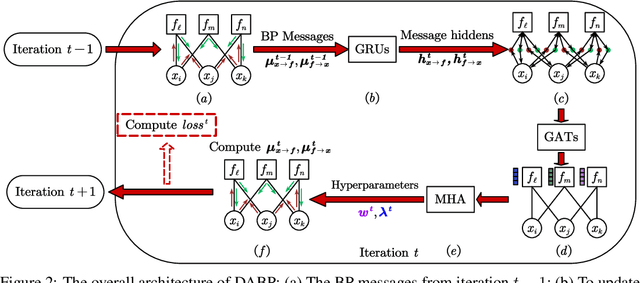
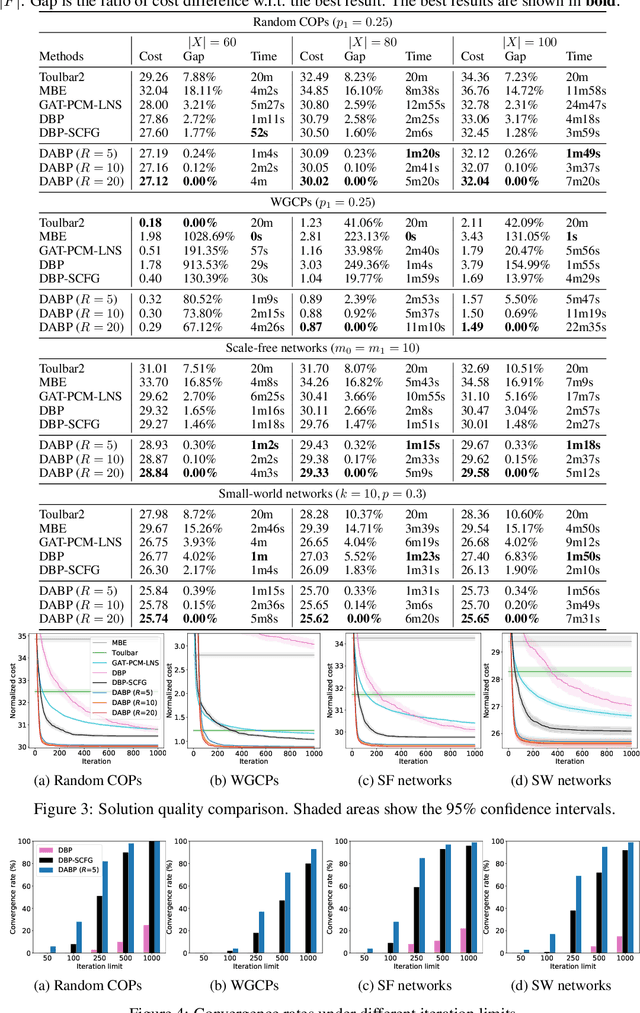
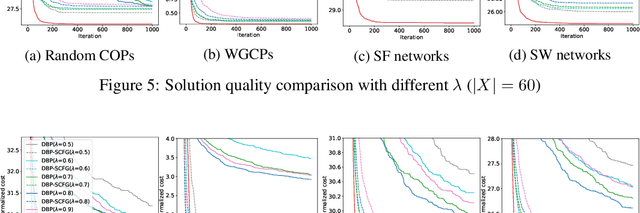
Belief Propagation (BP) is an important message-passing algorithm for various reasoning tasks over graphical models, including solving the Constraint Optimization Problems (COPs). It has been shown that BP can achieve state-of-the-art performance on various benchmarks by mixing old and new messages before sending the new one, i.e., damping. However, existing methods of tuning a static damping factor for BP not only are laborious but also harm their performance. Moreover, existing BP algorithms treat each variable node's neighbors equally when composing a new message, which also limits their exploration ability. To address these issues, we seamlessly integrate BP, Gated Recurrent Units (GRUs), and Graph Attention Networks (GATs) within the message-passing framework to reason about dynamic weights and damping factors for composing new BP messages. Our model, Deep Attentive Belief Propagation (DABP), takes the factor graph and the BP messages in each iteration as the input and infers the optimal weights and damping factors through GRUs and GATs, followed by a multi-head attention layer. Furthermore, unlike existing neural-based BP variants, we propose a novel self-supervised learning algorithm for DABP with a smoothed solution cost, which does not require expensive training labels and also avoids the common out-of-distribution issue through efficient online learning. Extensive experiments show that our model significantly outperforms state-of-the-art baselines.