 Add to Chrome
 Add to Firefox
 Add to Edge
Machine Learning Methods for Studying Latent Neural Activity Dynamics
Jun 09, 2026
Recent developments in brain recording are driving a demand for machine learning tools capable of decoding the latent structure of large populations of neurons. In this paper, we provide a comprehensive survey that outlines the trajectory of Latent Variable Models (LVMs) from early state-space models to more recent deep generative models. We organize the literature into three closely related domains: (1) Single-Region Latent Dynamics, which includes models such as linear dynamical systems to more complex dynamics represented by Recurrent Neural Networks (RNNs) and Neural Ordinary Differential Equations (ODEs); (2) Multi-Region Communication, which employs probabilistic as well as subspace methods to study how information is transferred across different brain areas considering synaptic propagation delays and network connectivity; and (3) Behavior-Aligned Modeling, which seeks to disentangle neural activity related to task performance from other internal states via supervised or contrastive learning. This survey also includes large-scale neural foundation models, such as Transformers and diffusion models, that rely on large-scale pre-training for optimal performance across subjects. Finally, we conclude and discuss benchmarks, evaluation criteria, and open challenges, such as the ability to identify causal links or directionality of communication, to facilitate future research for bridging interpretable brain dynamics with reliable neural decoding.

Dual Control of Linear Systems from Bilinear Observations with Belief Space Model Predictive Control
Apr 27, 2026We study finite-horizon quadratic control of linear systems with bilinear observations, in which the control input affects not only the state dynamics but also the partial observations of the state. In this setting, the separation principle can fail because control inputs influence the future quality of state estimates. State estimation requires an input-dependent Kalman filter whose gain and error covariance evolve as functions of the control inputs. To address this challenge, we propose a belief-space model predictive control ($\texttt{B-MPC}$) method that plans directly over both the estimated state and its error covariance. In particular, $\texttt{B-MPC}$ plans with a deterministic surrogate of the belief evolution defined by the input-dependent Kalman filter. Through numerical experiments in two synthetic settings, we show that $\texttt{B-MPC}$ can outperform both the separation-principle controller and its MPC variant in favorable regimes, and that these gains are accompanied by lower estimation covariance and more uncertainty-aware action choices.
Automating Thought of Search: A Journey Towards Soundness and Completeness
Aug 21, 2024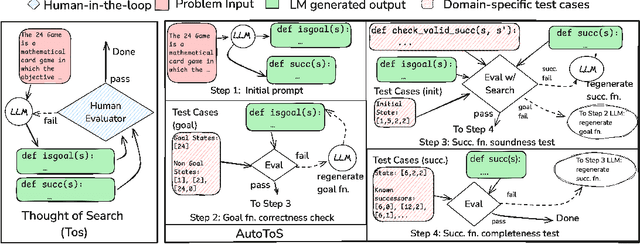
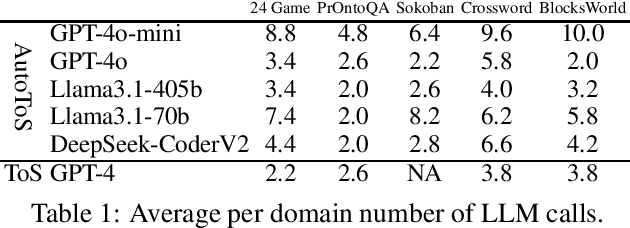
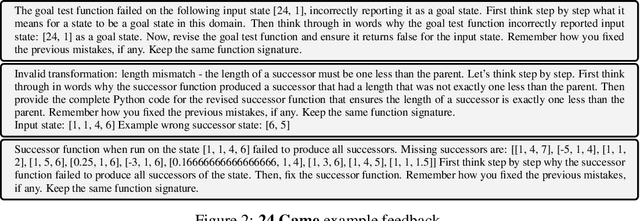
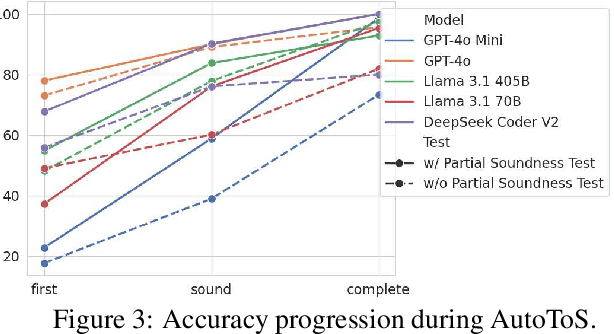
Planning remains one of the last standing bastions for large language models (LLMs), which now turn their attention to search. Most of the literature uses the language models as world models to define the search space, forgoing soundness for the sake of flexibility. A recent work, Thought of Search (ToS), proposed defining the search space with code, having the language models produce that code. ToS requires a human in the loop, collaboratively producing a sound successor function and goal test. The result, however, is worth the effort: all the tested datasets were solved with 100% accuracy. At the same time LLMs have demonstrated significant progress in code generation and refinement for complex reasoning tasks. In this work, we automate ToS (AutoToS), completely taking the human out of the loop of solving planning problems. AutoToS guides the language model step by step towards the generation of sound and complete search components, through feedback from both generic and domain specific unit tests. We achieve 100% accuracy, with minimal feedback iterations, using LLMs of various sizes on all evaluated domains.