 Add to Chrome
 Add to Firefox
 Add to Edge
Shopping Reasoning Bench: An Expert-Authored Benchmark for Multi-Turn Conversational Shopping Assistants
Jun 10, 2026
Conversational shopping assistants now serve hundreds of millions of customers, yet no existing benchmark jointly evaluates the open-ended multi-turn reasoning, domain expertise, and criterion-level quality that real shopping conversations demand. Shopping reasoning is unique among language model applications. Unlike factual question answering or verifiable code generation, it requires balancing subjective preferences, budget constraints, and cross-product trade-offs across multi-turn dialogue, capabilities absent from previous e-commerce and general-purpose benchmarks. We introduce the Shopping Reasoning Bench, an expert-authored benchmark of 525 missions (232 single-turn, 293 multi-turn) with 10863 importance-weighted binary rubrics authored by retail domain experts. These criteria are organized under a taxonomy of five reasoning categories and fifteen subcategories covering diverse demands such as preference refinement, trade-off analysis, and compatibility assessment. An evaluation of nine models across three families (GPT, Claude, Gemini) shows that pass rates reach only 57--77% overall. On multi-turn missions, all models score 13--29 points lower on optional above-and-beyond criteria than on required ones, and performance degrades 4--18 points as conversations progress. These gaps show that current models handle basic shopping assistance but fall short of expert-level advice, making Shopping Reasoning Bench a challenging testbed for future shopping assistant development.

Does Few-Shot Learning Help LLM Performance in Code Synthesis?
Dec 03, 2024

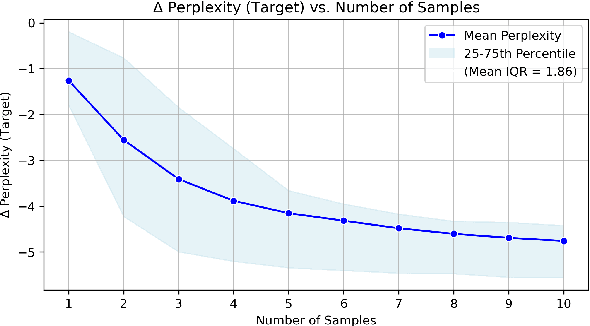
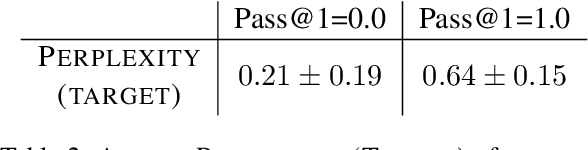
Large language models (LLMs) have made significant strides at code generation through improved model design, training, and chain-of-thought. However, prompt-level optimizations remain an important yet under-explored aspect of LLMs for coding. This work focuses on the few-shot examples present in most code generation prompts, offering a systematic study on whether few-shot examples improve LLM's coding capabilities, which few-shot examples have the largest impact, and how to select impactful examples. Our work offers 2 approaches for selecting few-shot examples, a model-free method, CODEEXEMPLAR-FREE, and a model-based method, CODEEXEMPLAR-BASED. The 2 methods offer a trade-off between improved performance and reliance on training data and interpretability. Both methods significantly improve CodeLlama's coding ability across the popular HumanEval+ coding benchmark. In summary, our work provides valuable insights into how to pick few-shot examples in code generation prompts to improve LLM code generation capabilities.
Automated Molecular Concept Generation and Labeling with Large Language Models
Jun 13, 2024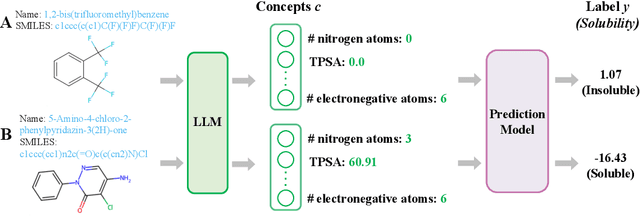
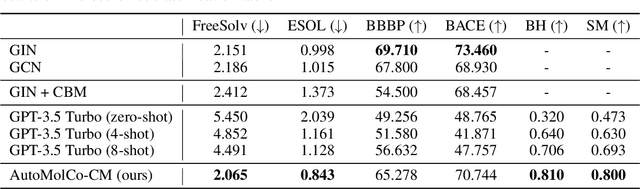
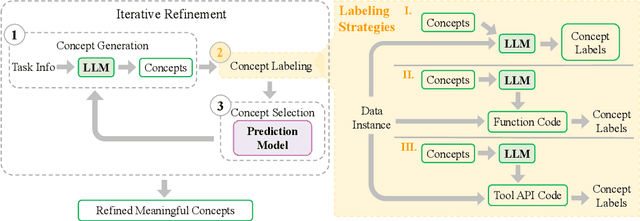

Artificial intelligence (AI) is significantly transforming scientific research. Explainable AI methods, such as concept-based models (CMs), are promising for driving new scientific discoveries because they make predictions based on meaningful concepts and offer insights into the prediction process. In molecular science, however, explainable CMs are not as common compared to black-box models like Graph Neural Networks (GNNs), primarily due to their requirement for predefined concepts and manual label for each instance, which demand domain knowledge and can be labor-intensive. This paper introduces a novel framework for Automated Molecular Concept (AutoMolCo) generation and labeling. AutoMolCo leverages the knowledge in Large Language Models (LLMs) to automatically generate predictive molecular concepts and label them for each molecule. Such procedures are repeated through iterative interactions with LLMs to refine concepts, enabling simple linear models on the refined concepts to outperform GNNs and LLM in-context learning on several benchmarks. The whole AutoMolCo framework is automated without any human knowledge inputs in either concept generation, labeling, or refinement, thereby surpassing the limitations of extant CMs while maintaining their explainability and allowing easy intervention. Through systematic experiments on MoleculeNet and High-Throughput Experimentation (HTE) datasets, we demonstrate that the AutoMolCo-induced explainable CMs are beneficial and promising for molecular science research.