 Add to Chrome
 Add to Firefox
 Add to Edge
Shopping Reasoning Bench: An Expert-Authored Benchmark for Multi-Turn Conversational Shopping Assistants
Jun 10, 2026
Conversational shopping assistants now serve hundreds of millions of customers, yet no existing benchmark jointly evaluates the open-ended multi-turn reasoning, domain expertise, and criterion-level quality that real shopping conversations demand. Shopping reasoning is unique among language model applications. Unlike factual question answering or verifiable code generation, it requires balancing subjective preferences, budget constraints, and cross-product trade-offs across multi-turn dialogue, capabilities absent from previous e-commerce and general-purpose benchmarks. We introduce the Shopping Reasoning Bench, an expert-authored benchmark of 525 missions (232 single-turn, 293 multi-turn) with 10863 importance-weighted binary rubrics authored by retail domain experts. These criteria are organized under a taxonomy of five reasoning categories and fifteen subcategories covering diverse demands such as preference refinement, trade-off analysis, and compatibility assessment. An evaluation of nine models across three families (GPT, Claude, Gemini) shows that pass rates reach only 57--77% overall. On multi-turn missions, all models score 13--29 points lower on optional above-and-beyond criteria than on required ones, and performance degrades 4--18 points as conversations progress. These gaps show that current models handle basic shopping assistance but fall short of expert-level advice, making Shopping Reasoning Bench a challenging testbed for future shopping assistant development.

Graph-based Multilingual Product Retrieval in E-commerce Search
May 06, 2021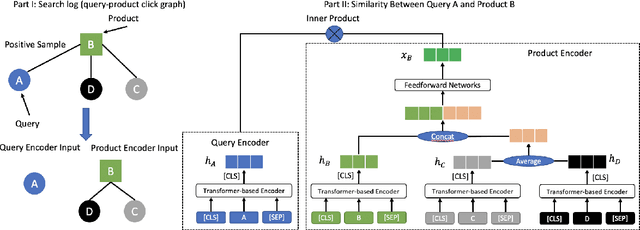

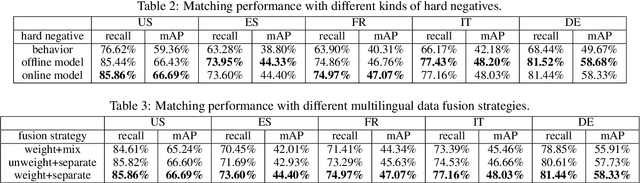
Nowadays, with many e-commerce platforms conducting global business, e-commerce search systems are required to handle product retrieval under multilingual scenarios. Moreover, comparing with maintaining per-country specific e-commerce search systems, having a universal system across countries can further reduce the operational and computational costs, and facilitate business expansion to new countries. In this paper, we introduce a universal end-to-end multilingual retrieval system, and discuss our learnings and technical details when training and deploying the system to serve billion-scale product retrieval for e-commerce search. In particular, we propose a multilingual graph attention based retrieval network by leveraging recent advances in transformer-based multilingual language models and graph neural network architectures to capture the interactions between search queries and items in e-commerce search. Offline experiments on five countries data show that our algorithm outperforms the state-of-the-art baselines by 35% recall and 25% mAP on average. Moreover, the proposed model shows significant increase of conversion/revenue in online A/B experiments and has been deployed in production for multiple countries.
Shareable Representations for Search Query Understanding
Dec 20, 2019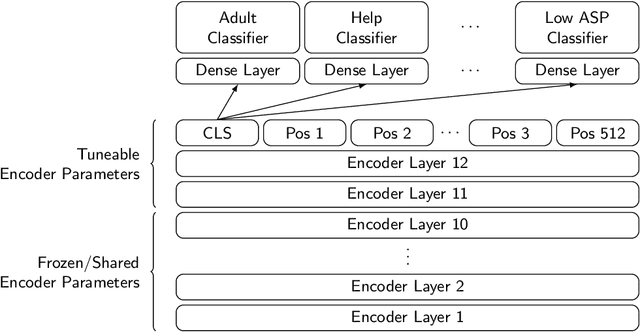
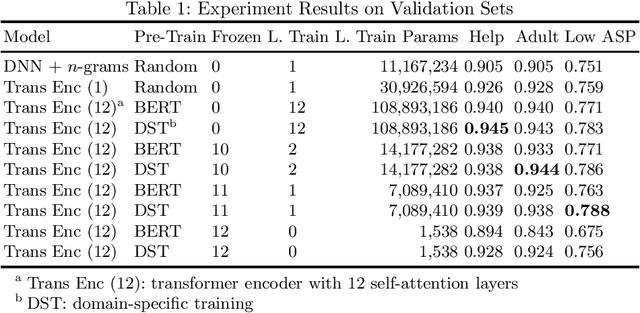

Understanding search queries is critical for shopping search engines to deliver a satisfying customer experience. Popular shopping search engines receive billions of unique queries yearly, each of which can depict any of hundreds of user preferences or intents. In order to get the right results to customers it must be known queries like "inexpensive prom dresses" are intended to not only surface results of a certain product type but also products with a low price. Referred to as query intents, examples also include preferences for author, brand, age group, or simply a need for customer service. Recent works such as BERT have demonstrated the success of a large transformer encoder architecture with language model pre-training on a variety of NLP tasks. We adapt such an architecture to learn intents for search queries and describe methods to account for the noisiness and sparseness of search query data. We also describe cost effective ways of hosting transformer encoder models in context with low latency requirements. With the right domain-specific training we can build a shareable deep learning model whose internal representation can be reused for a variety of query understanding tasks including query intent identification. Model sharing allows for fewer large models needed to be served at inference time and provides a platform to quickly build and roll out new search query classifiers.