 Add to Chrome
 Add to Firefox
 Add to Edge
Hyperparameter Transfer in Graph Neural Networks
Jul 06, 2026
The performance of deep learning models crucially depends on the settings of hyperparameters like learning rate, initialization scale, and weight decay. Hyperparameter transfer aims to make near-optimal hyperparameter settings consistent across model scale, so that large models can be optimized by proxy tuning their smaller, cheaper-to-optimize counterparts. While transfer principles are well-studied in the context of dense neural networks in language and vision tasks, they remain comparatively under-explored for graph neural networks (GNNs). We develop and validate a transfer parameterization for GNNs trained with SGD, Adam, and AdamW. Through theoretical scaling analyses and controlled experiments, we show that the proposed parameterization yields stable feature updates, learning rate transfer, and improved performance as width and depth increase. For SGD, we identify graph-dependent first-layer correction factors and show that their use can accelerate early training in graphs with sparse bag-of-words inputs. For Adam, we explore how different message passing normalizations affect early- and late-training transfer behavior, illustrating the importance of message passing normalization and advocating for an associated hyperparameter. For AdamW, we adapt a parameterization that allows for the joint transfer of weight decay and learning rate. Together, these results provide a practical recipe for scaling GNNs across a variety of learning tasks and training scenarios.

Bayesian Inference with Shaped Deep Non-linear MLPs
May 29, 2026A central aim of deep learning theory is to characterize how neural networks make predictions in the regime of simultaneously large model and training set size. Since the limits of diverging number of model parameters and dataset size do not commute it is not clear a priori what limits exist. In this work, we shed new light on these questions by studying Bayesian inference in deep non-linear MLPs in the regime where the number of training samples ($P$), the input dimension ($N_0$), the hidden layer width ($N$), and the number of hidden layers ($L$) can all be large. We build on the Neural Covariance SDE (Li et al., 2022) to analyze predictive posteriors in the regime where $LP/N\inΘ(1)$, playing the role of an effective network depth. Our framework covers both smooth and ReLU activation functions and applies to arbitrary temperature. We find to first order in $LP/N$ a simple criterion for which data generating processes benefit from depth in the sense that larger $LP/N$ increases the Bayesian model evidence. We also give a novel derivation of a prior result from the physics literature that at least to first order in $LP/N$, the Bayesian predictive posterior is remarkably simple and is simply equivalent to that of a data-dependent kernel method.
The Score Hamiltonian: Mapping Diffusion Models to Adiabatic Transport
May 28, 2026We exhibit an exact correspondence between sampling with score-based diffusion models and adiabatic transport of ground states for a family of Schrödinger operators we call Score Hamiltonians, built from the learned score's quantum potential. We obtain novel density reconstruction bounds and principled annealing schedules via adiabatic theorems for Fokker-Planck equations with time-varying potentials. We find the fundamental limit of sampling is set by the ratio of squared score-matching error to Score Hamiltonian spectral gap - the inverse Poincaré constant of the data density.
Hyperparameter Transfer for Dense Associative Memories
May 11, 2026Dense Associative Memory (DenseAM) is a promising family of AI architectures that is represented by a neural network performing temporal dynamics on an energy landscape. While hyperparameter transfer methods are well-studied for feed-forward networks, these methods have not been developed for settings in which weights are shared across layers and within the layer, which is common in DenseAMs. Additionally, DenseAMs utilize rapidly peaking activation functions that are rarely used in feed-forward architectures. The confluence of these aspects makes DenseAM a challenging framework for using existing methods for hyperparameter transfer. Our work initiates the development of hyperparameter transfer methods for this class of models. We derive explicit prescriptions for how the hyperparameters tuned on small models can be transferred to models trained at scale. We demonstrate excellent agreement between these theoretical findings and empirical results.
Hyperparameter Transfer with Mixture-of-Expert Layers
Jan 28, 2026Mixture-of-Experts (MoE) layers have emerged as an important tool in scaling up modern neural networks by decoupling total trainable parameters from activated parameters in the forward pass for each token. However, sparse MoEs add complexity to training due to (i) new trainable parameters (router weights) that, like all other parameter groups, require hyperparameter (HP) tuning; (ii) new architecture scale dimensions (number of and size of experts) that must be chosen and potentially taken large. To make HP selection cheap and reliable, we propose a new parameterization for transformer models with MoE layers when scaling model width, depth, number of experts, and expert (hidden) size. Our parameterization is justified by a novel dynamical mean-field theory (DMFT) analysis. When varying different model dimensions trained at a fixed token budget, we find empirically that our parameterization enables reliable HP transfer across models from 51M to over 2B total parameters. We further take HPs identified from sweeping small models on a short token horizon to train larger models on longer horizons and report performant model behaviors.
Implicit Bias of the JKO Scheme
Nov 18, 2025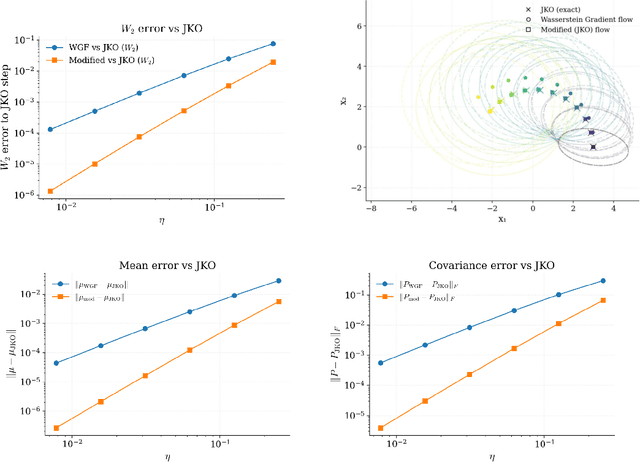
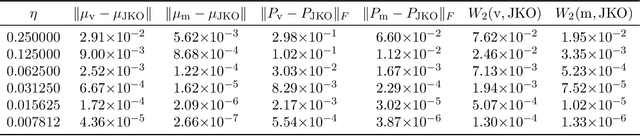
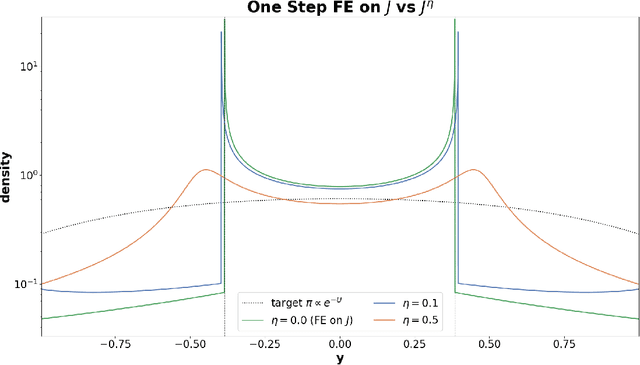
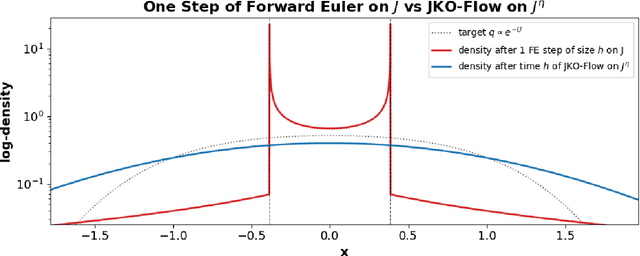
Wasserstein gradient flow provides a general framework for minimizing an energy functional $J$ over the space of probability measures on a Riemannian manifold $(M,g)$. Its canonical time-discretization, the Jordan-Kinderlehrer-Otto (JKO) scheme, produces for any step size $η>0$ a sequence of probability distributions $ρ_k^η$ that approximate to first order in $η$ Wasserstein gradient flow on $J$. But the JKO scheme also has many other remarkable properties not shared by other first order integrators, e.g. it preserves energy dissipation and exhibits unconditional stability for $λ$-geodesically convex functionals $J$. To better understand the JKO scheme we characterize its implicit bias at second order in $η$. We show that $ρ_k^η$ are approximated to order $η^2$ by Wasserstein gradient flow on a \emph{modified} energy \[ J^η(ρ) = J(ρ) - \fracη{4}\int_M \Big\lVert \nabla_g \frac{δJ}{δρ} (ρ) \Big\rVert_{2}^{2} \,ρ(dx), \] obtained by subtracting from $J$ the squared metric curvature of $J$ times $η/4$. The JKO scheme therefore adds at second order in $η$ a \textit{deceleration} in directions where the metric curvature of $J$ is rapidly changing. This corresponds to canonical implicit biases for common functionals: for entropy the implicit bias is the Fisher information, for KL-divergence it is the Fisher-Hyv{ä}rinen divergence, and for Riemannian gradient descent it is the kinetic energy in the metric $g$. To understand the differences between minimizing $J$ and $J^η$ we study \emph{JKO-Flow}, Wasserstein gradient flow on $J^η$, in several simple numerical examples. These include exactly solvable Langevin dynamics on the Bures-Wasserstein space and Langevin sampling from a quartic potential in 1D.
Don't be lazy: CompleteP enables compute-efficient deep transformers
May 02, 2025We study compute efficiency of LLM training when using different parameterizations, i.e., rules for adjusting model and optimizer hyperparameters (HPs) as model size changes. Some parameterizations fail to transfer optimal base HPs (such as learning rate) across changes in model depth, requiring practitioners to either re-tune these HPs as they scale up (expensive), or accept sub-optimal training when re-tuning is prohibitive. Even when they achieve HP transfer, we develop theory to show parameterizations may still exist in the lazy learning regime where layers learn only features close to their linearization, preventing effective use of depth and nonlinearity. Finally, we identify and adopt the unique parameterization we call CompleteP that achieves both depth-wise HP transfer and non-lazy learning in all layers. CompleteP enables a wider range of model width/depth ratios to remain compute-efficient, unlocking shapes better suited for different hardware settings and operational contexts. Moreover, CompleteP enables 12-34\% compute efficiency improvements over the prior state-of-the-art.
Deep Nets as Hamiltonians
Mar 31, 2025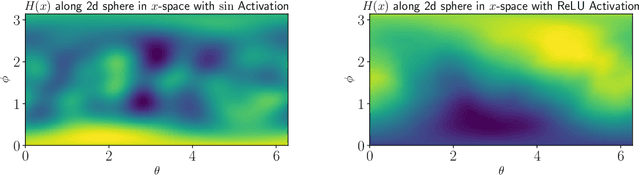
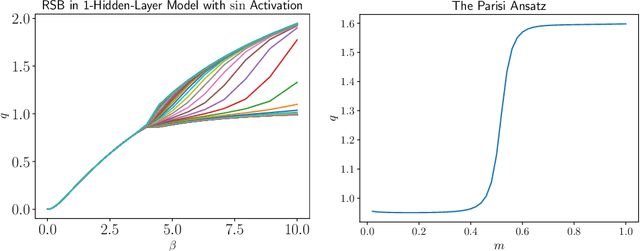
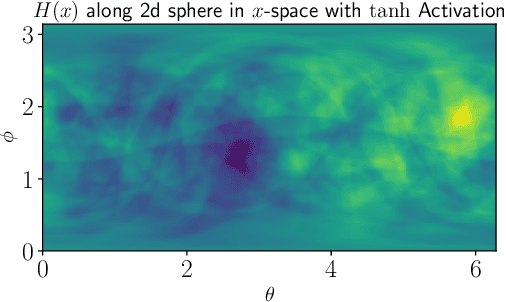
Neural networks are complex functions of both their inputs and parameters. Much prior work in deep learning theory analyzes the distribution of network outputs at a fixed a set of inputs (e.g. a training dataset) over random initializations of the network parameters. The purpose of this article is to consider the opposite situation: we view a randomly initialized Multi-Layer Perceptron (MLP) as a Hamiltonian over its inputs. For typical realizations of the network parameters, we study the properties of the energy landscape induced by this Hamiltonian, focusing on the structure of near-global minimum in the limit of infinite width. Specifically, we use the replica trick to perform an exact analytic calculation giving the entropy (log volume of space) at a given energy. We further derive saddle point equations that describe the overlaps between inputs sampled iid from the Gibbs distribution induced by the random MLP. For linear activations we solve these saddle point equations exactly. But we also solve them numerically for a variety of depths and activation functions, including $\tanh, \sin, \text{ReLU}$, and shaped non-linearities. We find even at infinite width a rich range of behaviors. For some non-linearities, such as $\sin$, for instance, we find that the landscapes of random MLPs exhibit full replica symmetry breaking, while shallow $\tanh$ and ReLU networks or deep shaped MLPs are instead replica symmetric.
Optimizing Model Selection for Compound AI Systems
Feb 20, 2025Compound AI systems that combine multiple LLM calls, such as self-refine and multi-agent-debate, achieve strong performance on many AI tasks. We address a core question in optimizing compound systems: for each LLM call or module in the system, how should one decide which LLM to use? We show that these LLM choices have a large effect on quality, but the search space is exponential. We propose LLMSelector, an efficient framework for model selection in compound systems, which leverages two key empirical insights: (i) end-to-end performance is often monotonic in how well each module performs, with all other modules held fixed, and (ii) per-module performance can be estimated accurately by an LLM. Building upon these insights, LLMSelector iteratively selects one module and allocates to it the model with the highest module-wise performance, as estimated by an LLM, until no further gain is possible. LLMSelector is applicable to any compound system with a bounded number of modules, and its number of API calls scales linearly with the number of modules, achieving high-quality model allocation both empirically and theoretically. Experiments with popular compound systems such as multi-agent debate and self-refine using LLMs such as GPT-4o, Claude 3.5 Sonnet and Gemini 1.5 show that LLMSelector confers 5%-70% accuracy gains compared to using the same LLM for all modules.
Unintentional Unalignment: Likelihood Displacement in Direct Preference Optimization
Oct 11, 2024Direct Preference Optimization (DPO) and its variants are increasingly used for aligning language models with human preferences. Although these methods are designed to teach a model to generate preferred responses more frequently relative to dispreferred responses, prior work has observed that the likelihood of preferred responses often decreases during training. The current work sheds light on the causes and implications of this counter-intuitive phenomenon, which we term likelihood displacement. We demonstrate that likelihood displacement can be catastrophic, shifting probability mass from preferred responses to responses with an opposite meaning. As a simple example, training a model to prefer $\texttt{No}$ over $\texttt{Never}$ can sharply increase the probability of $\texttt{Yes}$. Moreover, when aligning the model to refuse unsafe prompts, we show that such displacement can unintentionally lead to unalignment, by shifting probability mass from preferred refusal responses to harmful responses (e.g., reducing the refusal rate of Llama-3-8B-Instruct from 74.4% to 33.4%). We theoretically characterize that likelihood displacement is driven by preferences that induce similar embeddings, as measured by a centered hidden embedding similarity (CHES) score. Empirically, the CHES score enables identifying which training samples contribute most to likelihood displacement in a given dataset. Filtering out these samples effectively mitigated unintentional unalignment in our experiments. More broadly, our results highlight the importance of curating data with sufficiently distinct preferences, for which we believe the CHES score may prove valuable.