 Add to Chrome
 Add to Firefox
 Add to Edge
Towards Robustness against Typographic Attack with Training-free Concept Localization
Jul 02, 2026
Models trained via Contrastive Language-Image Pretraining (CLIP) serve as the foundational vision encoders for most modern Large Vision Language Models (LVLMs). Despite their widespread adoption, CLIP models exhibit a critical yet underexplored failure mode: irrelevant text appearing within images confounds visual representations, biasing them toward lexical meaning rather than true visual semantics. This robustness issue, commonly described as a Typographic Attack (TA), exposes a vulnerability that poses a significant risk to safety-critical applications such as autonomous driving. To achieve interpretable and effective robustness against TA, we propose a novel, training-free mechanistic interpretability method. Our method provides sampling-based interpretations of hidden state representations and quantitatively attributes semantic versus lexical focus to individual attention heads. Through probabilistic analysis and circuit mining, we isolate specific Vision Transformer (ViT) components that disproportionately encode lexical information, thereby identifying the mechanistic source of TA. We further show that simple interventions applied directly to the identified circuits, without any additional training, can substantially improve robustness against Typographic Attacks in object classification. These interventions, such as selective adjustment of attention weights, also outperform both supervised and training-free defense methods. Our experiments demonstrate that applying the proposed intervention to the vision encoders of several state-of-the-art LVLMs yields substantial gains in Visual Question Answering accuracy under Typographic Attack interference on RIO-Bench. These results confirm both the efficacy and the generalizability of our mechanistic approach. Code is released at https://github.com/Liu-524/SamplingTAR.

Attention-guided Fine-tuning of Multimodal Large Language Models Improves Chain-of-Thought Reasoning
Jun 01, 2026The effectiveness of Chain-of-Thought (CoT) prompting in Multimodal Large Language Models (MLLMs) remains uncertain: across several visual reasoning benchmarks, CoT prompting often degrades performance compared to direct prompting. In this paper, we provide a systematic analysis of CoT behavior in three modern MLLM families across model scales on datasets requiring step-wise visual evidence. Our analysis identifies two recurring failure modes: premature answer commitment and limited direct visual-token access during rationale generation. We further find that standard CoT-style Supervised Fine-Tuning (CoT-SFT) can mitigate these issues only partially, while often increasing reliance on textual priors and reducing counterfactual visual dependence. Motivated by these findings, we propose Attentive-CoT (Att-CoT), an attention-guided fine-tuning objective that encourages CoT trajectories to delay answer commitment while maintaining sustained visual-token access. Att-CoT can be plugged into any CoT-SFT training run without architectural changes. Experiments on three visual reasoning benchmarks across six MLLMs show that Att-CoT enhances CoT performance over standard fine-tuning.
SIREN: Unified Multi-Granularity Semantic Interaction for Multi-Modal Lifelong User Interest Modeling
May 25, 2026Industrial recommender systems increasingly leverage lifelong user behavior histories and rich multi-modal content to capture evolving user preferences. However, effectively integrating multi-modal features into lifelong interest modeling remains challenging due to the inherent misalignment between multi-modal and collaborative spaces. Existing paradigms typically rely on separate modeling of multi-modal sequence and behavior sequence, and late fusion to alleviate the modality gap, which results in coarse-grained multi-modal representation and limited integration. In this paper, we propose SIREN, a unified multi-granularity semantic interaction framework for multi-modal lifelong user interest modeling. In the General Search Unit stage, we introduce two alternative retrieval strategies: multi-modal similarity-based soft retrieval for retrieval effectiveness, and Semantic ID (SemID)-based hard retrieval for efficient industrial serving. For the Exact Search Unit stage, we explicitly incorporate target-aware relevance via coarse similarity buckets and fine-grained prefix-encoded SemIDs, enabling unified interaction with collaborative ID features within the target-conditioned transformer architecture. Extensive experiments on the offline dataset demonstrate that SIREN achieves a state-of-the-art GAUC. Online A/B tests further demonstrate consistent GMV gains across multiple production scenarios, including +2.28% in Weixin Moments, +3.87% in Weixin Official Accounts, and +1.61% in Weixin Channels. From July 2025, SIREN has been fully launched for full-traffic serving in Tencent's advertising platform.
TopoEdge: Topology-Grounded Agentic Framework for Edge Networking Code Generation and Repair
Feb 28, 2026TopoEdge is a topology-grounded, edge-deployable framework for end-to-end software-defined networking (SDN) configuration generation and repair, motivated by the brittleness of configuration artefacts under topology variation and by strict operational constraints on latency, privacy, and on-site execution. TopoEdge represents each target topology as a router-level graph and embeds it using a contrastively trained graph neural network (GNN), enabling nearest-neighbour retrieval of a verified reference configuration paired with an executable Python driver (a Topotest/pytest test script that orchestrates the emulated network and checks protocol assertions). The target topology, retrieved reference topology, and reference driver are assembled into a topology-grounded retrieval-augmented generation context (TopoRAG), which grounds a distributed, execution-centric generate--verify--repair loop coordinated by a central controller and realised by three role-specialised agents: (i) a Planning agent that produces a topology-consistent configuration plan and a per-device skeleton; (ii) a Generation agent that materialises executable configuration artefacts, including device configurations and the driver; and (iii) a Verification agent that runs the FRRouting Topotest/pytest harness, compresses failures into a compact trace, and emits localised patch directives for iterative repair.
* 6 pages, 4 figures, 3 tables
Devling into Adversarial Transferability on Image Classification: Review, Benchmark, and Evaluation
Feb 26, 2026Adversarial transferability refers to the capacity of adversarial examples generated on the surrogate model to deceive alternate, unexposed victim models. This property eliminates the need for direct access to the victim model during an attack, thereby raising considerable security concerns in practical applications and attracting substantial research attention recently. In this work, we discern a lack of a standardized framework and criteria for evaluating transfer-based attacks, leading to potentially biased assessments of existing approaches. To rectify this gap, we have conducted an exhaustive review of hundreds of related works, organizing various transfer-based attacks into six distinct categories. Subsequently, we propose a comprehensive framework designed to serve as a benchmark for evaluating these attacks. In addition, we delineate common strategies that enhance adversarial transferability and highlight prevalent issues that could lead to unfair comparisons. Finally, we provide a brief review of transfer-based attacks beyond image classification.
Reasoning Beyond Chain-of-Thought: A Latent Computational Mode in Large Language Models
Jan 12, 2026Chain-of-Thought (CoT) prompting has improved the reasoning performance of large language models (LLMs), but it remains unclear why it works and whether it is the unique mechanism for triggering reasoning in large language models. In this work, we study this question by directly analyzing and intervening on the internal representations of LLMs with Sparse Autoencoders (SAEs), identifying a small set of latent features that are causally associated with LLM reasoning behavior. Across multiple model families and reasoning benchmarks, we find that steering a single reasoning-related latent feature can substantially improve accuracy without explicit CoT prompting. For large models, latent steering achieves performance comparable to standard CoT prompting while producing more efficient outputs. We further observe that this reasoning-oriented internal state is triggered early in generation and can override prompt-level instructions that discourage explicit reasoning. Overall, our results suggest that multi-step reasoning in LLMs is supported by latent internal activations that can be externally activated, while CoT prompting is one effective, but not unique, way of activating this mechanism rather than its necessary cause.
Toward Faithful Retrieval-Augmented Generation with Sparse Autoencoders
Dec 09, 2025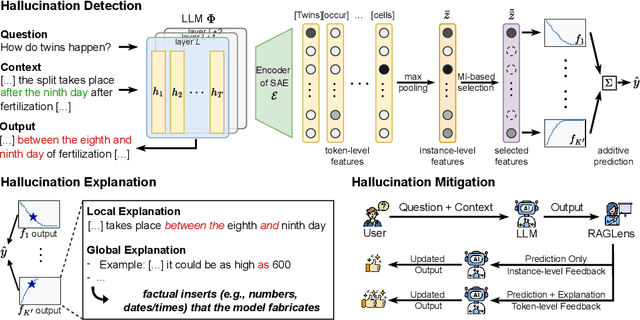
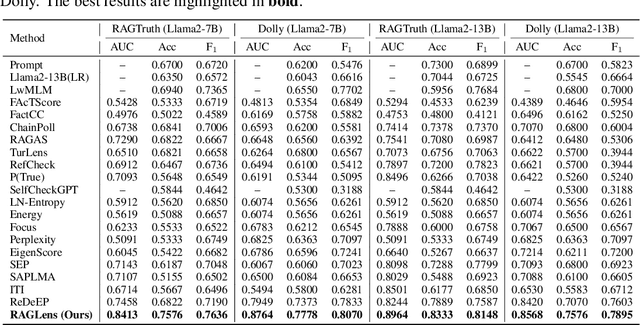
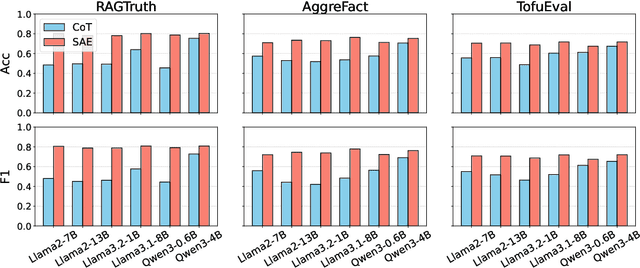
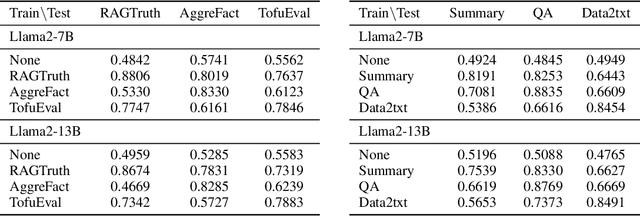
Retrieval-Augmented Generation (RAG) improves the factuality of large language models (LLMs) by grounding outputs in retrieved evidence, but faithfulness failures, where generations contradict or extend beyond the provided sources, remain a critical challenge. Existing hallucination detection methods for RAG often rely either on large-scale detector training, which requires substantial annotated data, or on querying external LLM judges, which leads to high inference costs. Although some approaches attempt to leverage internal representations of LLMs for hallucination detection, their accuracy remains limited. Motivated by recent advances in mechanistic interpretability, we employ sparse autoencoders (SAEs) to disentangle internal activations, successfully identifying features that are specifically triggered during RAG hallucinations. Building on a systematic pipeline of information-based feature selection and additive feature modeling, we introduce RAGLens, a lightweight hallucination detector that accurately flags unfaithful RAG outputs using LLM internal representations. RAGLens not only achieves superior detection performance compared to existing methods, but also provides interpretable rationales for its decisions, enabling effective post-hoc mitigation of unfaithful RAG. Finally, we justify our design choices and reveal new insights into the distribution of hallucination-related signals within LLMs. The code is available at https://github.com/Teddy-XiongGZ/RAGLens.
SAGE: Spuriousness-Aware Guided Prompt Exploration for Mitigating Multimodal Bias
Nov 17, 2025Large vision-language models, such as CLIP, have shown strong zero-shot classification performance by aligning images and text in a shared embedding space. However, CLIP models often develop multimodal spurious biases, which is the undesirable tendency to rely on spurious features. For example, CLIP may infer object types in images based on frequently co-occurring backgrounds rather than the object's core features. This bias significantly impairs the robustness of pre-trained CLIP models on out-of-distribution data, where such cross-modal associations no longer hold. Existing methods for mitigating multimodal spurious bias typically require fine-tuning on downstream data or prior knowledge of the bias, which undermines the out-of-the-box usability of CLIP. In this paper, we first theoretically analyze the impact of multimodal spurious bias in zero-shot classification. Based on this insight, we propose Spuriousness-Aware Guided Exploration (SAGE), a simple and effective method that mitigates spurious bias through guided prompt selection. SAGE requires no training, fine-tuning, or external annotations. It explores a space of prompt templates and selects the prompts that induce the largest semantic separation between classes, thereby improving worst-group robustness. Extensive experiments on four real-world benchmark datasets and five popular backbone models demonstrate that SAGE consistently improves zero-shot performance and generalization, outperforming previous zero-shot approaches without any external knowledge or model updates.
Online Reasoning Video Segmentation with Just-in-Time Digital Twins
Mar 27, 2025Reasoning segmentation (RS) aims to identify and segment objects of interest based on implicit text queries. As such, RS is a catalyst for embodied AI agents, enabling them to interpret high-level commands without requiring explicit step-by-step guidance. However, current RS approaches rely heavily on the visual perception capabilities of multimodal large language models (LLMs), leading to several major limitations. First, they struggle with queries that require multiple steps of reasoning or those that involve complex spatial/temporal relationships. Second, they necessitate LLM fine-tuning, which may require frequent updates to maintain compatibility with contemporary LLMs and may increase risks of catastrophic forgetting during fine-tuning. Finally, being primarily designed for static images or offline video processing, they scale poorly to online video data. To address these limitations, we propose an agent framework that disentangles perception and reasoning for online video RS without LLM fine-tuning. Our innovation is the introduction of a just-in-time digital twin concept, where -- given an implicit query -- a LLM plans the construction of a low-level scene representation from high-level video using specialist vision models. We refer to this approach to creating a digital twin as "just-in-time" because the LLM planner will anticipate the need for specific information and only request this limited subset instead of always evaluating every specialist model. The LLM then performs reasoning on this digital twin representation to identify target objects. To evaluate our approach, we introduce a new comprehensive video reasoning segmentation benchmark comprising 200 videos with 895 implicit text queries. The benchmark spans three reasoning categories (semantic, spatial, and temporal) with three different reasoning chain complexity.
Operating Room Workflow Analysis via Reasoning Segmentation over Digital Twins
Mar 26, 2025
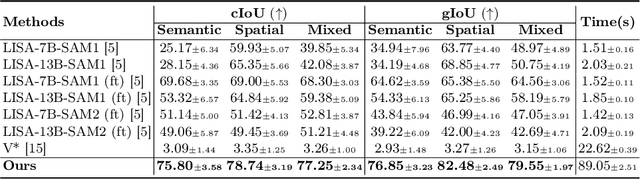
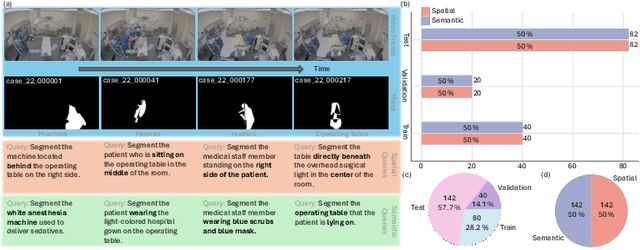
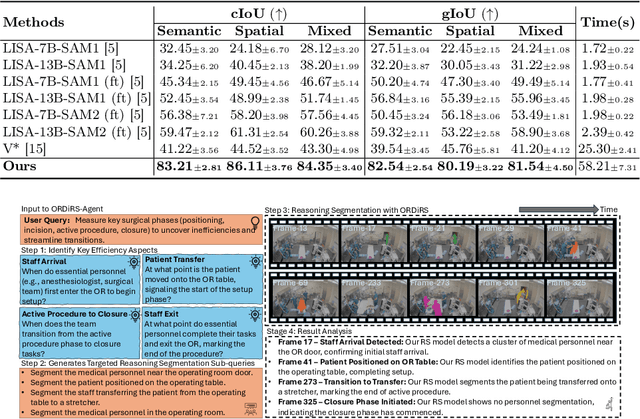
Analyzing operating room (OR) workflows to derive quantitative insights into OR efficiency is important for hospitals to maximize patient care and financial sustainability. Prior work on OR-level workflow analysis has relied on end-to-end deep neural networks. While these approaches work well in constrained settings, they are limited to the conditions specified at development time and do not offer the flexibility necessary to accommodate the OR workflow analysis needs of various OR scenarios (e.g., large academic center vs. rural provider) without data collection, annotation, and retraining. Reasoning segmentation (RS) based on foundation models offers this flexibility by enabling automated analysis of OR workflows from OR video feeds given only an implicit text query related to the objects of interest. Due to the reliance on large language model (LLM) fine-tuning, current RS approaches struggle with reasoning about semantic/spatial relationships and show limited generalization to OR video due to variations in visual characteristics and domain-specific terminology. To address these limitations, we first propose a novel digital twin (DT) representation that preserves both semantic and spatial relationships between the various OR components. Then, building on this foundation, we propose ORDiRS (Operating Room Digital twin representation for Reasoning Segmentation), an LLM-tuning-free RS framework that reformulates RS into a "reason-retrieval-synthesize" paradigm. Finally, we present ORDiRS-Agent, an LLM-based agent that decomposes OR workflow analysis queries into manageable RS sub-queries and generates responses by combining detailed textual explanations with supporting visual evidence from RS. Experimental results on both an in-house and a public OR dataset demonstrate that our ORDiRS achieves a cIoU improvement of 6.12%-9.74% compared to the existing state-of-the-arts.