 Add to Chrome
 Add to Firefox
 Add to Edge
SIREN: Unified Multi-Granularity Semantic Interaction for Multi-Modal Lifelong User Interest Modeling
May 25, 2026
Industrial recommender systems increasingly leverage lifelong user behavior histories and rich multi-modal content to capture evolving user preferences. However, effectively integrating multi-modal features into lifelong interest modeling remains challenging due to the inherent misalignment between multi-modal and collaborative spaces. Existing paradigms typically rely on separate modeling of multi-modal sequence and behavior sequence, and late fusion to alleviate the modality gap, which results in coarse-grained multi-modal representation and limited integration. In this paper, we propose SIREN, a unified multi-granularity semantic interaction framework for multi-modal lifelong user interest modeling. In the General Search Unit stage, we introduce two alternative retrieval strategies: multi-modal similarity-based soft retrieval for retrieval effectiveness, and Semantic ID (SemID)-based hard retrieval for efficient industrial serving. For the Exact Search Unit stage, we explicitly incorporate target-aware relevance via coarse similarity buckets and fine-grained prefix-encoded SemIDs, enabling unified interaction with collaborative ID features within the target-conditioned transformer architecture. Extensive experiments on the offline dataset demonstrate that SIREN achieves a state-of-the-art GAUC. Online A/B tests further demonstrate consistent GMV gains across multiple production scenarios, including +2.28% in Weixin Moments, +3.87% in Weixin Official Accounts, and +1.61% in Weixin Channels. From July 2025, SIREN has been fully launched for full-traffic serving in Tencent's advertising platform.

Disentangled Representation with Cross Experts Covariance Loss for Multi-Domain Recommendation
May 21, 2024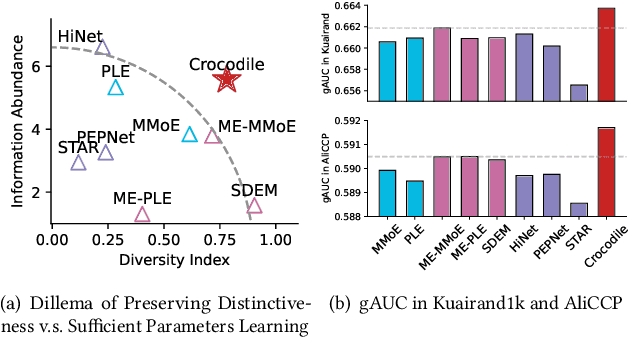

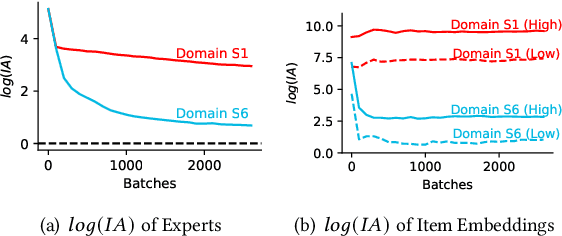
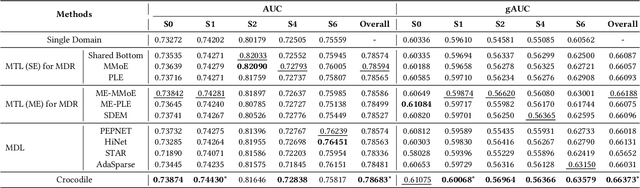
Multi-domain learning (MDL) has emerged as a prominent research area aimed at enhancing the quality of personalized services. The key challenge in MDL lies in striking a balance between learning commonalities across domains while preserving the distinct characteristics of each domain. However, this gives rise to a challenging dilemma. On one hand, a model needs to leverage domain-specific modules, such as experts or embeddings, to preserve the uniqueness of each domain. On the other hand, due to the long-tailed distributions observed in real-world domains, some tail domains may lack sufficient samples to fully learn their corresponding modules. Unfortunately, existing approaches have not adequately addressed this dilemma. To address this issue, we propose a novel model called Crocodile, which stands for Cross-experts Covariance Loss for Disentangled Learning. Crocodile adopts a multi-embedding paradigm to facilitate model learning and employs a Covariance Loss on these embeddings to disentangle them. This disentanglement enables the model to capture diverse user interests across domains effectively. Additionally, we introduce a novel gating mechanism to further enhance the capabilities of Crocodile. Through empirical analysis, we demonstrate that our proposed method successfully resolves these two challenges and outperforms all state-of-the-art methods on publicly available datasets. We firmly believe that the analytical perspectives and design concept of disentanglement presented in our work can pave the way for future research in the field of MDL.