 Add to Chrome
 Add to Firefox
 Add to Edge
MeXtract: Light-Weight Metadata Extraction from Scientific Papers
Oct 08, 2025
Metadata plays a critical role in indexing, documenting, and analyzing scientific literature, yet extracting it accurately and efficiently remains a challenging task. Traditional approaches often rely on rule-based or task-specific models, which struggle to generalize across domains and schema variations. In this paper, we present MeXtract, a family of lightweight language models designed for metadata extraction from scientific papers. The models, ranging from 0.5B to 3B parameters, are built by fine-tuning Qwen 2.5 counterparts. In their size family, MeXtract achieves state-of-the-art performance on metadata extraction on the MOLE benchmark. To further support evaluation, we extend the MOLE benchmark to incorporate model-specific metadata, providing an out-of-domain challenging subset. Our experiments show that fine-tuning on a given schema not only yields high accuracy but also transfers effectively to unseen schemas, demonstrating the robustness and adaptability of our approach. We release all the code, datasets, and models openly for the research community.

Mind-the-Glitch: Visual Correspondence for Detecting Inconsistencies in Subject-Driven Generation
Sep 26, 2025We propose a novel approach for disentangling visual and semantic features from the backbones of pre-trained diffusion models, enabling visual correspondence in a manner analogous to the well-established semantic correspondence. While diffusion model backbones are known to encode semantically rich features, they must also contain visual features to support their image synthesis capabilities. However, isolating these visual features is challenging due to the absence of annotated datasets. To address this, we introduce an automated pipeline that constructs image pairs with annotated semantic and visual correspondences based on existing subject-driven image generation datasets, and design a contrastive architecture to separate the two feature types. Leveraging the disentangled representations, we propose a new metric, Visual Semantic Matching (VSM), that quantifies visual inconsistencies in subject-driven image generation. Empirical results show that our approach outperforms global feature-based metrics such as CLIP, DINO, and vision--language models in quantifying visual inconsistencies while also enabling spatial localization of inconsistent regions. To our knowledge, this is the first method that supports both quantification and localization of inconsistencies in subject-driven generation, offering a valuable tool for advancing this task. Project Page:https://abdo-eldesokey.github.io/mind-the-glitch/
Hala Technical Report: Building Arabic-Centric Instruction & Translation Models at Scale
Sep 17, 2025We present Hala, a family of Arabic-centric instruction and translation models built with our translate-and-tune pipeline. We first compress a strong AR$\leftrightarrow$EN teacher to FP8 (yielding $\sim$2$\times$ higher throughput with no quality loss) and use it to create high-fidelity bilingual supervision. A lightweight language model LFM2-1.2B is then fine-tuned on this data and used to translate high-quality English instruction sets into Arabic, producing a million-scale corpus tailored to instruction following. We train Hala models at 350M, 700M, 1.2B, and 9B parameters, and apply slerp merging to balance Arabic specialization with base-model strengths. On Arabic-centric benchmarks, Hala achieves state-of-the-art results within both the "nano" ($\leq$2B) and "small" (7-9B) categories, outperforming their bases. We release models, data, evaluation, and recipes to accelerate research in Arabic NLP.
ResidualViT for Efficient Temporally Dense Video Encoding
Sep 16, 2025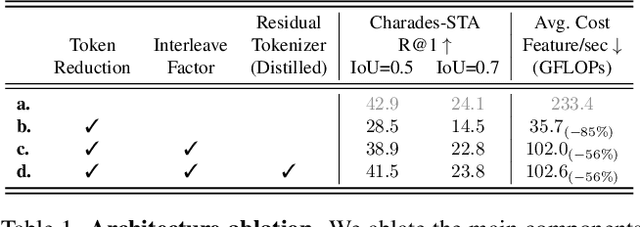
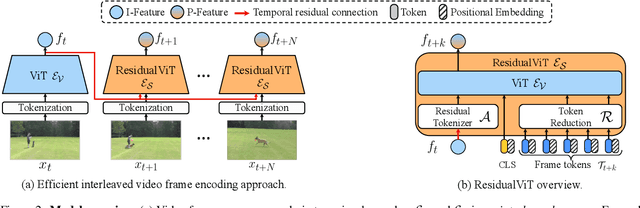
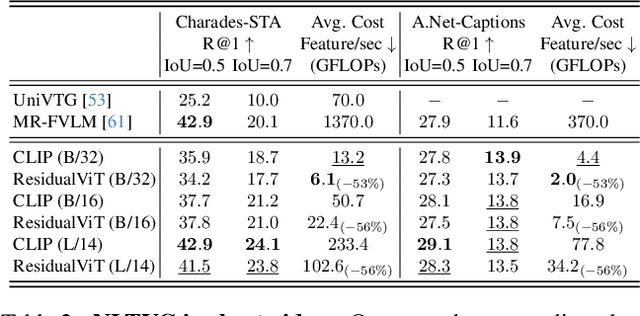
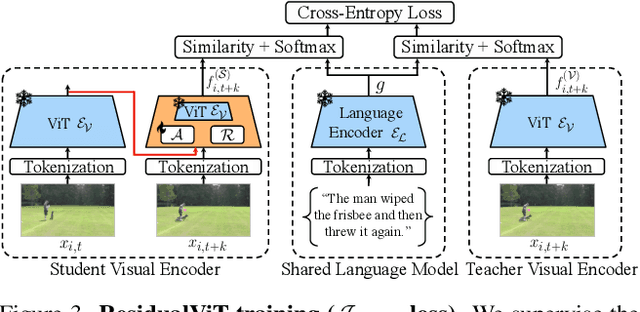
Several video understanding tasks, such as natural language temporal video grounding, temporal activity localization, and audio description generation, require "temporally dense" reasoning over frames sampled at high temporal resolution. However, computing frame-level features for these tasks is computationally expensive given the temporal resolution requirements. In this paper, we make three contributions to reduce the cost of computing features for temporally dense tasks. First, we introduce a vision transformer (ViT) architecture, dubbed ResidualViT, that leverages the large temporal redundancy in videos to efficiently compute temporally dense frame-level features. Our architecture incorporates (i) learnable residual connections that ensure temporal consistency across consecutive frames and (ii) a token reduction module that enhances processing speed by selectively discarding temporally redundant information while reusing weights of a pretrained foundation model. Second, we propose a lightweight distillation strategy to approximate the frame-level features of the original foundation model. Finally, we evaluate our approach across four tasks and five datasets, in both zero-shot and fully supervised settings, demonstrating significant reductions in computational cost (up to 60%) and improvements in inference speed (up to 2.5x faster), all while closely approximating the accuracy of the original foundation model.
Turning the Spell Around: Lightweight Alignment Amplification via Rank-One Safety Injection
Aug 28, 2025Safety alignment in Large Language Models (LLMs) often involves mediating internal representations to refuse harmful requests. Recent research has demonstrated that these safety mechanisms can be bypassed by ablating or removing specific representational directions within the model. In this paper, we propose the opposite approach: Rank-One Safety Injection (ROSI), a white-box method that amplifies a model's safety alignment by permanently steering its activations toward the refusal-mediating subspace. ROSI operates as a simple, fine-tuning-free rank-one weight modification applied to all residual stream write matrices. The required safety direction can be computed from a small set of harmful and harmless instruction pairs. We show that ROSI consistently increases safety refusal rates - as evaluated by Llama Guard 3 - while preserving the utility of the model on standard benchmarks such as MMLU, HellaSwag, and Arc. Furthermore, we show that ROSI can also re-align 'uncensored' models by amplifying their own latent safety directions, demonstrating its utility as an effective last-mile safety procedure. Our results suggest that targeted, interpretable weight steering is a cheap and potent mechanism to improve LLM safety, complementing more resource-intensive fine-tuning paradigms.
SoccerNet 2025 Challenges Results
Aug 26, 2025The SoccerNet 2025 Challenges mark the fifth annual edition of the SoccerNet open benchmarking effort, dedicated to advancing computer vision research in football video understanding. This year's challenges span four vision-based tasks: (1) Team Ball Action Spotting, focused on detecting ball-related actions in football broadcasts and assigning actions to teams; (2) Monocular Depth Estimation, targeting the recovery of scene geometry from single-camera broadcast clips through relative depth estimation for each pixel; (3) Multi-View Foul Recognition, requiring the analysis of multiple synchronized camera views to classify fouls and their severity; and (4) Game State Reconstruction, aimed at localizing and identifying all players from a broadcast video to reconstruct the game state on a 2D top-view of the field. Across all tasks, participants were provided with large-scale annotated datasets, unified evaluation protocols, and strong baselines as starting points. This report presents the results of each challenge, highlights the top-performing solutions, and provides insights into the progress made by the community. The SoccerNet Challenges continue to serve as a driving force for reproducible, open research at the intersection of computer vision, artificial intelligence, and sports. Detailed information about the tasks, challenges, and leaderboards can be found at https://www.soccer-net.org, with baselines and development kits available at https://github.com/SoccerNet.
Rethinking Safety in LLM Fine-tuning: An Optimization Perspective
Aug 17, 2025Fine-tuning language models is commonly believed to inevitably harm their safety, i.e., refusing to respond to harmful user requests, even when using harmless datasets, thus requiring additional safety measures. We challenge this belief through systematic testing, showing that poor optimization choices, rather than inherent trade-offs, often cause safety problems, measured as harmful responses to adversarial prompts. By properly selecting key training hyper-parameters, e.g., learning rate, batch size, and gradient steps, we reduce unsafe model responses from 16\% to approximately 5\%, as measured by keyword matching, while maintaining utility performance. Based on this observation, we propose a simple exponential moving average (EMA) momentum technique in parameter space that preserves safety performance by creating a stable optimization path and retains the original pre-trained model's safety properties. Our experiments on the Llama families across multiple datasets (Dolly, Alpaca, ORCA) demonstrate that safety problems during fine-tuning can largely be avoided without specialized interventions, outperforming existing approaches that require additional safety data while offering practical guidelines for maintaining both model performance and safety during adaptation.
Train Long, Think Short: Curriculum Learning for Efficient Reasoning
Aug 12, 2025Recent work on enhancing the reasoning abilities of large language models (LLMs) has introduced explicit length control as a means of constraining computational cost while preserving accuracy. However, existing approaches rely on fixed-length training budgets, which do not take advantage of the natural progression from exploration to compression during learning. In this work, we propose a curriculum learning strategy for length-controlled reasoning using Group Relative Policy Optimization (GRPO). Our method starts with generous token budgets and gradually tightens them over training, encouraging models to first discover effective solution strategies and then distill them into more concise reasoning traces. We augment GRPO with a reward function that balances three signals: task correctness (via verifier feedback), length efficiency, and formatting adherence (via structural tags). Experiments on GSM8K, MATH500, SVAMP, College Math, and GSM+ demonstrate that curriculum-based training consistently outperforms fixed-budget baselines at the same final budget, achieving higher accuracy and significantly improved token efficiency. We further ablate the impact of reward weighting and decay schedule design, showing that progressive constraint serves as a powerful inductive bias for training efficient reasoning models. Our code and checkpoints are released at: https://github.com/hammoudhasan/curriculum_grpo.
PlanQA: A Benchmark for Spatial Reasoning in LLMs using Structured Representations
Jul 10, 2025We introduce PlanQA, a diagnostic benchmark for evaluating geometric and spatial reasoning in large-language models (LLMs). PlanQA is grounded in structured representations of indoor scenes, such as kitchens, living rooms, and bedrooms, encoded in a symbolic format (e.g., JSON, XML layouts). The benchmark includes diverse question types that test not only metric and topological reasoning (e.g., distance, visibility, shortest paths) but also interior design constraints such as affordance, clearance, balance, and usability. Our results across a variety of frontier open-source and commercial LLMs show that while models may succeed in shallow queries, they often fail to simulate physical constraints, preserve spatial coherence, or generalize under layout perturbation. PlanQA uncovers a clear blind spot in today's LLMs: they do not consistently reason about real-world layouts. We hope that this benchmark inspires new work on language models that can accurately infer and manipulate spatial and geometric properties in practical settings.
Dynamic Context-oriented Decomposition for Task-aware Low-rank Adaptation with Less Forgetting and Faster Convergence
Jun 16, 2025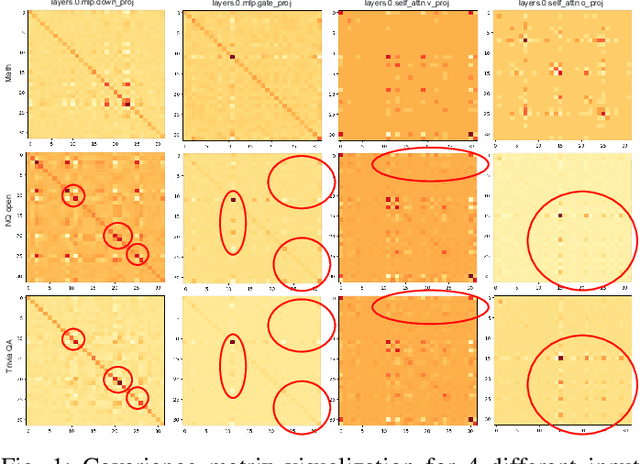
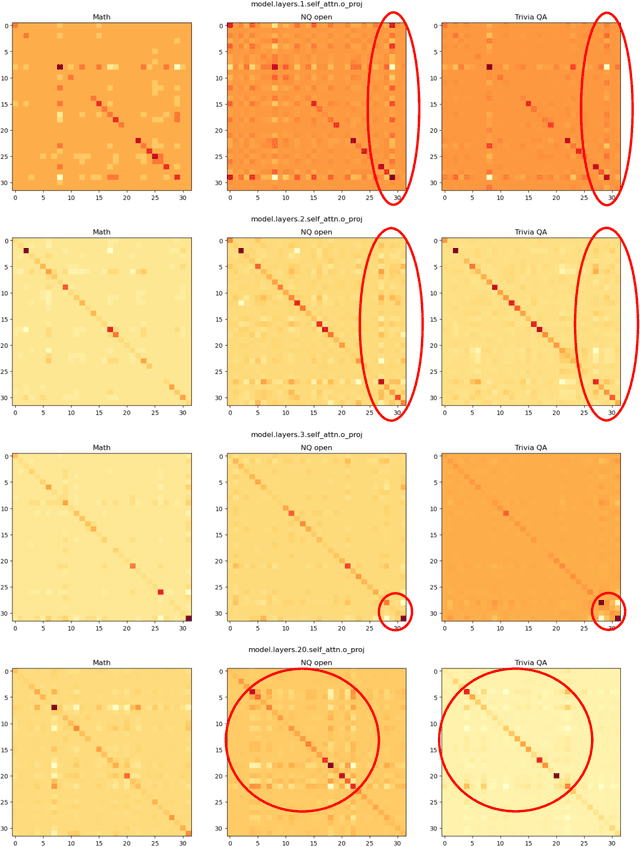
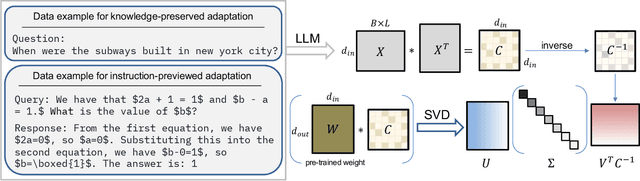

Conventional low-rank adaptation methods build adapters without considering data context, leading to sub-optimal fine-tuning performance and severe forgetting of inherent world knowledge. In this paper, we propose context-oriented decomposition adaptation (CorDA), a novel method that initializes adapters in a task-aware manner. Concretely, we develop context-oriented singular value decomposition, where we collect covariance matrices of input activations for each linear layer using sampled data from the target task, and apply SVD to the product of weight matrix and its corresponding covariance matrix. By doing so, the task-specific capability is compacted into the principal components. Thanks to the task awareness, our method enables two optional adaptation modes, knowledge-preserved mode (KPM) and instruction-previewed mode (IPM), providing flexibility to choose between freezing the principal components to preserve their associated knowledge or adapting them to better learn a new task. We further develop CorDA++ by deriving a metric that reflects the compactness of task-specific principal components, and then introducing dynamic covariance selection and dynamic rank allocation strategies based on the same metric. The two strategies provide each layer with the most representative covariance matrix and a proper rank allocation. Experimental results show that CorDA++ outperforms CorDA by a significant margin. CorDA++ in KPM not only achieves better fine-tuning performance than LoRA, but also mitigates the forgetting of pre-trained knowledge in both large language models and vision language models. For IPM, our method exhibits faster convergence, \emph{e.g.,} 4.5x speedup over QLoRA, and improves adaptation performance in various scenarios, outperforming strong baseline methods. Our method has been integrated into the PEFT library developed by Hugging Face.