 Add to Chrome
 Add to Firefox
 Add to Edge
Slot-RAE: Streamlining Object-Centric Learning via Direct Representation Auto-Encoders
Jul 13, 2026
Deploying object-centric models for real-world scene understanding typically requires complex pipelines to achieve both robust scene decomposition and high-fidelity generation. Recent diffusion-based approaches have improved visual quality, but they almost universally rely on heavy, pretrained generative priors (e.g., Stable Diffusion) and external VAE latent spaces. In this paper, we propose Slot-RAE, a much simpler, fully integrated framework that operates directly within the continuous semantic feature space of visual foundation models (e.g., DINOv3). Slot-RAE employs a feature-space diffusion process using a Diffusion Transformer (DiT) decoder and a Representation Alignment (REPA) head. Unlike existing diffusion-based objectcentric methods that rely heavily on subsidized text-toimage priors, the generative core of Slot-RAE (Slot Attention and the DiT) is trained from scratch within the frozen VFM feature space. This eliminates the need for VAE bottlenecks and task-agnostic generative pre-training. Experiments on the COCO dataset demonstrate that despite its architectural simplicity, Slot-RAE achieves state-of-the-art results. It delivers comparable unsupervised object discovery, higher-fidelity image reconstruction, and robust zero-shot compositionality, all while being significantly faster and more computationally efficient than existing object-centric latent diffusion models.

More Structure, Not More Capacity: Object-Centric Representations for Visuomotor Imitation Learning
Jul 10, 2026Robotic manipulation policies rely on pre-trained vision models that give either a global scene embedding or a dense patch grid. Both mix task-relevant and task-irrelevant features. Object-centric slot representations are a structured alternative: they group features into a few per-object slots. We test what this structure buys on ManiSkill3 PickCube-v1, with a frozen encoder and a held-out-seed evaluation. Holding the policy, goal token, rendering, and calibration fixed and changing only the encoder, a frozen object-centric SPOT representation (DINO ViT-B/16 + Slot Attention) reaches 55.0$\pm$2.9% success, 22.4% above a dense DINO global-feature baseline (32.6 $\pm$ 1.5%), with the same trainable policy and no encoder fine-tuning. More tokens alone do not help: a dense patch grid with 16x the tokens performs no better than the global feature. Adding an explicit 2D spatial goal and native-resolution rendering raises the full system to 68.7$\pm$4.2%, just below a privileged 3D-oracle upper bound (71.7$\pm$4.1%). An automated kinematic failure taxonomy then separates spatial-precision (Near-Miss) failures from object-tracking (No-Grasp) failures: spatial grounding reduces Near-Miss while leaving No- Grasp unchanged. The same taxonomy transfers to the harder StackCube-v1 and points to occlusion as the main bottleneck.
Flowing With Purpose: Latent Action Guided Flow Matching Policies For Robotic Manipulation
Jun 22, 2026Flow matching has recently become a new standard for behavior cloning in robotic manipulation. However, state-of-the-art flow matching policies suffer from a systematic structural mismatch: they rely on a globally fixed isotropic source distribution despite the strongly fragmented and heteroscedastic structure of robotic action spaces. This agnostic initialization forces the model to learn highly entangled vector fields, bottlenecking training efficiency and limiting overall policy performance. To address this limitation, we introduce Latent Action Guided Flow Matching (LAFM), a novel framework that replaces the monolithic Gaussian with an adaptive library of learned prior distributions. By grounding these distributions using a latent action model, LAFM maps current observations to discrete motion primitives, selecting a specialized base distribution that provides an informed, structurally aligned initialization for the denoising process. This dynamic adaptivity naturally accommodates heteroscedasticity in human demonstrations and makes transport trajectories shorter and less entangled. Empirically, LAFM substantially outperforms standard flow matching formulations, increasing task success rates by 23.4% in real-world robotic deployments and by 10.4% on the LIBERO-90 benchmark. Furthermore, we demonstrate that LAFM achieves state-of-the-art results, surpassing massively pre-trained vision-language-action models while utilizing significantly smaller architectures.
Spotlighting Task-Relevant Features: Object-Centric Representations for Better Generalization in Robotic Manipulation
Jan 29, 2026The generalization capabilities of robotic manipulation policies are heavily influenced by the choice of visual representations. Existing approaches typically rely on representations extracted from pre-trained encoders, using two dominant types of features: global features, which summarize an entire image via a single pooled vector, and dense features, which preserve a patch-wise embedding from the final encoder layer. While widely used, both feature types mix task-relevant and irrelevant information, leading to poor generalization under distribution shifts, such as changes in lighting, textures, or the presence of distractors. In this work, we explore an intermediate structured alternative: Slot-Based Object-Centric Representations (SBOCR), which group dense features into a finite set of object-like entities. This representation permits to naturally reduce the noise provided to the robotic manipulation policy while keeping enough information to efficiently perform the task. We benchmark a range of global and dense representations against intermediate slot-based representations, across a suite of simulated and real-world manipulation tasks ranging from simple to complex. We evaluate their generalization under diverse visual conditions, including changes in lighting, texture, and the presence of distractors. Our findings reveal that SBOCR-based policies outperform dense and global representation-based policies in generalization settings, even without task-specific pretraining. These insights suggest that SBOCR is a promising direction for designing visual systems that generalize effectively in dynamic, real-world robotic environments.
STORM: Slot-based Task-aware Object-centric Representation for robotic Manipulation
Jan 28, 2026Visual foundation models provide strong perceptual features for robotics, but their dense representations lack explicit object-level structure, limiting robustness and contractility in manipulation tasks. We propose STORM (Slot-based Task-aware Object-centric Representation for robotic Manipulation), a lightweight object-centric adaptation module that augments frozen visual foundation models with a small set of semantic-aware slots for robotic manipulation. Rather than retraining large backbones, STORM employs a multi-phase training strategy: object-centric slots are first stabilized through visual--semantic pretraining using language embeddings, then jointly adapted with a downstream manipulation policy. This staged learning prevents degenerate slot formation and preserves semantic consistency while aligning perception with task objectives. Experiments on object discovery benchmarks and simulated manipulation tasks show that STORM improves generalization to visual distractors, and control performance compared to directly using frozen foundation model features or training object-centric representations end-to-end. Our results highlight multi-phase adaptation as an efficient mechanism for transforming generic foundation model features into task-aware object-centric representations for robotic control.
Warm-Starting Collision-Free Model Predictive Control With Object-Centric Diffusion
Jan 06, 2026Acting in cluttered environments requires predicting and avoiding collisions while still achieving precise control. Conventional optimization-based controllers can enforce physical constraints, but they struggle to produce feasible solutions quickly when many obstacles are present. Diffusion models can generate diverse trajectories around obstacles, yet prior approaches lacked a general and efficient way to condition them on scene structure. In this paper, we show that combining diffusion-based warm-starting conditioned with a latent object-centric representation of the scene and with a collision-aware model predictive controller (MPC) yields reliable and efficient motion generation under strict time limits. Our approach conditions a diffusion transformer on the system state, task, and surroundings, using an object-centric slot attention mechanism to provide a compact obstacle representation suitable for control. The sampled trajectories are refined by an optimal control problem that enforces rigid-body dynamics and signed-distance collision constraints, producing feasible motions in real time. On benchmark tasks, this hybrid method achieved markedly higher success rates and lower latency than sampling-based planners or either component alone. Real-robot experiments with a torque-controlled Panda confirm reliable and safe execution with MPC.
Robotic Manipulation via Imitation Learning: Taxonomy, Evolution, Benchmark, and Challenges
Aug 24, 2025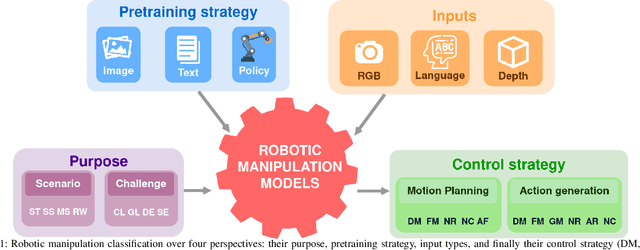
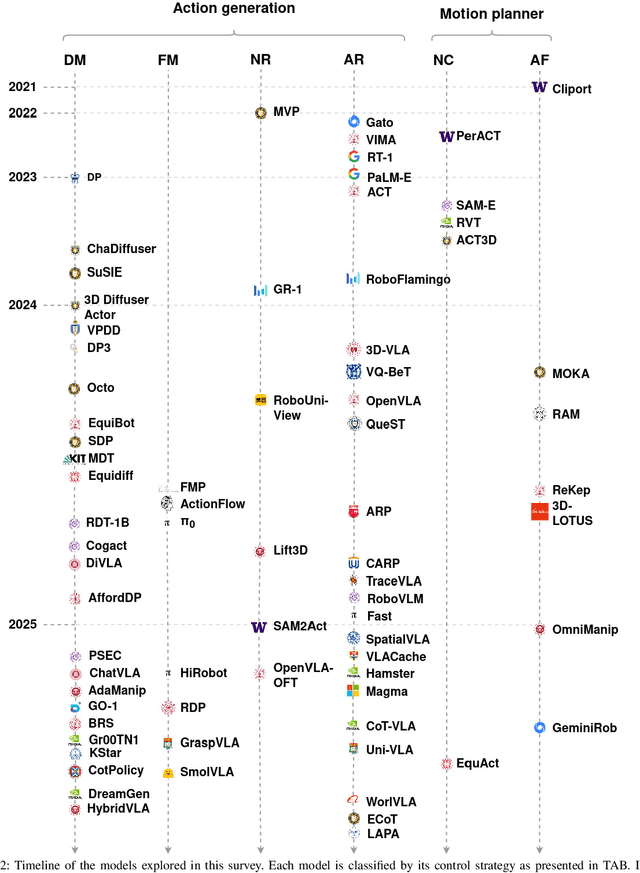
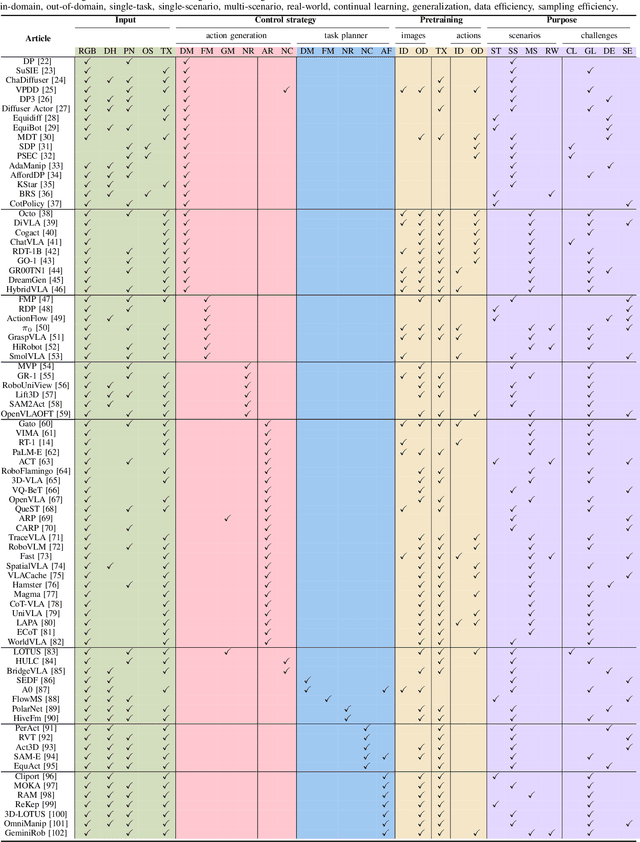
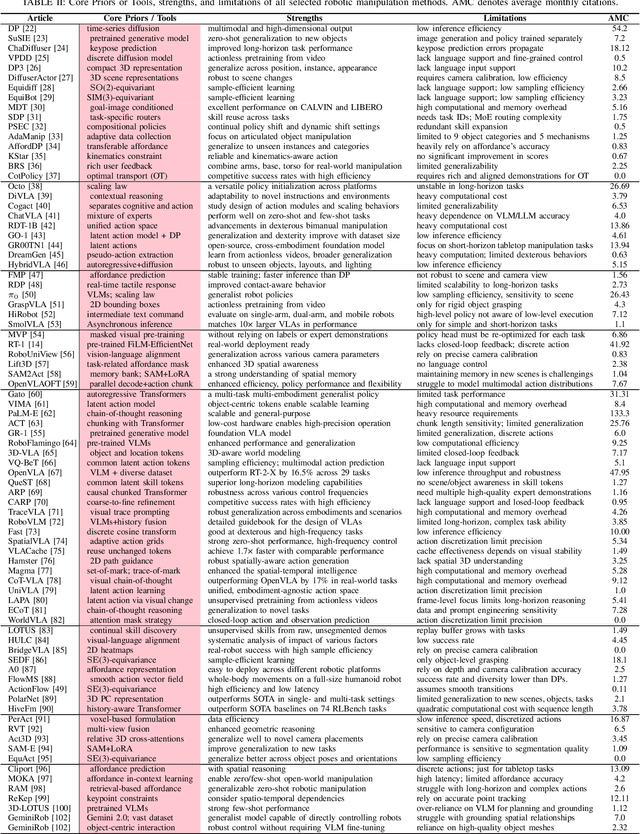
Robotic Manipulation (RM) is central to the advancement of autonomous robots, enabling them to interact with and manipulate objects in real-world environments. This survey focuses on RM methodologies that leverage imitation learning, a powerful technique that allows robots to learn complex manipulation skills by mimicking human demonstrations. We identify and analyze the most influential studies in this domain, selected based on community impact and intrinsic quality. For each paper, we provide a structured summary, covering the research purpose, technical implementation, hierarchical classification, input formats, key priors, strengths and limitations, and citation metrics. Additionally, we trace the chronological development of imitation learning techniques within RM policy (RMP), offering a timeline of key technological advancements. Where available, we report benchmark results and perform quantitative evaluations to compare existing methods. By synthesizing these insights, this review provides a comprehensive resource for researchers and practitioners, highlighting both the state of the art and the challenges that lie ahead in the field of robotic manipulation through imitation learning.
Is an object-centric representation beneficial for robotic manipulation ?
Jun 24, 2025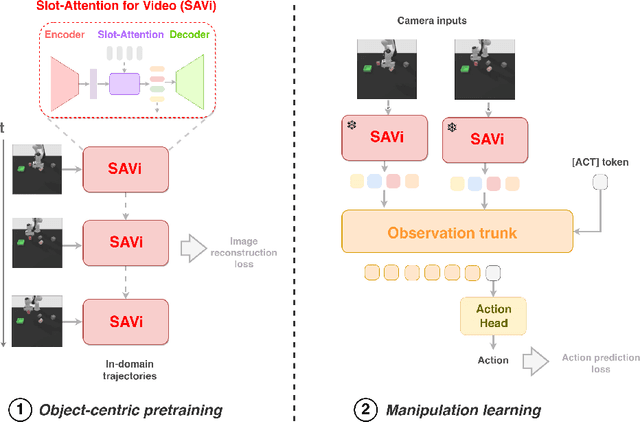
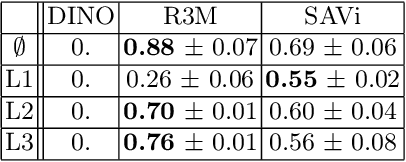
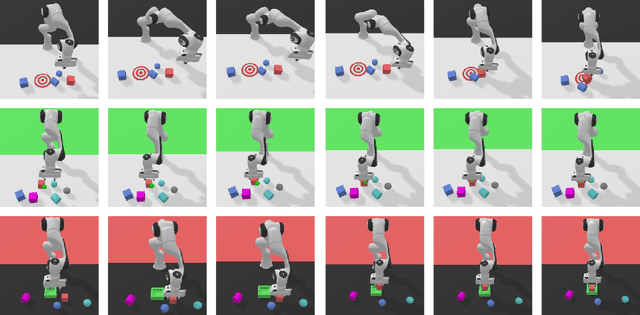
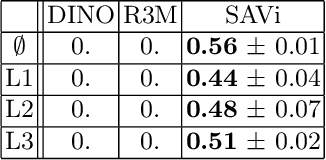
Object-centric representation (OCR) has recently become a subject of interest in the computer vision community for learning a structured representation of images and videos. It has been several times presented as a potential way to improve data-efficiency and generalization capabilities to learn an agent on downstream tasks. However, most existing work only evaluates such models on scene decomposition, without any notion of reasoning over the learned representation. Robotic manipulation tasks generally involve multi-object environments with potential inter-object interaction. We thus argue that they are a very interesting playground to really evaluate the potential of existing object-centric work. To do so, we create several robotic manipulation tasks in simulated environments involving multiple objects (several distractors, the robot, etc.) and a high-level of randomization (object positions, colors, shapes, background, initial positions, etc.). We then evaluate one classical object-centric method across several generalization scenarios and compare its results against several state-of-the-art hollistic representations. Our results exhibit that existing methods are prone to failure in difficult scenarios involving complex scene structures, whereas object-centric methods help overcome these challenges.
Object-Centric Representations Improve Policy Generalization in Robot Manipulation
May 16, 2025Visual representations are central to the learning and generalization capabilities of robotic manipulation policies. While existing methods rely on global or dense features, such representations often entangle task-relevant and irrelevant scene information, limiting robustness under distribution shifts. In this work, we investigate object-centric representations (OCR) as a structured alternative that segments visual input into a finished set of entities, introducing inductive biases that align more naturally with manipulation tasks. We benchmark a range of visual encoders-object-centric, global and dense methods-across a suite of simulated and real-world manipulation tasks ranging from simple to complex, and evaluate their generalization under diverse visual conditions including changes in lighting, texture, and the presence of distractors. Our findings reveal that OCR-based policies outperform dense and global representations in generalization settings, even without task-specific pretraining. These insights suggest that OCR is a promising direction for designing visual systems that generalize effectively in dynamic, real-world robotic environments.