 Add to Chrome
 Add to Firefox
 Add to Edge
Stay or Stray - A Dynamical Systems Viewpoint of Popularity Bias
Aug 11, 2026
Popularity bias in recommendation systems arises when a majority user class generates disproportionate interaction data, causing the system to increasingly favour it while degrading recommendation quality for niche users. While extensive empirical evidence of popularity bias exists, the dynamics leading to its emergence are not well understood. In this work, we study the coupled evolution of recommender model updates and user engagement through the lens of dynamical systems. We formulate a stochastic process and analyse its asymptotic behaviour through an ordinary differential equation (ODE) framework grounded in two-time-scale stochastic approximation. We characterise the equilibrium points of this dynamical system, and derive conditions under which popularity bias is provably emergent, as well as conditions under which symmetric retention of all user classes is possible. We conduct experiments on synthetic data and real-world production logs derived from a large-scale commercial music recommendation platform to validate our theoretical results.

Finding the Signal in the Spam: Jointly Learning Rewards and Worker Reliability from Pairwise Comparisons
Aug 10, 2026The problem of learning from pairwise comparisons has been widely studied across many domains such as recommendation systems, social choice, and more recently, fine-tuning large language models. In this problem, the goal is to learn item rewards based on pairwise comparisons between them. In many scenarios, these comparisons are elicited from crowdworkers using platforms such as Amazon Mechanical Turk, Scale AI, etc. However, crowdworkers are often unreliable due to limited domain knowledge or revenue-maximizing (spamming) behavior. In this work, our goal is to understand whether worker reliability (competency) can be learned jointly with item rewards. To this end, we adopt the Boltzmann-rational model for pairwise comparisons, which extends the Bradley-Terry-Luce model by incorporating worker competencies. We derive an EM-based algorithm for learning under this model by introducing Polya-Gamma latent variables to transform the logistic likelihood into a conditionally Gaussian form, enabling tractable optimization and leading to a simplified $Q$ function in the E-step of the algorithm. This technique allows us to reduce our formulation to a matrix sensing problem, using which we establish theoretical convergence guarantees for our algorithm. We conduct extensive experiments on real-world and synthetic datasets. These experiments demonstrate the advantages of using our algorithm over several baselines and confirm its strong robustness to both spammers and adversarial workers, highlighting its practical effectiveness in realistic crowdsourcing and reward learning settings. The code and data is publicly available at https://github.com/KaustubhShejole/BoRa_EM.
Jailbreaking for the Average Jane: Choosing Optimal Jailbreaks via Bandit Algorithms for Automatically Enhanced Queries
Jun 25, 2026With a profusion of jailbreaks for LLMs now widely known, a growing concern is that non-expert malicious actors ("the average Jane") could elicit actionable responses to malicious requests. In this work, we examine whether this concern is justified. A non-expert malicious actor requires two ingredients for a successful attack: a powerful jailbreak for their target model, acting on an effective malicious query. For the former, we propose a novel attack strategy based on the multi-armed bandit framework. This allows efficient online learning of the optimal jailbreak from a large choice set via noisy exploration on a small number of queries, with subsequent application of the learnt policy on an exploitation set. For the latter, we curate $\mathrm{FrankensteinBench}$, a safety benchmark of $11,279$ malicious queries drawn from manual curation over $7$ existing benchmarks, along with automated enhancement and generation. Each query is categorized as simple or complex by the technical expertise required to craft it. Our findings confirm the concern. Our bandit-based attack achieves success rates as high as $97\%$ on average over $15$ SoTA open-weight LLMs. Moreover, adding complexity to queries raises the attack success rate by up to $26\%$ on average across models -- making it an effective, automatable prompting strategy.
Creator Incentives in Recommender Systems: A Cooperative Game-Theoretic Approach for Stable and Fair Collaboration in Multi-Agent Bandits
Apr 09, 2026User interactions in online recommendation platforms create interdependencies among content creators: feedback on one creator's content influences the system's learning and, in turn, the exposure of other creators' contents. To analyze incentives in such settings, we model collaboration as a multi-agent stochastic linear bandit problem with a transferable utility (TU) cooperative game formulation, where a coalition's value equals the negative sum of its members' cumulative regrets. We show that, for identical (homogenous) agents with fixed action sets, the induced TU game is convex under mild algorithmic conditions, implying a non-empty core that contains the Shapley value and ensures both stability and fairness. For heterogeneous agents, the game still admits a non-empty core, though convexity and Shapley value core-membership are no longer guaranteed. To address this, we propose a simple regret-based payout rule that satisfies three out of the four Shapley axioms and also lies in the core. Experiments on MovieLens-100k dataset illustrate when the empirical payout aligns with -- and diverges from -- the Shapley fairness across different settings and algorithms.
A Modularized Design Approach for GelSight Family of Vision-based Tactile Sensors
Apr 20, 2025GelSight family of vision-based tactile sensors has proven to be effective for multiple robot perception and manipulation tasks. These sensors are based on an internal optical system and an embedded camera to capture the deformation of the soft sensor surface, inferring the high-resolution geometry of the objects in contact. However, customizing the sensors for different robot hands requires a tedious trial-and-error process to re-design the optical system. In this paper, we formulate the GelSight sensor design process as a systematic and objective-driven design problem and perform the design optimization with a physically accurate optical simulation. The method is based on modularizing and parameterizing the sensor's optical components and designing four generalizable objective functions to evaluate the sensor. We implement the method with an interactive and easy-to-use toolbox called OptiSense Studio. With the toolbox, non-sensor experts can quickly optimize their sensor design in both forward and inverse ways following our predefined modules and steps. We demonstrate our system with four different GelSight sensors by quickly optimizing their initial design in simulation and transferring it to the real sensors.
System-2 Recommenders: Disentangling Utility and Engagement in Recommendation Systems via Temporal Point-Processes
May 29, 2024
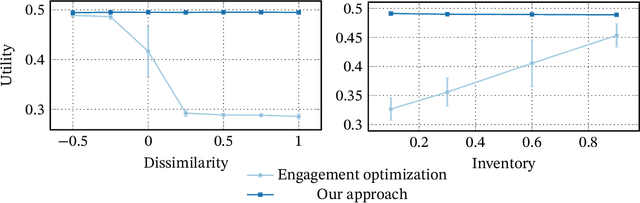
Recommender systems are an important part of the modern human experience whose influence ranges from the food we eat to the news we read. Yet, there is still debate as to what extent recommendation platforms are aligned with the user goals. A core issue fueling this debate is the challenge of inferring a user utility based on engagement signals such as likes, shares, watch time etc., which are the primary metric used by platforms to optimize content. This is because users utility-driven decision-processes (which we refer to as System-2), e.g., reading news that are relevant for them, are often confounded by their impulsive decision-processes (which we refer to as System-1), e.g., spend time on click-bait news. As a result, it is difficult to infer whether an observed engagement is utility-driven or impulse-driven. In this paper we explore a new approach to recommender systems where we infer user utility based on their return probability to the platform rather than engagement signals. Our intuition is that users tend to return to a platform in the long run if it creates utility for them, while pure engagement-driven interactions that do not add utility, may affect user return in the short term but will not have a lasting effect. We propose a generative model in which past content interactions impact the arrival rates of users based on a self-exciting Hawkes process. These arrival rates to the platform are a combination of both System-1 and System-2 decision processes. The System-2 arrival intensity depends on the utility and has a long lasting effect, while the System-1 intensity depends on the instantaneous gratification and tends to vanish rapidly. We show analytically that given samples it is possible to disentangle System-1 and System-2 and allow content optimization based on user utility. We conduct experiments on synthetic data to demonstrate the effectiveness of our approach.
Optimal and Adaptive Non-Stationary Dueling Bandits Under a Generalized Borda Criterion
Mar 19, 2024In dueling bandits, the learner receives preference feedback between arms, and the regret of an arm is defined in terms of its suboptimality to a winner arm. The more challenging and practically motivated non-stationary variant of dueling bandits, where preferences change over time, has been the focus of several recent works (Saha and Gupta, 2022; Buening and Saha, 2023; Suk and Agarwal, 2023). The goal is to design algorithms without foreknowledge of the amount of change. The bulk of known results here studies the Condorcet winner setting, where an arm preferred over any other exists at all times. Yet, such a winner may not exist and, to contrast, the Borda version of this problem (which is always well-defined) has received little attention. In this work, we establish the first optimal and adaptive Borda dynamic regret upper bound, which highlights fundamental differences in the learnability of severe non-stationarity between Condorcet vs. Borda regret objectives in dueling bandits. Surprisingly, our techniques for non-stationary Borda dueling bandits also yield improved rates within the Condorcet winner setting, and reveal new preference models where tighter notions of non-stationarity are adaptively learnable. This is accomplished through a novel generalized Borda score framework which unites the Borda and Condorcet problems, thus allowing reduction of Condorcet regret to a Borda-like task. Such a generalization was not previously known and is likely to be of independent interest.
Scalable, Simulation-Guided Compliant Tactile Finger Design
Mar 07, 2024
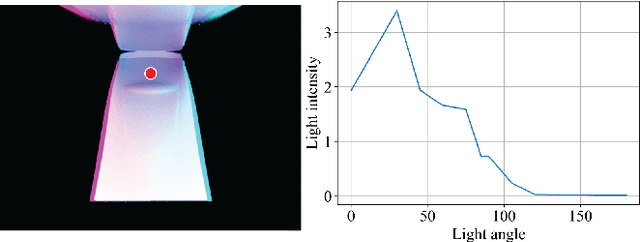
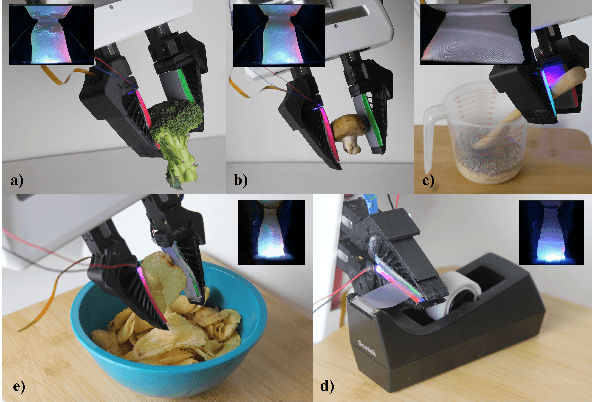
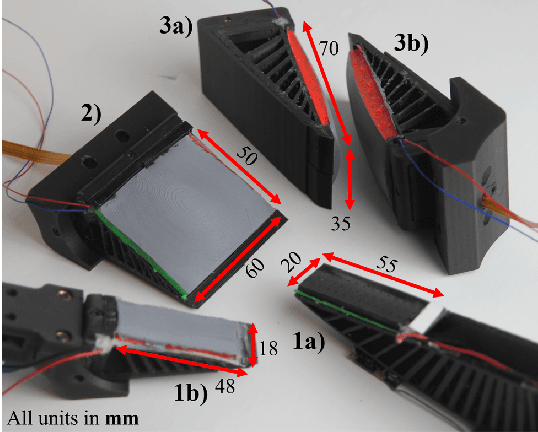
Compliant grippers enable robots to work with humans in unstructured environments. In general, these grippers can improve with tactile sensing to estimate the state of objects around them to precisely manipulate objects. However, co-designing compliant structures with high-resolution tactile sensing is a challenging task. We propose a simulation framework for the end-to-end forward design of GelSight Fin Ray sensors. Our simulation framework consists of mechanical simulation using the finite element method (FEM) and optical simulation including physically based rendering (PBR). To simulate the fluorescent paint used in these GelSight Fin Rays, we propose an efficient method that can be directly integrated in PBR. Using the simulation framework, we investigate design choices available in the compliant grippers, namely gel pad shapes, illumination conditions, Fin Ray gripper sizes, and Fin Ray stiffness. This infrastructure enables faster design and prototype time frames of new Fin Ray sensors that have various sensing areas, ranging from 48 mm $\times$ \18 mm to 70 mm $\times$ 35 mm. Given the parameters we choose, we can thus optimize different Fin Ray designs and show their utility in grasping day-to-day objects.
Misalignment, Learning, and Ranking: Harnessing Users Limited Attention
Feb 21, 2024In digital health and EdTech, recommendation systems face a significant challenge: users often choose impulsively, in ways that conflict with the platform's long-term payoffs. This misalignment makes it difficult to effectively learn to rank items, as it may hinder exploration of items with greater long-term payoffs. Our paper tackles this issue by utilizing users' limited attention spans. We propose a model where a platform presents items with unknown payoffs to the platform in a ranked list to $T$ users over time. Each user selects an item by first considering a prefix window of these ranked items and then picking the highest preferred item in that window (and the platform observes its payoff for this item). We study the design of online bandit algorithms that obtain vanishing regret against hindsight optimal benchmarks. We first consider adversarial window sizes and stochastic iid payoffs. We design an active-elimination-based algorithm that achieves an optimal instance-dependent regret bound of $O(\log(T))$, by showing matching regret upper and lower bounds. The key idea is using the combinatorial structure of the problem to either obtain a large payoff from each item or to explore by getting a sample from that item. This method systematically narrows down the item choices to enhance learning efficiency and payoff. Second, we consider adversarial payoffs and stochastic iid window sizes. We start from the full-information problem of finding the permutation that maximizes the expected payoff. By a novel combinatorial argument, we characterize the polytope of admissible item selection probabilities by a permutation and show it has a polynomial-size representation. Using this representation, we show how standard algorithms for adversarial online linear optimization in the space of admissible probabilities can be used to obtain a polynomial-time algorithm with $O(\sqrt{T})$ regret.
Semi-Bandit Learning for Monotone Stochastic Optimization
Dec 24, 2023Stochastic optimization is a widely used approach for optimization under uncertainty, where uncertain input parameters are modeled by random variables. Exact or approximation algorithms have been obtained for several fundamental problems in this area. However, a significant limitation of this approach is that it requires full knowledge of the underlying probability distributions. Can we still get good (approximation) algorithms if these distributions are unknown, and the algorithm needs to learn them through repeated interactions? In this paper, we resolve this question for a large class of "monotone" stochastic problems, by providing a generic online learning algorithm with $\sqrt{T \log T}$ regret relative to the best approximation algorithm (under known distributions). Importantly, our online algorithm works in a semi-bandit setting, where in each period, the algorithm only observes samples from the r.v.s that were actually probed. Our framework applies to several fundamental problems in stochastic optimization such as prophet inequality, Pandora's box, stochastic knapsack, stochastic matchings and stochastic submodular optimization.